Overview
Scenarios
Product Architecture
Instance Types
Compatibility Notes
Node Type | Node Specifications | Number of Nodes |
Peer node | 16-Core CPU/32 GB of Memory/Enhanced SSD with 300 GB | 3 |
Management nodes | 4Core CPU/8GB Memory | 3 |
Node Type | Software Version |
Peer node | v21.1.0 |
v5.0 |
set persist audit_log_policy = "NONE";set persist max_prepared_stmt_count = 1000000;set persist temptable_max_mmap = 214748364800
props.mysql configuration file and fill in the corresponding connection information for the instance:cd benchmarksql/runvi props.mysql
props.mysql and its main parameters are as follows:db=mysqldriver=com.mysql.jdbc.Driverconn=jdbc:mysql://{ip}:{port}/tpcc?useSSL=false&useServerPrepStmts=true&useConfigs=maxPerformance&rewriteBatchedStatements=true&cachePrepStmts=true&prepStmtCacheSize=1000&prepStmtCacheSqlLimit=2048user={user}password={password}warehouses=1000loadWorkers=20terminals={terminals}runTxnsPerTerminal=0runMins=5limitTxnsPerMin=0terminalWarehouseFixed=truenewOrderWeight=45paymentWeight=43orderStatusWeight=4deliveryWeight=4stockLevelWeight=4
create database tpcc;
cd benchmarksql/run/sql.common# Modify the table structure. The core table is defined as a hash partitioned table, which has 9 partitions by default.cp tableCreates.sql tableCreates_tdsql.sqlvi tableCreates_tdsql.sqlCREATE TABLE bmsql_config(cfg_name varchar(30)primary key,cfg_value varchar(50));CREATE TABLE bmsql_warehouse(w_id integer not null,w_ytd decimal(12,2),w_tax decimal(4,4),w_name varchar(10),w_street_1 varchar(20),w_street_2 varchar(20),w_city varchar(20),w_state char(2),w_zip char(9),primary key(w_id))partition by hash(w_id)partitions9;CREATE TABLE bmsql_district(d_w_id integer not null,d_id integer not null,d_ytd decimal(12,2),d_tax decimal(4,4),d_next_o_id integer,d_name varchar(10),d_street_1 varchar(20),d_street_2 varchar(20),d_city varchar(20),d_state char(2),d_zip char(9),PRIMARY KEY(d_w_id, d_id))partition by hash(d_w_id)partitions9;CREATE TABLE bmsql_customer(c_w_id integer not null,c_d_id integer not null,c_id integer not null,c_discount decimal(4,4),c_credit char(2),c_last varchar(16),c_first varchar(16),c_credit_lim decimal(12,2),c_balance decimal(12,2),c_ytd_payment decimal(12,2),c_payment_cnt integer,c_delivery_cnt integer,c_street_1 varchar(20),c_street_2 varchar(20),c_city varchar(20),c_state char(2),c_zip char(9),c_phone char(16),c_since timestamp,c_middle char(2),c_data varchar(500),PRIMARY KEY(c_w_id, c_d_id, c_id))partition by hash(c_w_id)partitions9;CREATE TABLE bmsql_history(hist_id integer,h_c_id integer,h_c_d_id integer,h_c_w_id integer,h_d_id integer,h_w_id integer,h_date timestamp,h_amount decimal(6,2),h_data varchar(24))partition by hash(h_w_id)partitions9;CREATE TABLE bmsql_new_order(no_w_id integer not null ,no_d_id integer not null,no_o_id integer not null,PRIMARY KEY(no_w_id, no_d_id, no_o_id))partition by hash(no_w_id)partitions9;CREATE TABLE bmsql_oorder(o_w_id integer not null,o_d_id integer not null,o_id integer not null,o_c_id integer,o_carrier_id integer,o_ol_cnt integer,o_all_local integer,o_entry_d timestamp,PRIMARY KEY(o_w_id, o_d_id, o_id))partition by hash(o_w_id)partitions9;CREATE TABLE bmsql_order_line(ol_w_id integer not null,ol_d_id integer not null,ol_o_id integer not null,ol_number integer not null,ol_i_id integer not null,ol_delivery_d timestamp,ol_amount decimal(6,2),ol_supply_w_id integer,ol_quantity integer,ol_dist_info char(24),PRIMARY KEY(ol_w_id, ol_d_id, ol_o_id, ol_number))partition by hash(ol_w_id)partitions9;CREATE TABLE bmsql_item(i_id integer not null,i_name varchar(24),i_price decimal(5,2),i_data varchar(50),i_im_id integer,PRIMARY KEY(i_id));CREATE TABLE bmsql_stock(s_w_id integer not null,s_i_id integer not null,s_quantity integer,s_ytd integer,s_order_cnt integer,s_remote_cnt integer,s_data varchar(50),s_dist_01 char(24),s_dist_02 char(24),s_dist_03 char(24),s_dist_04 char(24),s_dist_05 char(24),s_dist_06 char(24),s_dist_07 char(24),s_dist_08 char(24),s_dist_09 char(24),s_dist_10 char(24),PRIMARY KEY(s_w_id, s_i_id))partition by hash(s_w_id)partitions9;
cd ..nohup ./runLoader.sh props.mysql &
create index bmsql_customer_idx1 on bmsql_customer (c_w_id, c_d_id, c_last, c_first);create unique index bmsql_oorder_idx1 on bmsql_oorder (o_w_id, o_d_id, o_carrier_id, o_id);
cdbenchmarksql/run./runBenchmark.sh props.mysql
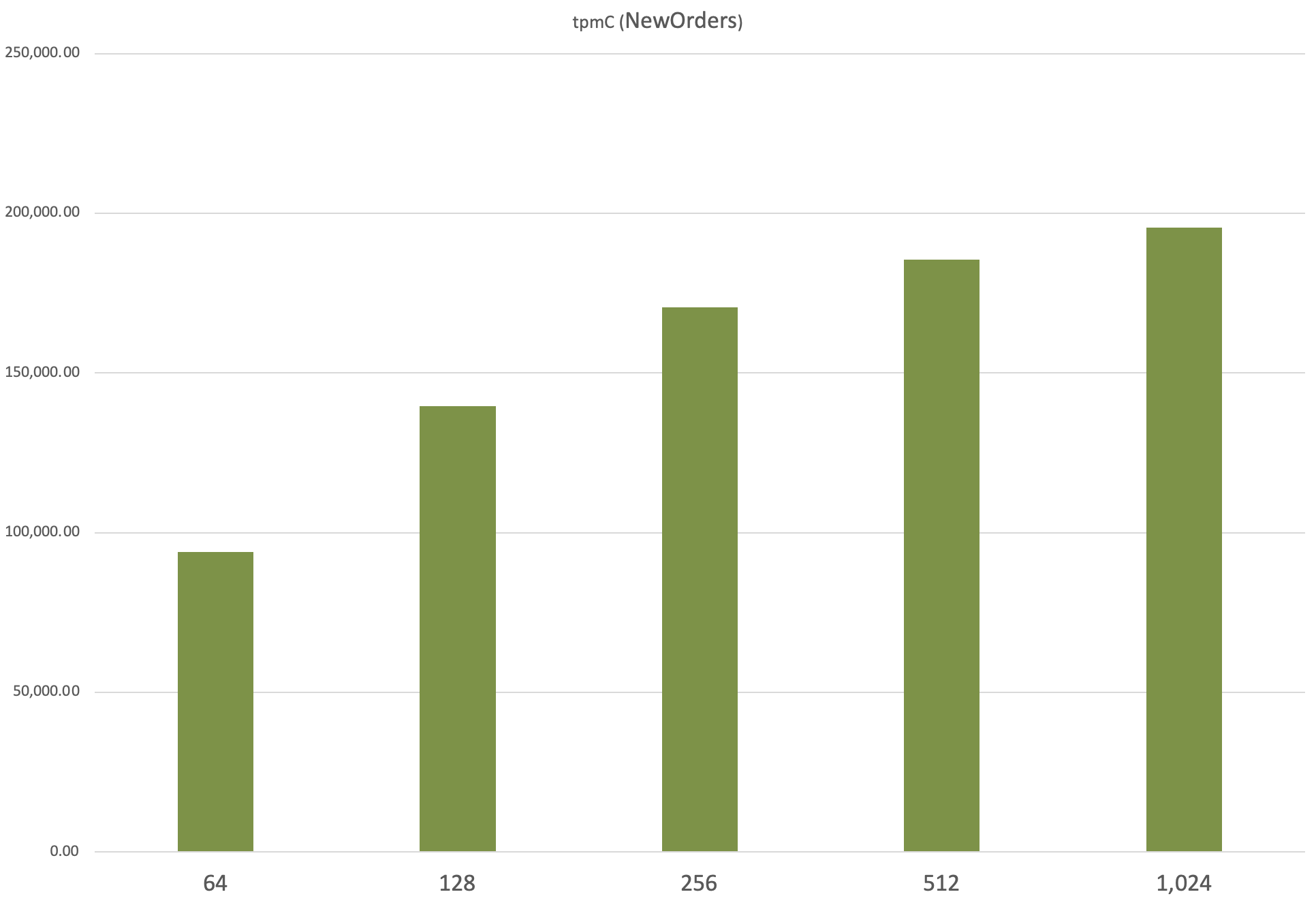
Number of threads | tpmTOTAL | tpmC (NewOrders) |
64 | 208,948.14 | 94,035.97 |
128 | 310,788.33 | 139,550.15 |
256 | 379,050.95 | 170,517.90 |
512 | 412,147.72 | 185,392.99 |
1,024 | 434,737.57 | 195,442.64 |
Was this page helpful?
You can also Contact sales or Submit a Ticket for help.
Help us improve! Rate your documentation experience in 5 mins.
Feedback