Creating Rule Template
Download
Focus Mode
Font Size
This document describes how to create a rule template via the console.
Note:
As of September 25, 2023, the relationship between rule templates and audit instances has been adjusted from initialization to strong association. Any modification to the content of a rule template will synchronously impact the audit rule applied to instances that are bound to the rule template.
The same field of rule content can be configured with a maximum of 5 characteristic strings. And each string is separated by vertical bar"|".
Directions
1. Log in to the TDSQL-C for MySQL console.
2. On the left sidebar, click Database Audit.
3. Select Region and click Rule Template.
4. In the template list, click Create Rule Template.

5. In the Create Rule Template window, set the following configuration items and click OK.
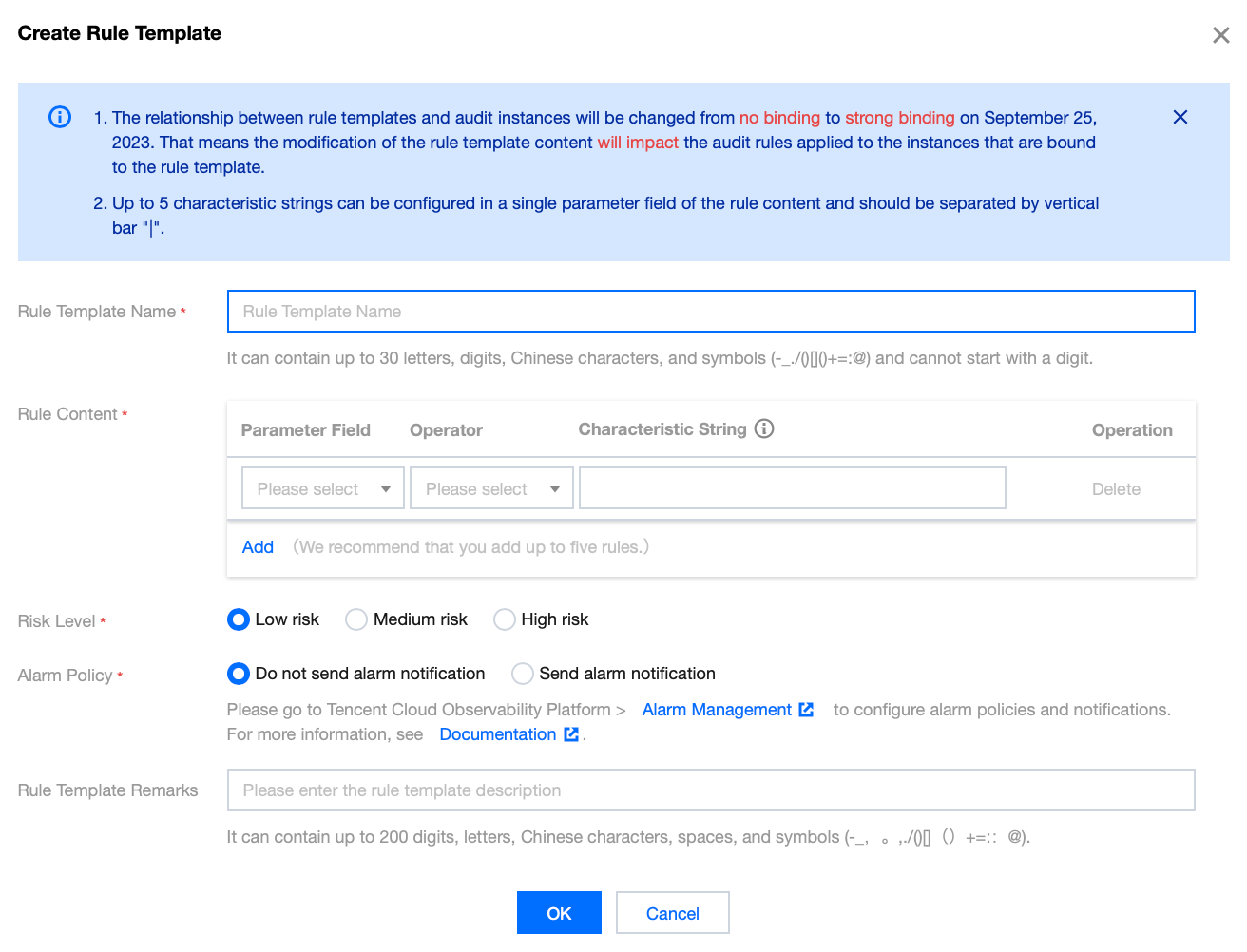
Parameter | Description |
Rule Template Name | This field can contain up to 30 letters, digits, and symbols -_./()[]()+=::@and cannot start with a digit. |
Rule Content | This fields sets the rule content (parameter field, operator, characteristic string). For detailed instructions, see the following Rule content details and examples. Note: Click Add to add parameter fields in rule content. Click Delete in the Operation column in rule content to remove the unnecessary parameter field and condition. Note that at least one parameter field and condition should be reserved. |
Risk Level | Select a risk level for the created rule template, with options of Low risk, Medium risk, and High risk. |
Alarm Policy | Select an alarm policy for the created rule template, with options of Do not send alarm notification or Send alarm notification. Note: Please proceed to Tencent Cloud Observability Platform > Alarm Management to configure alarm rules and notifications. For more information, please refer to Post-Event Alarm Configuration. |
Rule Template Remarks | This field can contain up to 200 letters, digits, and symbols-_./()[]()+=::@and cannot start with a digit. |
Rule content details and examples
Note:
You can configure one or multiple rules.
Different rules are in AND relationship; that is, they need to be met at the same time.
Different characteristic strings in a rule are in OR relationship; that is, at least one of them needs to be met.
You can add only one operator for the same parameter field; for example, for the database name, the operator can be either Include or Exclude.
Parameter Field | Operator | Characteristic String |
Client IP | Include, Exclude, Equal to, Not equal to, Regex | Up to 5 client IPs can be configured and should be separated by vertical bar "|". |
User Account | Include, Exclude, Equal to, Not equal to, Regex | Up to 5 usernames can be configured and should be separated by vertical bar "|". |
Database Name | Include, Exclude, Equal to, Not equal to, Regex | Up to 5 database names can be configured and should be separated by vertical bar "|". |
SQL Details | Include, Exclude | Up to five SQL commands can be configured and should be separated by vertical bar "|". |
SQL Type | Equal to, Not equal to | Available types: ALTER, CHANGEUSER, CREATE, DELETE, DROP, EXECUTE, INSERT, LOGOUT, OTHER, REPLACE, SELECT, SET, UPDATE, and PREPARE. Up to 5 SQL types can be selected. |
Affected Rows | Greater than, Less than | Select affected rows. |
Returned Rows | Greater than, Less than | Select returned rows. |
Scanned Rows | Greater than, Less than | Select scanned rows. |
Execution Time | Greater than, Less than | Select execution time in milliseconds. |
Error Code | Equal to, Not equal to | Enter an error code. |
Example
If the following rule content is set: the database name should include
a, b, or c, and the client IP should include IP1, 2 or 3, then the audit logs filtered by the rule are those where the database name includes a, b, or c and the client IP includes IP1, 2, or 3. Related APIs
API | Description |
This API (CreateAuditRuleTemplate) is used to create audit rule templates. | |
This API (DescribeAuditRuleTemplates) is used to query audit rule template information. |
Help and Support
Was this page helpful?
You can also Contact sales or Submit a Ticket for help.
Help us improve! Rate your documentation experience in 5 mins.
Feedback