
Overview

Last updated: 2025-09-04 14:27:52
TDMQ for RabbitMQ is Tencent's proprietary message queue service. It supports the AMQP 0-9-1 protocol and is fully compatible with all components and principles of Apache RabbitMQ. It also has the underlying benefits of computing-storage separation and flexible scaling.
TDMQ for RabbitMQ has extremely flexible routing to adapt to the message delivery rules of various businesses. It can buffer the upstream traffic pressure and ensure the stable operations of the message system. It is often used to implement async communication and service decoupling between systems to reduce their mutual dependency, making it widely applicable to distributed systems in finance and government affairs industries.
Infrastructure
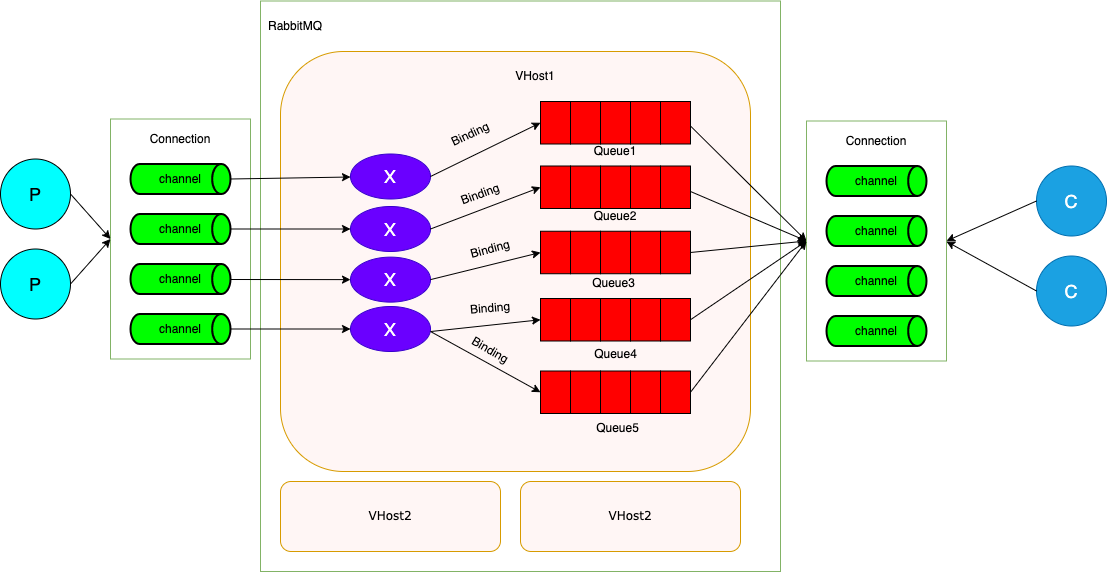
The architecture diagram of TDMQ RabbitMQ is as follows:
Concepts
Producer (P): Send messages to Exchanges.
Connection: A TCP connection, which is a physical TCP connection between the producer or consumer and TDMQ RabbitMQ.
Channel: Multiple channels can be created within each physical TCP connection on the client, with each channel representing a session task.
Connection: A TCP connection, which is a physical TCP connection between the producer or consumer and TDMQ RabbitMQ.
Vhost: Used for logical isolation. Exchanges and Queues between different Vhosts are isolated in data and do not interfere with one another.
Exchange (X): A component that receives messages from producers and routes them to Queues.
Queue: Cache messages for consumers to consume them.
Consumer (C): Pull messages from Queues for consumption.
Message sending and receiving process:
After establishing a connection with the RabbitMQ server through the client, the user implements efficient message interaction based on the Channel: the producer sends messages to the switch through the channel, and the switch routes them to the target queue according to binding rules; the consumer then pulls messages from the queue through the channel to complete business logic processing.
Quick Navigation
TDMQ RabbitMQ offers two product forms: managed open-source version and Serverless Edition. Based on the innovative storage-compute separation architecture, the Serverless Edition is compatible with AMQP 0-9-1 protocol and open-source RabbitMQ components and concepts. Through architecture upgrade, it effectively solves common stability issues in open-source versions, such as split-brain and message backlog, with advantages of stability, security, and flexible scaling.
You can quickly view the related documentation for TDMQ RabbitMQ Serverless Edition through the following link.
Document Type | Document Title | Content Overview |
Version description Comparison | Serverless version and open-source managed sales specification. | |
| Advantages of Serverless over open-source RabbitMQ. | |
| Comparison of architecture, features and usage limits between Serverless and open-source managed versions. | |
Use Limits | Usage limits and throttling rules for Serverless clusters. | |
Billing | Serverless Billing Rules and Billing Item Description. | |
| Overview and comparison of billing rules between Serverless and open-source managed versions. | |
Was this page helpful?
You can also Contact Sales or Submit a Ticket for help.
Yes
No
Feedback