tencent cloud

Virtual Private Cloud

Release Notes and Announcements
Release Notes
Announcements
Tencent Cloud Network Overview
Product Introduction
Overview
Strengths
Use Cases
Concepts
Quota Limit
Service Regions and Service Providers
Purchase Guide
Billing Overview
Payment Overdue
Quick Start
Network Planning
VPC Connections
Building Up an IPv4 VPC
Operation Guide
Network Topology
Network performance dashboard
Virtual Private Cloud (VPC)
Subnets
Route Tables
Elastic IP
HAVIPs
Elastic Network Interface
Bandwidth Package
Network Connection
Security Management
Diagnostic Tools
Alarming and Monitoring
Practical Tutorial
View the Total Bandwidth for Single-Region Traffic-Based Billing
Migrating from the Classic Network to VPC
Best Practices of Security Group Change
Configuring CVM Instance as Public Gateway
Building HA Primary/Secondary Cluster with HAVIP + Keepalived
Hybrid Cloud Primary/Secondary Communication (DC and VPN)
Hybrid Cloud Primary/Secondary Communication (CCN and VPN)
CVM Access to Internet Through EIP
Troubleshooting
VPCs or Subnets Cannot Be Deleted
Network Disconnection After Connecting Two VPCs over CCN
Failed to Ping CVMs in the Same VPC
API Documentation
History
Introduction
API Category
Making API Requests
VPC APIs
Route Table APIs
Elastic Public IP APIs
Elastic IPv6 APIs
Highly Available Virtual IP APIs
ENI APIs
Bandwidth Package APIs
NAT Gateway APIs
Direct Connect Gateway APIs
Cloud Connect Network APIs
Network ACL APIs
Network Parameter Template APIs
Network Detection-Related APIs
Flow Log APIs
Gateway Traffic Monitor APIs
Private Link APIs
Traffic Mirroring APIs
Other APIs
Subnet APIs
VPN Gateway APIs
Security Group APIs
Snapshot Policy APIs
Error Codes
Data Types
FAQs
General
Connection
Security
Contact Us
Glossary

Overview

PDF
Focus Mode
Font Size
Last updated: 2024-10-22 16:25:49
Traffic mirror provides a traffic collection service that filters and copies desired traffic from the specified network interface to CVM instances in the same VPC. This feature is applicable to use cases including security audit, risk monitoring, troubleshooting and business analysis.
Note:
However, traffic mirror consumes CVM resources such as CPU, memory and bandwidth pro rata. For example, if you mirror a network interface that has 1 Gbps of inbound traffic and 1 Gbps of outbound traffic. In this case, the instance needs to handle 1 Gbps of inbound traffic and 3 Gbps of outbound traffic (1 Gbps for the outbound traffic, 1 Gbps for the mirrored inbound traffic and 1 Gbps for the mirrored outbound traffic).

Procedure

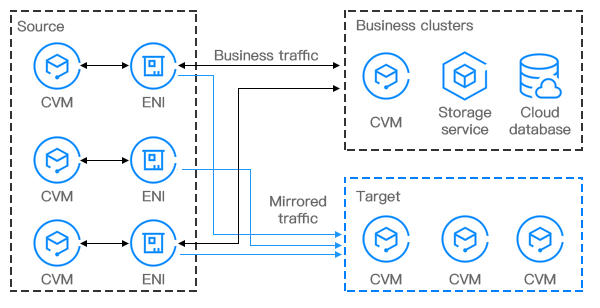
The following are key components of a traffic mirror, together with its workflow.
Source: the specified ENI in the VPC that applies the filter rules such as network, collection range, collection type and traffic filtering.
Target: the receiving IPs that get the collected traffic.


Use Cases

Security auditing

A running system may occur unhealthy network traffic or generate an error message due to software exception, hardware fault, computer virus or improper use. To locate causes of these issues, you can use traffic mirror to analyze the network messages.

Intrusion checking

To ensure the confidentiality, integrity and availability of network system resources, you can use traffic mirror to copy traffic to CVM clusters for real-time analysis.

Business analysis

Use traffic mirror to clearly and visually present the business traffic mode.
Help and Support

Was this page helpful?

Help us improve! Rate your documentation experience in 5 mins.

Feedback