tencent cloud

Tencent Cloud Observability Platform

Release Notes and Announcements
Release Notes
Product Introduction
Overview
Strengths
Basic Features
Basic Concepts
Use Cases
Use Limits
Purchase Guide
Tencent Cloud Product Monitoring
Application Performance Management
Mobile App Performance Monitoring
Real User Monitoring
Cloud Automated Testing
Prometheus Monitoring
Grafana
EventBridge
PTS
Quick Start
Monitoring Overview
Instance Group
Tencent Cloud Product Monitoring
Application Performance Management
Real User Monitoring
Cloud Automated Testing
Performance Testing Service
Prometheus Getting Started
Grafana
Dashboard Creation
EventBridge
Alarm Service
Cloud Product Monitoring
Tencent Cloud Service Metrics
Operation Guide
CVM Agents
Cloud Product Monitoring Integration with Grafana
Troubleshooting
Practical Tutorial
Application Performance Management
Product Introduction
Access Guide
Operation Guide
Practical Tutorial
Parameter Information
FAQs
Mobile App Performance Monitoring
Overview
Operation Guide
Access Guide
Practical Tutorial
Tencent Cloud Real User Monitoring
Product Introduction
Operation Guide
Connection Guide
FAQs
Cloud Automated Testing
Product Introduction
Operation Guide
FAQs
Performance Testing Service
Overview
Operation Guide
Practice Tutorial
JavaScript API List
FAQs
Prometheus Monitoring
Product Introduction
Access Guide
Operation Guide
Practical Tutorial
Terraform
FAQs
Grafana
Product Introduction
Operation Guide
Guide on Grafana Common Features
FAQs
Dashboard
Overview
Operation Guide
Alarm Management
Console Operation Guide
Troubleshooting
FAQs
EventBridge
Product Introduction
Operation Guide
Practical Tutorial
FAQs
Report Management
FAQs
General
Alarm Service
Concepts
Monitoring Charts
CVM Agents
Dynamic Alarm Threshold
CM Connection to Grafana
Documentation Guide
Related Agreements
Application Performance Management Service Level Agreement
APM Privacy Policy
APM Data Processing And Security Agreement
RUM Service Level Agreement
Mobile Performance Monitoring Service Level Agreement
Cloud Automated Testing Service Level Agreement
Prometheus Service Level Agreement
TCMG Service Level Agreements
PTS Service Level Agreement
PTS Use Limits
Cloud Monitor Service Level Agreement
API Documentation
History
Introduction
API Category
Making API Requests
Monitoring Data Query APIs
Alarm APIs
Legacy Alert APIs
Notification Template APIs
TMP APIs
Grafana Service APIs
Event Center APIs
TencentCloud Managed Service for Prometheus APIs
Monitoring APIs
Data Types
Error Codes
Glossary

Creating Alarm Silence Rule

PDF
Focus Mode
Font Size
Last updated: 2024-01-27 17:35:59
This document describes how to create an alarm silence rule.

Directions

1. Log in to the TCOP console and go to the Silence Alarm page.
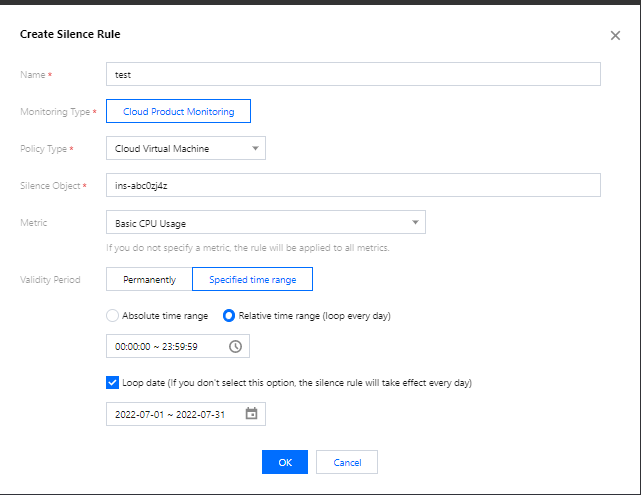
2. Click Create Silence Rule and configure the following in the pop-up window:
Configuration item
Description
Name
The custom silence rule name.
Monitoring Type
Currently, only Tencent Cloud services is supported.
Policy Type
Select a policy type for alarm silencing as needed.
Silence Object
Enter the ID(s) of the instance(s) you want to silence and separate them by comma, such as “ins-abc0zj4z,ins-abckwosm”.
Metric
The metric of a specified instance of a specified Tencent Cloud service.
If you don’t select any metrics, the alarm silence rule will take effect for all metrics.
If you select a metric, the silence rule will only take effect for that metric.
Validity Period - “Permanently”
If you select “Permanently”, you will not receive any alarm notifications for the specified metric of a specified Tencent Cloud service’s instance, as long as the silence rule is enabled.
Validity Period - “Specified time range”
If you select “Specified time range”, the alarm silence rule will take effect in the time range you specify.
Absolute time range: The silence rule only takes effect in the specified time range (in “YYYY-MM-DD HH:mm:ss” format).
Relative time range (loop every day): By default, the silence rule takes effect in the specified time range (in “HH:mm:ss” format) every day. You can also select the “Loop date” option to specify the date range. For example, if you select a time range of 10:00-11:00 and a date range of 2022-06-01 - 2022-06-30, the silence rule will take effect in 10:00-11:00 every day between June 1, 2022 and June 30, 2022.


Help and Support

Was this page helpful?

Help us improve! Rate your documentation experience in 5 mins.

Feedback