Live Comments (Android)
This document provides a comprehensive guide for iOS developers to quickly integrate a feature-rich, high-performance live chat overlay (barrage/danmaku) system into your live streaming application using the
BarrageStore module from the AtomicXCore framework.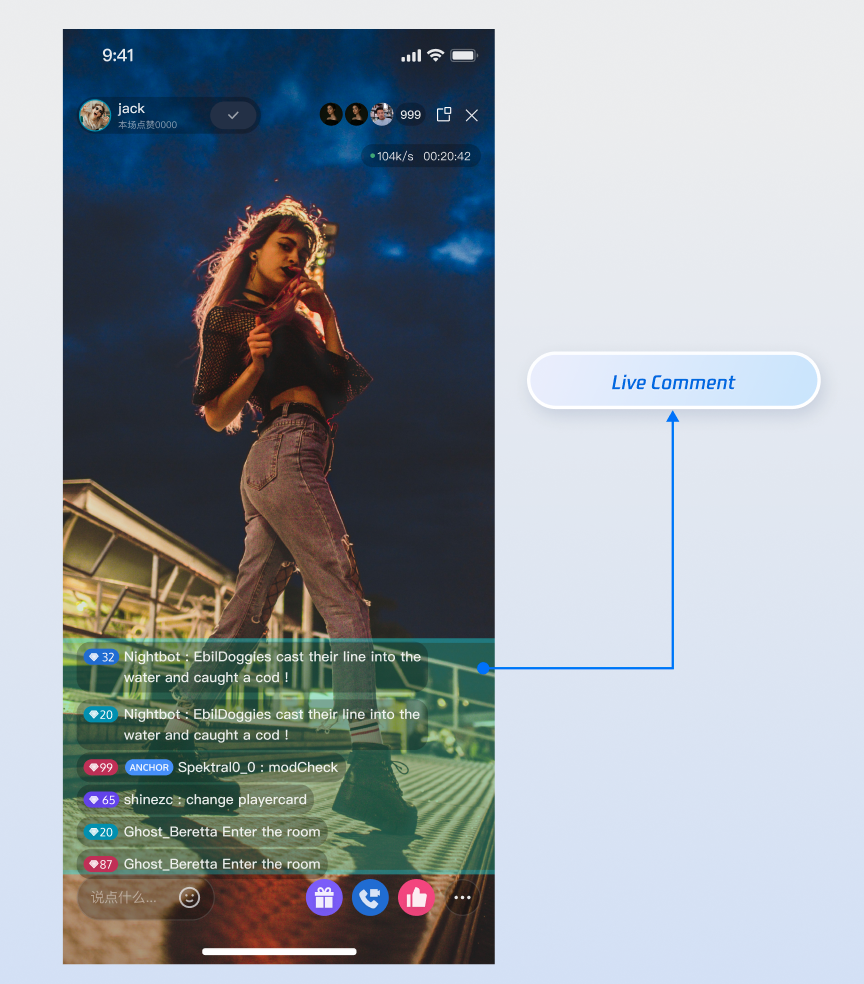
Core Features
BarrageStore delivers a complete barrage solution for your live streaming app. Core features include:Receiving and displaying barrage messages in the live room.
Sending text barrage messages to interact with viewers.
Sending custom business barrage messages to support complex scenarios such as gifts and likes.
Inserting system tips into the local message list (for example, "Welcome XX to the live room").
Core Concepts
Core Concept | Type | Core Responsibility & Description |
data class | Represents a single barrage message. Contains sender info (sender), message content (textContent or data), and message type (messageType). | |
data class | Represents the current state of the barrage module. The main property, messageList, is a StateFlow containing all barrage messages for the current live room, ordered chronologically. This serves as the UI data source. | |
abstract class | The main manager for barrage features. Use it to send messages (sendTextMessage, sendCustomMessage) and subscribe to barrage message updates via its state property. |
Implementation
Step 1: Component Integration
Video Live Streaming: Please refer to Quick Start to integrate AtomicXCore.
Voice Chat Room: Please refer to Quick Start to integrate AtomicXCore.
Step 2: Initialize and Listen to Barrages
Create a
BarrageStore instance bound to the current live room's liveId, and subscribe to receive the latest barrage message list in real time.import kotlinx.coroutines.*import kotlinx.coroutines.flow.*import io.trtc.tuikit.atomicxcore.api.barrage.Barrageimport io.trtc.tuikit.atomicxcore.api.barrage.BarrageStoreclass BarrageManager(private val liveId: String) {private val barrageStore: BarrageStore = BarrageStore.create(liveId)private val scope = CoroutineScope(Dispatchers.Main)// Expose the [full] message list as a Flow for the UI layer to subscribe toprivate val _messagesFlow = MutableStateFlow<List<Barrage>>(emptyList())val messagesFlow: StateFlow<List<Barrage>> = _messagesFlow.asStateFlow()init {// Start listening for barrage messages immediately after initializationsubscribeToBarrageUpdates()}private fun subscribeToBarrageUpdates() {scope.launch {barrageStore.barrageState.messageList.collect { messageList ->// When messageList updates, pass the new list to the UI layer via Flow// Note: This is the [complete list], including all historical messages_messagesFlow.value = messageList}}}}
Step 3: Send Text Barrages
Use
sendTextMessage to broadcast a plain text message to all users in the live room.import io.trtc.tuikit.atomicxcore.api.CompletionHandlerimport io.trtc.tuikit.atomicxcore.api.barrage.BarrageStoreclass BarrageManager(private val liveId: String) {private val barrageStore: BarrageStore = BarrageStore.create(liveId)// Send a text barragefun sendTextMessage(text: String) {// We recommend adding a non-empty check to avoid sending invalid messagesif (text.isEmpty()) {return}// Call the core API to send the messagebarrageStore.sendTextMessage(text,mapOf("custom key" to "custom value",),object : CompletionHandler {override fun onSuccess() {println("Text barrage '$text' sent successfully")}override fun onFailure(code: Int, desc: String) {println("Failed to send text barrage: $desc")}})}}
API Parameters
Parameter | Type | Description |
text | String? | The text content to send. |
extensionInfo | Map<String, String>? | Additional data for business customization. |
completion | CompletionHandler? | Callback invoked after sending, indicating success or failure. |
Step 4: Send Custom Barrage
Send messages with custom business logic, such as gifts, likes, or gamification commands. The content format of this message is defined by the business layer. The receiver must parse and handle it based on the
businessId and data.class BarrageManager(private val liveId: String) {// Send a custom barrage, for example, to send a giftfun sendGiftMessage(giftId: String, giftCount: Int) {// 1. Define a business-recognizable IDval businessId = "live_gift"// 2. Encode business data as a JSON stringval giftData = mapOf("gift_id" to giftId,"gift_count" to giftCount)val jsonString = try {// Use Gson or another JSON library for serialization// Here we assume Gson is usedGson().toJson(giftData)} catch (e: Exception) {return}// 3. Call the core API to send the custom messagebarrageStore.sendCustomMessage(businessId,jsonString,object : CompletionHandler {override fun onSuccess() {println("Gift message (custom barrage) sent successfully")}override fun onFailure(code: Int, desc: String) {println("Failed to send gift message: $desc")}})}}
API Parameters
Parameter | Type | Description |
businessId | String | Unique business identifier (e.g., "live_gift"). Used by receivers to distinguish custom messages. |
data | String | Business data, typically a JSON string. |
completion | CompletionHandler? | Callback after sending. |
Step 5: Insert Local Tip Messages
Insert a local message into the current user's message list. This message is not sent to other users and is ideal for displaying system prompts, warnings, or operation tips.
class BarrageManager(private val liveId: String) {// Insert a welcome tip into the local message listfun showWelcomeMessage(user: LiveUserInfo) {// 1. Create a Barrage messageval welcomeTip = Barrage(liveID = liveId,messageType = BarrageType.TEXT, // You can reuse the text type for displaytextContent = "Welcome ${user.userName} to the live room!",sender = LiveUserInfo() // sender can be left empty or set to a system user identifier)// 2. Call the API to append it to the local listbarrageStore.appendLocalTip(welcomeTip)}}
API Parameters
Parameter | Type | Description |
message | Barrage | The message object to insert locally. The SDK appends this to messageList in BarrageState. |
Step 6: Manage User Speaking Permissions (Mute and Unmute)
As a host or administrator, you can control user messaging permissions to maintain a healthy community environment.
Mute/Unmute a Single User
Use the
disableSendMessage method in LiveAudienceStore to mute or unmute a user. This state persists even if the user rejoins the live room.import io.trtc.tuikit.atomicxcore.api.*import io.trtc.tuikit.atomicxcore.api.live.LiveAudienceStore// 1. Get the LiveAudienceStore instance bound to the current live roomval audienceStore = LiveAudienceStore.create(liveId)// 2. Define the user ID to operate on and the mute statusval userIdToMute = "user_id_to_be_muted"val shouldDisable = true // true to mute, false to unmute// 3. Call the interface to perform the operationaudienceStore.disableSendMessage(userIdToMute,shouldDisable,object : CompletionHandler {override fun onSuccess() {println("${if (shouldDisable) "Muted" else "Unmuted"} user $userIdToMute successfully")}override fun onFailure(code: Int, desc: String) {println("Operation failed: $desc")}})
Enable/Disable Global Mute
To mute all users in the live room (usually excluding the host), update the live room information via
LiveListStore.import io.trtc.tuikit.atomicxcore.api.CompletionHandlerimport io.trtc.tuikit.atomicxcore.api.live.LiveInfoimport io.trtc.tuikit.atomicxcore.api.live.LiveListStore// 1. Get the LiveListStore singletonval liveListStore = LiveListStore.shared()// 2. Get the current live room info and modify the global mute statusval currentLiveInfo = liveListStore.liveState.currentLive.value.copy(isMessageDisable = true // true to enable global mute, false to disable)// 3. Call the update interface and specify the modification flagliveListStore.updateLiveInfo(currentLiveInfo,listOf(LiveInfo.ModifyFlag.IS_MESSAGE_DISABLE),object : CompletionHandler {override fun onSuccess() {println("Global mute status updated successfully")}override fun onFailure(code: Int, desc: String) {println("Operation failed: $desc")}})
Advanced Features: Performance Optimization in High-Concurrency Scenarios
After implementing barrage features with
BarrageStore, use the following strategies to ensure smooth and stable user experiences in high-concurrency live streaming scenarios. This section provides optimization strategies and code samples for three core business scenarios.Scenario 1: Handling "Barrage Storms" in Popular Live Rooms
Scenario Description
During popular events, a large number of viewers may flood into the live room, with barrages updating at dozens of messages per second.
Technical Challenge
The SDK returns the complete barrage list at a high frequency. If you call
adapter.notifyDataSetChanged() on every update, the main thread may be blocked by intensive UI layout and rendering, causing UI lag.Optimization: Batch Processing & Debouncing
Do not respond to every data update. Instead, set a time threshold (e.g., 300 ms). Only refresh the UI if the time since the last update exceeds this threshold. This reduces dozens of
notifyDataSetChanged()calls per second to just 3–4, greatly improving smoothness.Code Example
Create a
BarrageUIManager class with a buffer and timer for batch updating data to the RecyclerView.import android.os.Handlerimport androidx.recyclerview.widget.RecyclerViewimport io.trtc.tuikit.atomicxcore.api.barrage.Barrageprivate const val UPDATE_DURATION_MS = 300Lclass BarrageUIManager() {private var timestampOnLastUpdate = 0Lprivate var dataSource: ArrayList<Barrage> = ArrayList()private val updateViewTask = Runnable { notifyDataSetChanged() }private val handler = Handler()private val adapter = BarrageAdapter(dataSource)// This method is called frequently from outside, passing in the latest full listfun update(newList: List<Barrage>) {handler.removeCallbacks(updateViewTask)dataSource.clear()dataSource.addAll(newList)// If the refresh interval is less than 0.3 seconds, do not refreshif (System.currentTimeMillis() - timestampOnLastUpdate < UPDATE_DURATION_MS) {handler.postDelayed(updateViewTask, UPDATE_DURATION_MS)return}}private fun notifyDataSetChanged() {adapter.notifyDataSetChanged()timestampOnLastUpdate = System.currentTimeMillis()}}class BarrageAdapter(dataSource: ArrayList<Barrage>): RecyclerView.Adapter<RecyclerView.ViewHolder>() {// Implement adapter capabilities here}
Scenario 2: Ensuring Memory Stability for Long-Duration Live Streams
Scenario Description
Your app may need to support hours-long or even all-day continuous live streaming, such as game streaming or slow live streams. The app must remain stable and avoid crashes due to long-term operation.
Technical Challenge
The SDK returns a full
messageList that grows indefinitely during long live streams. Even if the UI layer throttles updates, a large array in the data layer will continue consuming memory and may eventually cause the app to crash.Optimization: Circular Buffer with Fixed Capacity
Ensure your data source holds only a limited number of messages. Regardless of the size of the full list returned by the SDK, only retain the latest portion for display.
Code Example
After receiving the full list from the SDK, take only the latest 500 messages (or another number you define) to update the UI.
class BarrageUIManager(private val recyclerView: RecyclerView) {private val capacity: Int = 500 // Only retain the latest 500 messages// ... (other code as above) ...private fun refreshUIIfNeeded() {val fullList = this.latestMessageList ?: returnval adapter = recyclerView.adapter ?: returnthis.latestMessageList = null// Only take the latest N messagesval cappedList = fullList.takeLast(capacity)dataSource.clear()dataSource.addAll(cappedList)adapter.notifyDataSetChanged()}}
Scenario 3: Rendering Complex Barrage Styles with User Levels and Badges
Scenario Description
To enhance the live streaming atmosphere and highlight paying users, barrage messages may include rich visual elements such as usernames, user level icons, fan badges, and message content.
Technical Challenge
Rendering views with multiple images and texts, custom fonts, or complex layouts is more time-consuming than rendering plain text. High-frequency rendering of these complex views in a list increases the main thread's workload, causing lag during list scrolling.
Optimization: Asynchronous Drawing
Move the view rendering process off the main thread and onto a background thread. The main thread should only handle the final display of the already rendered bitmap, significantly reducing its computational load.
Code Example
In your custom
RecyclerView.ViewHolder, use AsyncLayoutInflater or a preloading mechanism to perform rendering tasks on a background thread whenever possible.import android.view.LayoutInflaterimport androidx.asynclayoutinflater.view.AsyncLayoutInflaterimport androidx.recyclerview.widget.RecyclerView// In your custom Barrage ViewHolderclass BarrageViewHolder(itemView: View) : RecyclerView.ViewHolder(itemView) {// ... (Declarations for TextView, ImageView, etc.)companion object {fun create(parent: ViewGroup): BarrageViewHolder {// Use async layout inflater to reduce main thread blockingval inflater = AsyncLayoutInflater(parent.context)val view = LayoutInflater.from(parent.context).inflate(R.layout.item_barrage, parent, false)return BarrageViewHolder(view)}}fun bind(viewModel: BarrageViewModel) {// Set your TextView text, ImageView images, etc. here// With async layout inflation, final rendering is done on a background thread whenever possible}// Advanced performance optimization: fully manual drawing// For finer control, use Canvas to manually draw text and images// Generate the Bitmap on a background thread, then draw it in the main thread's onDraw method for fully asynchronous rendering}
API Documentation
For detailed information on all public interfaces, properties, methods of BarrageStore and its related classes, refer to the official API documentation included with the AtomicXCore framework.
FAQs
In addition to basic text barrages, we also want to implement richer styles such as "colored barrages" and "gift barrages." How can we achieve this?
You can implement these features using custom messages with
sendCustomMessage. Implementation Steps
1. Define the Data Structure: Collaborate with your client and server teams to define the JSON structure for custom messages. For example, a colored barrage can be defined as:
{ "type": "colored_text", "text": "This is a colored bullet comment!", "color": "#FF5733" }
2. Sender: When sending, serialize this JSON structure to a string and send it via the
data parameter of sendCustomMessage. The businessID can be set to a unique identifier for your use case, such as barrage_style_v1.3. Receiver: Upon receiving a barrage message, check whether its messageType is
BarrageType.CUSTOM and whether the businessID matches. If so, parse the data string (usually as JSON), and render your custom UI style based on the parsed data (such as color, text).If I call BarrageStore.create(liveID = "some_id") in different classes or files, will this create multiple instances and cause confusion?
No. The internal mechanism of AtomicXCore ensures that as long as you pass in the same
liveID, you always get the same BarrageStore instance for that live room. You do not need to manage singletons manually.Why can't I see the message I sent after calling sendTextMessage in the message list?
Troubleshooting steps:
1. Check the completion callback: The
sendTextMessage method provides a completion callback. Check whether the callback indicates success or failure. If it fails, the error message will indicate the problem (such as "You have been muted," "Network error," etc.).2. Confirm subscription timing: Make sure you subscribe to
barrageStore.barrageState.messageList after the live session for the corresponding liveID has started. If you start listening before joining the live room, you may miss some messages.3. Check liveID: Ensure that the liveID used when creating the BarrageStore instance, joining the live room, and sending messages is exactly the same, including case sensitivity.
4. Network issues: Ensure the device's network connection is normal. Message sending depends on network connectivity.
Help and Support
Was this page helpful?
You can also Contact sales or Submit a Ticket for help.
Help us improve! Rate your documentation experience in 5 mins.
Feedback