tencent cloud

Elastic MapReduce

Release Notes and Announcements
Release Notes
Announcements
Security Announcements
Product Introduction
Overview
Strengths
Architecture
Features
Use Cases
Constraints and Limits
Technical Support Scope
Product release
Purchase Guide
EMR on CVM Billing Instructions
EMR on TKE Billing Instructions
EMR Serverless HBase Billing Instructions
Getting Started
EMR on CVM Quick Start
EMR on TKE Quick Start
EMR on CVM Operation Guide
Planning Cluster
Administrative rights
Configuring Cluster
Managing Cluster
Managing Service
Monitoring and Alarms
TCInsight
EMR on TKE Operation Guide
Introduction to EMR on TKE
Configuring Cluster
Cluster Management
Service Management
Monitoring and Ops
Application Analysis
EMR Serverless HBase Operation Guide
EMR Serverless HBase Product Introduction
Quotas and Limits
Planning an Instance
Managing an Instance
Monitoring and Alarms
Development Guide
EMR Development Guide
Hadoop Development Guide
Spark Development Guide
Hbase Development Guide
Phoenix on Hbase Development Guide
Hive Development Guide
Presto Development Guide
Sqoop Development Guide
Hue Development Guide
Oozie Development Guide
Flume Development Guide
Kerberos Development Guide
Knox Development Guide
Alluxio Development Guide
Kylin Development Guide
Livy Development Guide
Kyuubi Development Guide
Zeppelin Development Guide
Hudi Development Guide
Superset Development Guide
Impala Development Guide
Druid Development Guide
TensorFlow Development Guide
Kudu Development Guide
Ranger Development Guide
Kafka Development Guide
Iceberg Development Guide
StarRocks Development Guide
Flink Development Guide
JupyterLab Development Guide
MLflow Development Guide
Practical Tutorial
Practice of EMR on CVM Ops
Data Migration
Practical Tutorial on Custom Scaling
API Documentation
History
Introduction
API Category
Cluster Resource Management APIs
Cluster Services APIs
User Management APIs
Data Inquiry APIs
Scaling APIs
Configuration APIs
Other APIs
Serverless HBase APIs
YARN Resource Scheduling APIs
Making API Requests
Data Types
Error Codes
FAQs
EMR on CVM
Service Level Agreement
Contact Us

Logging in to Clusters

PDF
Mode fokus
Ukuran font
Terakhir diperbarui: 2023-12-27 09:58:34

Logging in Through a Remote Login Tool (on Windows)

This section uses Xshell as an example to describe how to log in to an EMR cluster with a password by using a remote login tool on Windows.

Applicable OS

Windows

Logging in with a password

1. Download PuTTY (a remote login tool on Windows) here and install it.
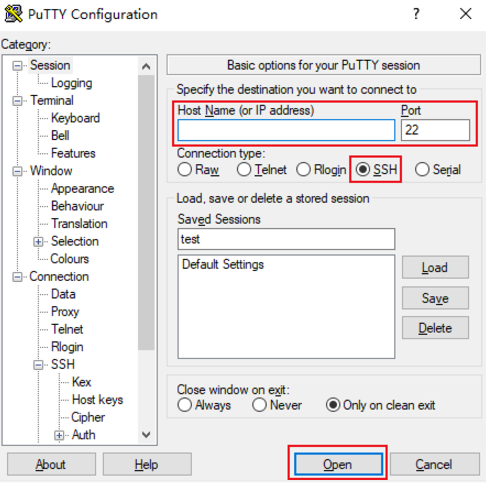
2. Launch the PuTTY client, enter the following in the PuTTY Configuration window, and click Open to create a session as shown below:
Host Name: The public IP address of the EMR cluster, which can be viewed on the list page or details page in the EMR Console.
Port: The port number of the CVM instance, which has to be 22. Please make sure that the port 22 in the CVM instance is opened. For more information, please see Security Group and Network ACL.
Connection type: Select SSH.

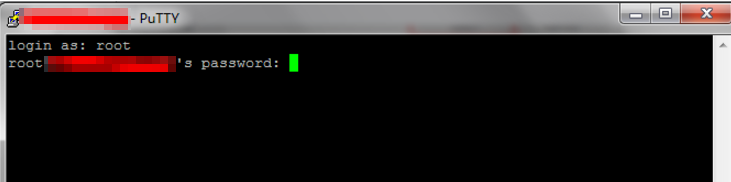
3. In the PuTTY session window, enter the obtained admin account and press Enter.
4. Enter the obtained login password and press Enter to log in as shown below:


Log in Through SSH (on Linux or macOS)

This section describes how to log in to an EMR cluster through SSH on Linux or macOS.

Applicable OS

Linux or Mac OS

Logging in with a password

1. On macOS, launch Terminal and run the following command. On Linux, run the following commands directly:
ssh <username>@<hostname or IP address>
username: The admin account, such as root.
hostname or IP address: The public IP address or custom domain name of your EMR cluster.
2. Enter the obtained password (only the input but not the output is displayed here) and press Enter to log in.
Bantuan dan Dukungan

Apakah halaman ini membantu?

masukan