tencent cloud

Cloud Object Storage

Release Notes and Announcements
Release Notes
Announcements
Product Introduction
Overview
Features
Use Cases
Strengths
Concepts
Regions and Access Endpoints
Specifications and Limits
Service Regions and Service Providers
Billing
Billing Overview
Billing Method
Billable Items
Free Tier
Billing Examples
Viewing and Downloading Bill
Payment Overdue
FAQs
Getting Started
Console
Getting Started with COSBrowser
User Guide
Creating Request
Bucket
Object
Data Management
Batch Operation
Global Acceleration
Monitoring and Alarms
Operations Center
Data Processing
Content Moderation
Smart Toolbox
Data Processing Workflow
Application Integration
User Tools
Tool Overview
Installation and Configuration of Environment
COSBrowser
COSCLI (Beta)
COSCMD
COS Migration
FTP Server
Hadoop
COSDistCp
HDFS TO COS
GooseFS-Lite
Online Tools
Diagnostic Tool
Use Cases
Overview
Access Control and Permission Management
Performance Optimization
Accessing COS with AWS S3 SDK
Data Disaster Recovery and Backup
Domain Name Management Practice
Image Processing
Audio/Video Practices
Workflow
Direct Data Upload
Content Moderation
Data Security
Data Verification
Big Data Practice
COS Cost Optimization Solutions
Using COS in the Third-party Applications
Migration Guide
Migrating Local Data to COS
Migrating Data from Third-Party Cloud Storage Service to COS
Migrating Data from URL to COS
Migrating Data Within COS
Migrating Data Between HDFS and COS
Data Lake Storage
Cloud Native Datalake Storage
Metadata Accelerator
GooseFS
Data Processing
Data Processing Overview
Image Processing
Media Processing
Content Moderation
File Processing Service
File Preview
Troubleshooting
Obtaining RequestId
Slow Upload over Public Network
403 Error for COS Access
Resource Access Error
POST Object Common Exceptions
API Documentation
Introduction
Common Request Headers
Common Response Headers
Error Codes
Request Signature
Action List
Service APIs
Bucket APIs
Object APIs
Batch Operation APIs
Data Processing APIs
Job and Workflow
Content Moderation APIs
Cloud Antivirus API
SDK Documentation
SDK Overview
Preparations
Android SDK
C SDK
C++ SDK
.NET(C#) SDK
Flutter SDK
Go SDK
iOS SDK
Java SDK
JavaScript SDK
Node.js SDK
PHP SDK
Python SDK
React Native SDK
Mini Program SDK
Error Codes
Harmony SDK
Endpoint SDK Quality Optimization
Security and Compliance
Data Disaster Recovery
Data Security
Cloud Access Management
FAQs
Popular Questions
General
Billing
Domain Name Compliance Issues
Bucket Configuration
Domain Names and CDN
Object Operations
Logging and Monitoring
Permission Management
Data Processing
Data Security
Pre-signed URL Issues
SDKs
Tools
APIs
Agreements
Service Level Agreement
Privacy Policy
Data Processing And Security Agreement
Contact Us
Glossary
DokumentasiCloud Object StorageTroubleshootingSlow Upload over Public Network

Slow Upload over Public Network

PDF
Mode fokus
Ukuran font
Terakhir diperbarui: 2024-03-25 18:01:58

Symptom


Symptom 1
:
The upload speed is low (below 8 Mbps) over a home network, while it is normal over a corporate network.
The upload speed is low (below 8 Mbps) over a corporate network, while it is normal over a 4G network.

Symptom 2
: The upload is slow at a custom domain name.

Possible Causes

Symptom 1
1.1 The speed is low due to your ISP and network conditions.
1.2 CORS is used and thus the speed is low.
Symptom 2: CNAME resolves the custom domain name to other products (e.g., Content Delivery Network (CDN), Cloud Virtual Machine (CVM), or Anti-DDoS) before resolving to COS.

Solutions

Symptom 1: Check the network conditions of your client. For detailed directions, see Troubleshooting client network issues.
Symptom 2: Reduce the intermediate links by modifying the DNS record for your custom domain name to improve the transfer efficiency. For detailed directions, see Modifying custom domain name's DNS record.

Troubleshooting

Troubleshooting client network issues

1. Run the following command to check whether the ISP of the IP address is the same as that of the client network:
ping COS domain name
For example:
ping examplebucket-1250000000.cos.ap-beijing.mqcloud.com
If so, proceed to step 3.
If not, proceed to step 2.
2. 
Check whether a proxy is enabled in the browser (with Chrome as an example)
.
2.1 Open Chrome and click

> Settings in the top-right corner.
2.2 Click Advanced. On the System page, click Open your computer's proxy settings to open the configuration window of your OS.
Check whether a proxy is enabled.
If so, disable the proxy.
If not, proceed to step 3.
3. 
Check whether your Wi-Fi router limits the speed.

If so, allocate the bandwidth as needed.
If not, proceed to step 4.
4. 
Test the performance of the upload to COS over the current network.
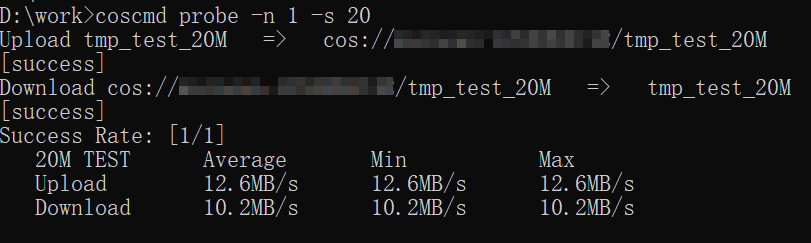
The following example uses a 20 MB object and COSCMD to test the upload and download speeds:
coscmd probe -n 1 -s 20
A message similar to the following will be displayed, from which you can get the average, min, and max speeds:


5. Visit Speed Test to test the speed. Then, compare the tested speed with the data obtained in step 4 to determine whether the client has used the maximum bandwidth.
If the speeds obtained in step 4 are below the client bandwidth, contact us.
If the speeds obtained in step 4 equal to the client bandwidth but don't reach the speed promised by your ISP, contact your ISP.
If the speeds obtained in step 4 equal to the client bandwidth and reach the bandwidth promised by your ISP, proceed to step 6.
6. 
Check whether the client is accessing a bucket residing in another country/region.

If so, we recommend you enable COS' global acceleration feature.
If not, contact us.

Modifying custom domain name's DNS record

1. Check whether the custom domain name is resolved to a COS domain name.
If so, contact us. Common COS domain names are as follows:
XXX.cos.ap-beijing.myqcloud.com (default COS domain name)
XXX.cos.accelerate.myqcloud.com (COS global acceleration domain name)
XXX.cos-website.ap-beijing.myqcloud.com (COS static website domain name)
XXX.picbj.myqcloud.com (COS' default CI domain name)
If not, proceed to step 2. Common non-COS domain names are as follows:
XXX.file.myqcloud.com or XXX.cdn.dnsv1.com (Tencent Cloud CDN's default domain names)
XXX.w.kunlungr.com (Alibaba Cloud CDN's default domain name)
2. 
Resolve the custom domain name to the desired COS domain name via the CNAME record and upload data.
For example, upload.mydomain.com cname XXX.cos.ap-beijing.myqcloud.com. For detailed directions, see Enabling Custom Origin Domains.
3. Modify the default COS domain name of the client. The following uses C# as an example:
CosXmlConfig config = new CosXmlConfig.Builder()
.SetConnectionTimeoutMs(60000) // Set the connection timeout period in milliseconds, which is 45,000 ms by default.
.SetReadWriteTimeoutMs(40000) // Set the read/write timeout period in milliseconds, which is 45,000 ms by default.
.IsHttps(true) // Set HTTPS as the default request method.
.SetAppid(appid) // Set the APPID of your Tencent Cloud account
.SetRegion(region) // Set the default bucket region.
.SetHost("XXXXXX.com") // Enter the custom domain name.
.SetDebugLog(true) .Build(); // Create the CosXmlConfig object.
For more information on how to call other SDKs, see SDK Overview.

Bantuan dan Dukungan

Apakah halaman ini membantu?

masukan