tencent cloud

Elastic MapReduce

Release Notes and Announcements
Release Notes
Announcements
Security Announcements
Product Introduction
Overview
Strengths
Architecture
Features
Use Cases
Constraints and Limits
Technical Support Scope
Product release
Purchase Guide
EMR on CVM Billing Instructions
EMR on TKE Billing Instructions
EMR Serverless HBase Billing Instructions
Getting Started
EMR on CVM Quick Start
EMR on TKE Quick Start
EMR on CVM Operation Guide
Planning Cluster
Administrative rights
Configuring Cluster
Managing Cluster
Managing Service
Monitoring and Alarms
TCInsight
EMR on TKE Operation Guide
Introduction to EMR on TKE
Configuring Cluster
Cluster Management
Service Management
Monitoring and Ops
Application Analysis
EMR Serverless HBase Operation Guide
EMR Serverless HBase Product Introduction
Quotas and Limits
Planning an Instance
Managing an Instance
Monitoring and Alarms
Development Guide
EMR Development Guide
Hadoop Development Guide
Spark Development Guide
Hbase Development Guide
Phoenix on Hbase Development Guide
Hive Development Guide
Presto Development Guide
Sqoop Development Guide
Hue Development Guide
Oozie Development Guide
Flume Development Guide
Kerberos Development Guide
Knox Development Guide
Alluxio Development Guide
Kylin Development Guide
Livy Development Guide
Kyuubi Development Guide
Zeppelin Development Guide
Hudi Development Guide
Superset Development Guide
Impala Development Guide
Druid Development Guide
TensorFlow Development Guide
Kudu Development Guide
Ranger Development Guide
Kafka Development Guide
Iceberg Development Guide
StarRocks Development Guide
Flink Development Guide
JupyterLab Development Guide
MLflow Development Guide
Practical Tutorial
Practice of EMR on CVM Ops
Data Migration
Practical Tutorial on Custom Scaling
API Documentation
History
Introduction
API Category
Cluster Resource Management APIs
Cluster Services APIs
User Management APIs
Data Inquiry APIs
Scaling APIs
Configuration APIs
Other APIs
Serverless HBase APIs
YARN Resource Scheduling APIs
Making API Requests
Data Types
Error Codes
FAQs
EMR on CVM
Service Level Agreement
Contact Us

Cluster Termination

PDF
フォーカスモード
フォントサイズ
最終更新日: 2023-12-27 11:08:14

Feature Overview

When you no longer need an EMR cluster, you can terminate it in the EMR console.

Prerequisites

Pay-as-you-go cluster: once terminated, the cluster will not be retained in the recycle bin but will be completely terminated and cannot be recovered. Please do so with caution.
Before terminating a cluster, please make sure that your data has been backed up as it cannot be recovered after termination.
If there is an EIP (an IP with a secondary ENI), the instance will be retained once returned, and the idle IP will continue to incur fees. If you don't need to retain it, please release it on the corresponding resource management page.

Directions

Caution
If MetaDB in the cluster to be terminated is associated with an external cluster as a Hive metadatabase, it will be retained when the cluster is terminated; if you no longer need it, please go to the TencentDB console to terminate it. Hive metadatabases cannot be recovered once terminated. Please do so with caution.
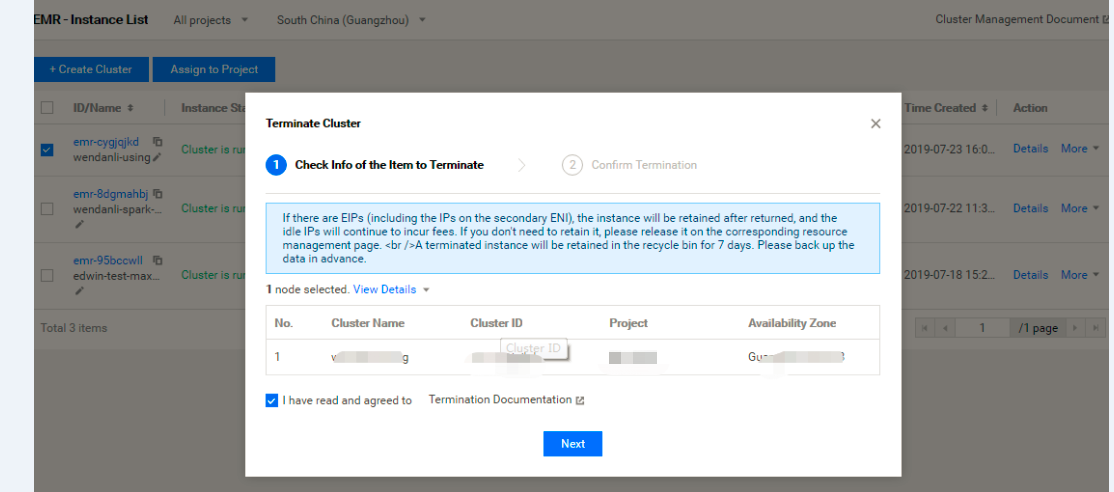
Log in to the EMR console, select Action > More > Terminate to enter the cluster termination page. Confirm the information of the cluster that needs to be terminated. After confirming that everything is correct, check I have read and agree to and click Next.

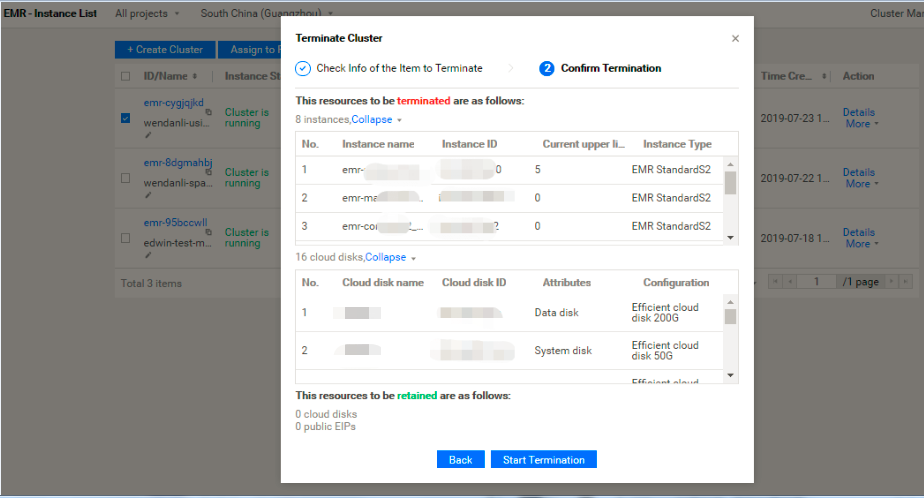
After confirming that everything is correct on the Confirm Termination tab, click Start Termination to terminate the cluster.
ヘルプとサポート

この記事はお役に立ちましたか?

フィードバック