tencent cloud

Elastic MapReduce

Release Notes and Announcements
Release Notes
Announcements
Security Announcements
Product Introduction
Overview
Strengths
Architecture
Features
Use Cases
Constraints and Limits
Technical Support Scope
Product release
Purchase Guide
EMR on CVM Billing Instructions
EMR on TKE Billing Instructions
EMR Serverless HBase Billing Instructions
Getting Started
EMR on CVM Quick Start
EMR on TKE Quick Start
EMR on CVM Operation Guide
Planning Cluster
Administrative rights
Configuring Cluster
Managing Cluster
Managing Service
Monitoring and Alarms
TCInsight
EMR on TKE Operation Guide
Introduction to EMR on TKE
Configuring Cluster
Cluster Management
Service Management
Monitoring and Ops
Application Analysis
EMR Serverless HBase Operation Guide
EMR Serverless HBase Product Introduction
Quotas and Limits
Planning an Instance
Managing an Instance
Monitoring and Alarms
Development Guide
EMR Development Guide
Hadoop Development Guide
Spark Development Guide
Hbase Development Guide
Phoenix on Hbase Development Guide
Hive Development Guide
Presto Development Guide
Sqoop Development Guide
Hue Development Guide
Oozie Development Guide
Flume Development Guide
Kerberos Development Guide
Knox Development Guide
Alluxio Development Guide
Kylin Development Guide
Livy Development Guide
Kyuubi Development Guide
Zeppelin Development Guide
Hudi Development Guide
Superset Development Guide
Impala Development Guide
Druid Development Guide
TensorFlow Development Guide
Kudu Development Guide
Ranger Development Guide
Kafka Development Guide
Iceberg Development Guide
StarRocks Development Guide
Flink Development Guide
JupyterLab Development Guide
MLflow Development Guide
Practical Tutorial
Practice of EMR on CVM Ops
Data Migration
Practical Tutorial on Custom Scaling
API Documentation
History
Introduction
API Category
Cluster Resource Management APIs
Cluster Services APIs
User Management APIs
Data Inquiry APIs
Scaling APIs
Configuration APIs
Other APIs
Serverless HBase APIs
YARN Resource Scheduling APIs
Making API Requests
Data Types
Error Codes
FAQs
EMR on CVM
Service Level Agreement
Contact Us

YARN Task Queue Management

PDF
フォーカスモード
フォントサイズ
最終更新日: 2025-04-15 16:35:57
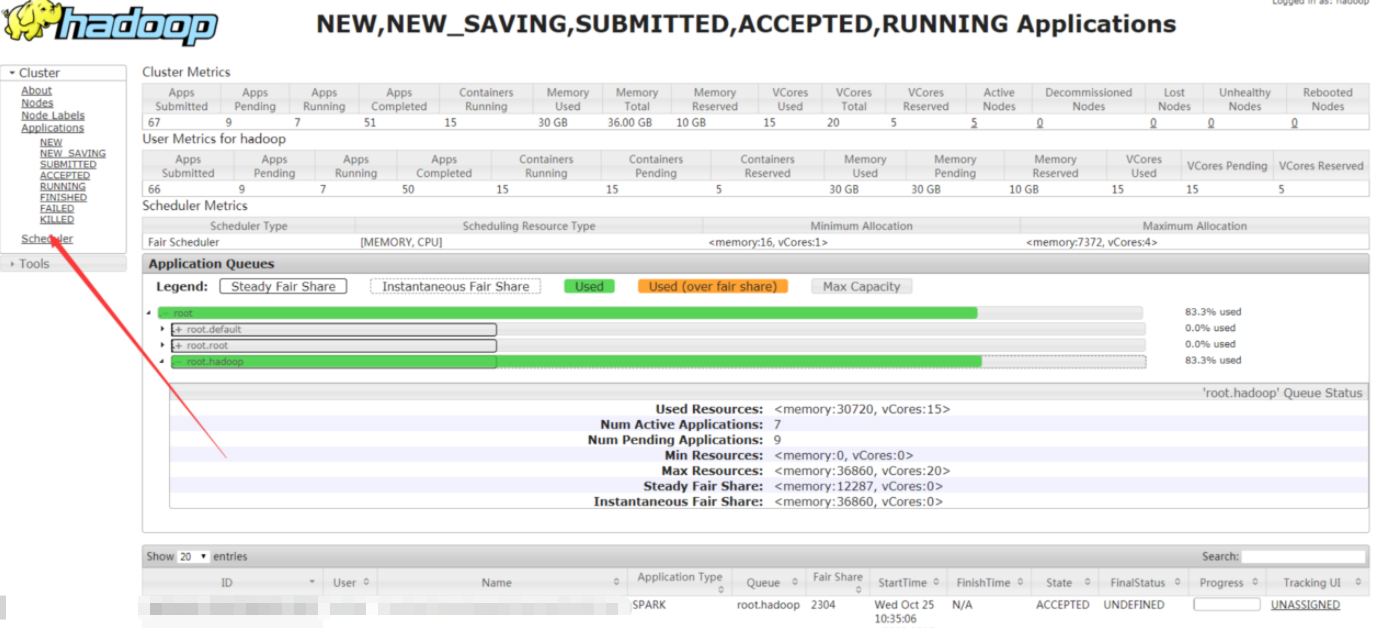
You can log in to the YARNwebUI, which is the web user interface of YARN, through the shortcut entry provided in EMR. For more information, please see the Software WebUI Entry. After logging in, you will see the following:

YARN


You can see some monitoring information of the entire cluster here:
Apps: 67 submitted apps, including 9 pending ones, 7 running ones, and 51 completed ones, where 15 containers are running.
Memory: 36 GB in total with 30 GB used and 10 GB reserved.
Virtual cores: 20 cores in total with 15 used ones and 5 reserved ones.
Nodes: 5 available nodes, 0 decommissioned ones, 0 lost ones, 0 unhealthy ones, and 0 rebooted ones.
Scheduler: Fair Scheduler, including maximum and minimum memory size and CPU allocation information.
The Application Queues section contains job queuing information of the cluster. Take the root.hadoop queue as an example:
Used resources: 30,720 MB (30 GB) memory, 15 virtual cores.
Active applications: 7.
Pending applications: 9.
Minimum memory occupied: 0 MB, 0 cores.
Maximum memory occupied: 36,860 MB, 20 cores.
Steady fair share.
Instantaneous fair share.
The proportion of memory occupied by this queue is 83.3%.
ヘルプとサポート

この記事はお役に立ちましたか?

フィードバック