tencent cloud

Tencent Cloud Observability Platform

Release Notes and Announcements
Release Notes
Product Introduction
Overview
Strengths
Basic Features
Basic Concepts
Use Cases
Use Limits
Purchase Guide
Tencent Cloud Product Monitoring
Application Performance Management
Mobile App Performance Monitoring
Real User Monitoring
Cloud Automated Testing
Prometheus Monitoring
Grafana
EventBridge
PTS
Quick Start
Monitoring Overview
Instance Group
Tencent Cloud Product Monitoring
Application Performance Management
Real User Monitoring
Cloud Automated Testing
Performance Testing Service
Prometheus Getting Started
Grafana
Dashboard Creation
EventBridge
Alarm Service
Cloud Product Monitoring
Tencent Cloud Service Metrics
Operation Guide
CVM Agents
Cloud Product Monitoring Integration with Grafana
Troubleshooting
Practical Tutorial
Application Performance Management
Product Introduction
Access Guide
Operation Guide
Practical Tutorial
Parameter Information
FAQs
Mobile App Performance Monitoring
Overview
Operation Guide
Access Guide
Practical Tutorial
Tencent Cloud Real User Monitoring
Product Introduction
Operation Guide
Connection Guide
FAQs
Cloud Automated Testing
Product Introduction
Operation Guide
FAQs
Performance Testing Service
Overview
Operation Guide
Practice Tutorial
JavaScript API List
FAQs
Prometheus Monitoring
Product Introduction
Access Guide
Operation Guide
Practical Tutorial
Terraform
FAQs
Grafana
Product Introduction
Operation Guide
Guide on Grafana Common Features
FAQs
Dashboard
Overview
Operation Guide
Alarm Management
Console Operation Guide
Troubleshooting
FAQs
EventBridge
Product Introduction
Operation Guide
Practical Tutorial
FAQs
Report Management
FAQs
General
Alarm Service
Concepts
Monitoring Charts
CVM Agents
Dynamic Alarm Threshold
CM Connection to Grafana
Documentation Guide
Related Agreements
Application Performance Management Service Level Agreement
APM Privacy Policy
APM Data Processing And Security Agreement
RUM Service Level Agreement
Mobile Performance Monitoring Service Level Agreement
Cloud Automated Testing Service Level Agreement
Prometheus Service Level Agreement
TCMG Service Level Agreements
PTS Service Level Agreement
PTS Use Limits
Cloud Monitor Service Level Agreement
API Documentation
History
Introduction
API Category
Making API Requests
Monitoring Data Query APIs
Alarm APIs
Legacy Alert APIs
Notification Template APIs
TMP APIs
Grafana Service APIs
Event Center APIs
TencentCloud Managed Service for Prometheus APIs
Monitoring APIs
Data Types
Error Codes
Glossary

Startup

PDF
フォーカスモード
フォントサイズ
最終更新日: 2024-05-20 10:47:31
Analyze startup metrics by using Startup Duration and Slow Startup Proportion. You can locate and analyze the root causes of slow app startups through the Slow Startup Issue List.

Feature Entry

2. In the left sidebar, select Startup, and choose the business system, application, and time range you want to analyze for startup issues.

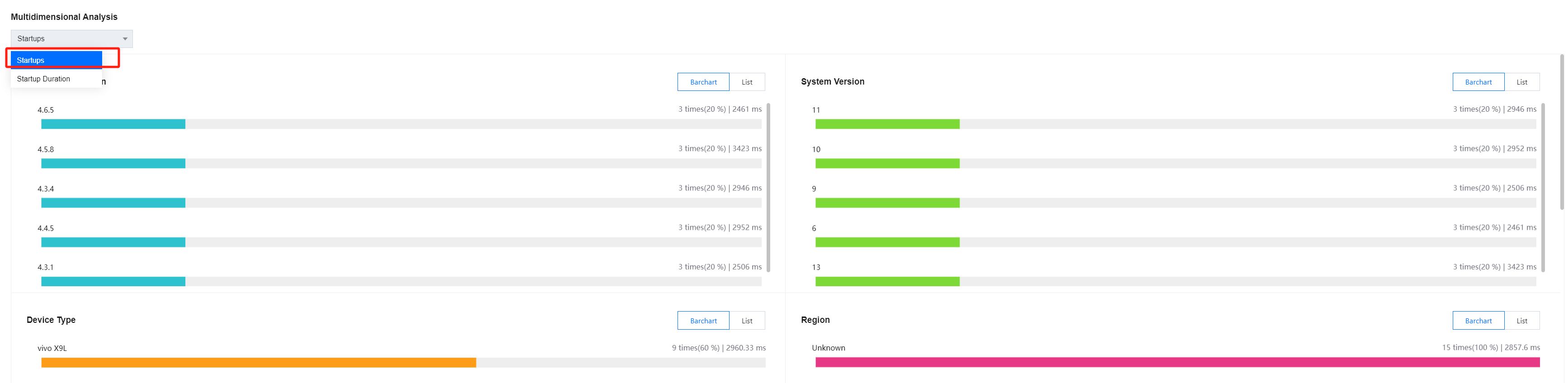
Multidimensional Analysis

Multidimensional analysis, based on application version, system version, device type, region, ISP, and other dimensions, facilitates targeted analysis of the root causes of observed slow startup.


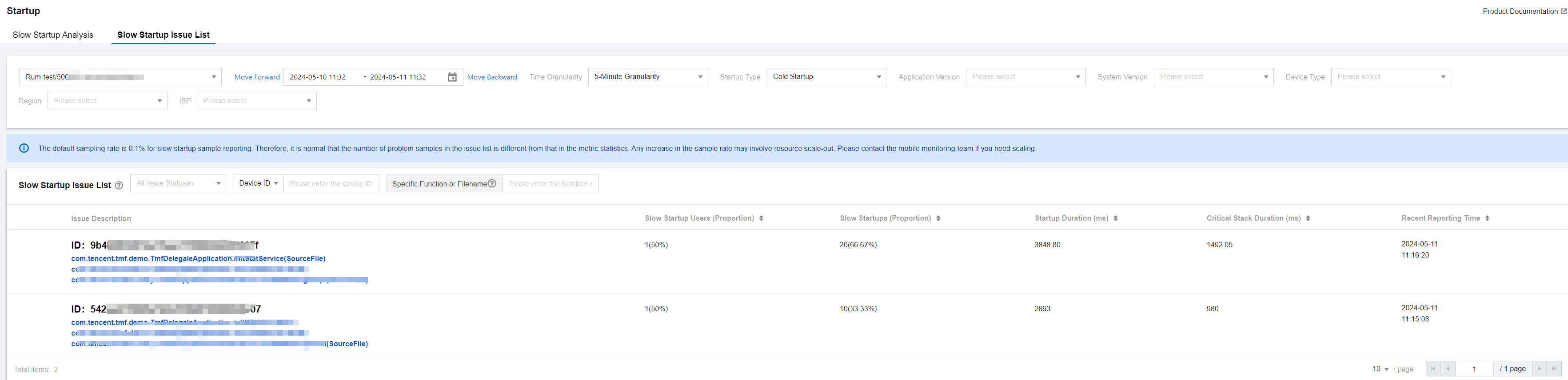
Slow Startup Issue List

The slow startup issue list displays slow startup issues for all devices. You can quickly filter for relevant slow startup devices based on issue exception type, problem device ID, specific function, or file name. You can also click Issue Description to view details of the slow startup issue and analyze the root cause of the app's slow startup.
For each application cold/first startup sample, the startup of an Android system with a duration greater than 2,500 ms is considered a slow startup, and the startup of an iOS system with a duration greater than 4,000 ms is considered a slow startup. For each warm startup sample, the startup of an Android system with a duration greater than 1,000 ms is considered a slow startup, and the startup of an iOS system with a startup duration greater than 2,000 ms is considered a slow startup. Only slow startup samples are displayed in the issue list.


Descriptions

Related metrics descriptions are as follows:
Metric Name
Descriptions
Startups
Application startups.
Startup Duration
Time consumed by the application startup.
Average Duration
The sum of an online sample startup duration/application startups.
Slow Startups (Proportion)
Slow startups/total startups.
For an Android terminal, a startup exceeding 2.5 s is, by default, defined as a slow startup.
For an iOS terminal, a startup exceeding 4s is, by default, defined as a slow startup, with the threshold being customizable.
Initial Startup
The first startup of the app after installation, considered as a special case of cold startup.
Cold Startup
The process of restarting the app after the app process ended, or running at the backend and the process has been reclaimed by the system.
Warm Startup
The process of awakening the app after it has been in the backend for 3 minutes or switching back from another app's interface.
ヘルプとサポート

この記事はお役に立ちましたか?

フィードバック