tencent cloud

Elastic MapReduce

Release Notes and Announcements
Release Notes
Announcements
Security Announcements
Product Introduction
Overview
Strengths
Architecture
Features
Use Cases
Constraints and Limits
Technical Support Scope
Product release
Purchase Guide
EMR on CVM Billing Instructions
EMR on TKE Billing Instructions
EMR Serverless HBase Billing Instructions
Getting Started
EMR on CVM Quick Start
EMR on TKE Quick Start
EMR on CVM Operation Guide
Planning Cluster
Administrative rights
Configuring Cluster
Managing Cluster
Managing Service
Monitoring and Alarms
TCInsight
EMR on TKE Operation Guide
Introduction to EMR on TKE
Configuring Cluster
Cluster Management
Service Management
Monitoring and Ops
Application Analysis
EMR Serverless HBase Operation Guide
EMR Serverless HBase Product Introduction
Quotas and Limits
Planning an Instance
Managing an Instance
Monitoring and Alarms
Development Guide
EMR Development Guide
Hadoop Development Guide
Spark Development Guide
Hbase Development Guide
Phoenix on Hbase Development Guide
Hive Development Guide
Presto Development Guide
Sqoop Development Guide
Hue Development Guide
Oozie Development Guide
Flume Development Guide
Kerberos Development Guide
Knox Development Guide
Alluxio Development Guide
Kylin Development Guide
Livy Development Guide
Kyuubi Development Guide
Zeppelin Development Guide
Hudi Development Guide
Superset Development Guide
Impala Development Guide
Druid Development Guide
TensorFlow Development Guide
Kudu Development Guide
Ranger Development Guide
Kafka Development Guide
Iceberg Development Guide
StarRocks Development Guide
Flink Development Guide
JupyterLab Development Guide
MLflow Development Guide
Practical Tutorial
Practice of EMR on CVM Ops
Data Migration
Practical Tutorial on Custom Scaling
API Documentation
History
Introduction
API Category
Cluster Resource Management APIs
Cluster Services APIs
User Management APIs
Data Inquiry APIs
Scaling APIs
Configuration APIs
Other APIs
Serverless HBase APIs
YARN Resource Scheduling APIs
Making API Requests
Data Types
Error Codes
FAQs
EMR on CVM
Service Level Agreement
Contact Us

EMR Serverless HBase Product Introduction

PDF
Modo Foco
Tamanho da Fonte
Última atualização: 2025-02-26 14:38:06
The EMR Serverless HBase (Alias EMR Lite HBase )provides a fully managed HBase service that is fully compatible with the open-source HBase protocol. You do not need to worry about the operation and maintenance of basic hardware facilities. Using features such as automatic fault recovery and backup and recovery provided by the Serverless version, you can efficiently carry out big data platform operation and maintenance. With EMR Serverless HBase, you can quickly build big data access applications with high throughput and low latency, such as real-time query of massive data, real-time data computation and processing, and time-series data storage and access.

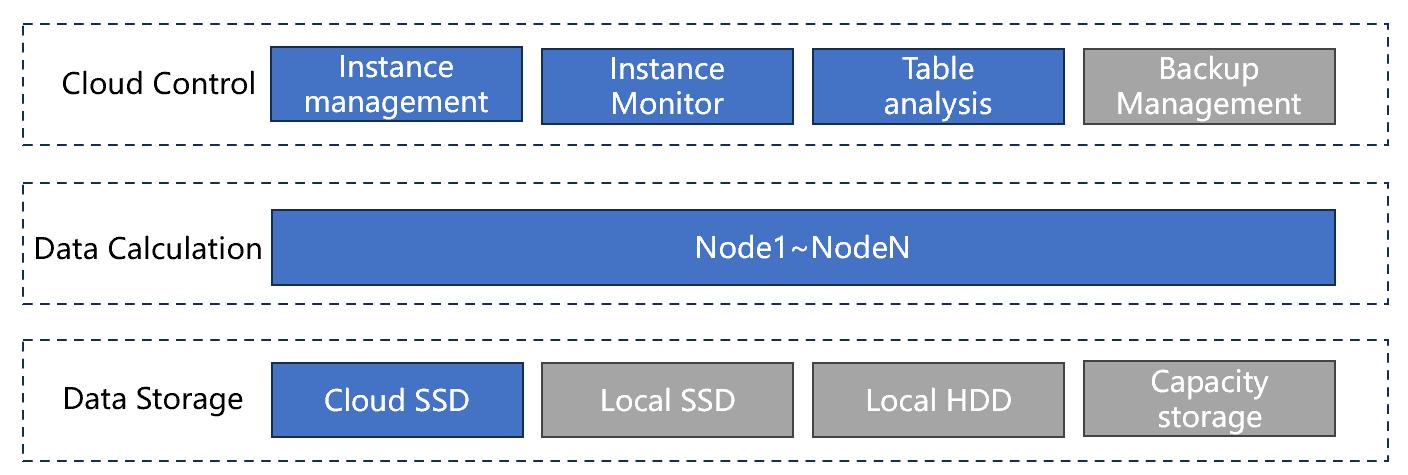
Product Architecture


Cloud Console: Provides visualization for managing EMR Serverless HBase instances, backup recovery, and monitoring and alarms for instance operation and maintenance.
Data Calculation: The instance computing capacity is provided by multiple nodes under the instance. After the instance is created, the number of instances can be expanded as needed.
Data Storage: Data can be stored on various storage media with different performance levels. During the beta period, only performance cloud storage is supported.

Strengths

Fully Compatible: Fully compatible with Open Source HBase, allowing seamless migration without code modification.
Simple Operations: No need to maintain underlying hardware resources, built-in parameter tuning is ready out of the box.
Secure and Reliable: VPC logical isolation, high availability architecture, and backup recovery ensure data security.

Ajuda e Suporte

Esta página foi útil?

comentários