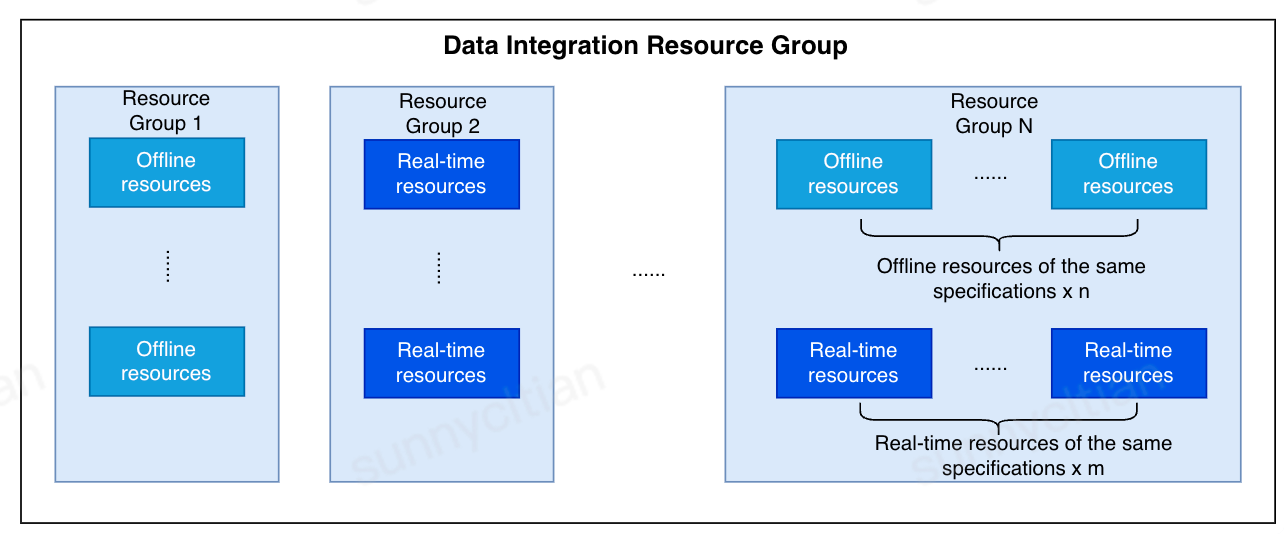
Data integration resources are execution resources dedicated for data integration tasks on the Tencent Cloud WeData platform. They support offline synchronization tasks and real-time synchronization tasks in the data integration module, as well as offline synchronization tasks in the data development module.
Integration resource groups bind tasks by resource group and consist of offline resource package and real-time resource package. An integration resource group can contain either offline resource packages or real-time resource packages, or both. The current integration resource group uses the yearly/monthly subscription billing mode.
Offline resource package: It is optional and can be configured as needed for offline integration. It is mainly used to construct an integration resource environment and run offline tasks. You can select the appropriate package specifications and quantity based on the volume of offline integration tasks.
Real-time resource package: It is optional and can be configured as needed for real-time integration. It is used to run real-time synchronization tasks. You can select the appropriate package specifications and quantity based on the volume of real-time integration tasks.
Must-Knows
Resource groups are the smallest task-binding units, where a single resource package can only belong to one resource group.
Offline resource packages are intended exclusively for offline tasks and cannot be applied to real-time tasks. Conversely, real-time resource packages are intended exclusively for real-time tasks and cannot be applied to offline tasks.
For an integration resource group that includes both offline and real-time resource packages, the real-time resource package can be terminated independently. However, if the offline resource package is terminated, the real-time resource package will also be terminated. Any unused basic and real-time resource package resources during the billing cycle will be refunded.
If an integration resource group contains both offline and real-time resource packages, both package types need to operate within a unified network environment.
Resource Performance Metrics
Resource Package Type
Specification
Maximum Number of Concurrent Threads for Offline Integration
Offline resource package
8C 16G
16
8C 32G
16
Resource Package Type
Specification
Maximum Number of Tasks for Full Database Migration
Maximum Number of Tasks for Real-time Synchronization of a Single Table
Real-time resource package
16C 64G
8 (A single full database migration task requires at least 2C.)
16
Fee Charging Standards
Deployment Regions
Resource Package Type
Specification
Recommended scenarios
Price
Singapore / Frankfurt / Virginia
Offline resource package
8C 16G
Suitable for smaller volumes of offline DataInLong tasks, or primarily used in conjunction with real-time packages for real-time integration
259 USD/month (before discount)
8C 32G
Suitable for offline DataInLong tasks with substantial memory consumption
519 USD/month (before discount)
Singapore / Frankfurt / Virginia
Real-time resource package
16C 64G
Suitable for more flexible real-time Data Warehouse construction and real-time report presentation scenarios
749 USD/month (before discount)
Singapore / Frankfurt / Virginia
Offline + Real-time Resource Package
8C 16G (Offline)
Suitable for more flexible offline + real-time data warehouse construction, real-time report presentation, and other business scenarios
1,008 USD/month (before discount)
16C 64G (Real-time)
8C 32G (Offline)
Suitable for data integration tasks with substantial memory consumption, both offline and real-time
1,268 USD/month (before discount)
16C 64G (Real-time)
Singapore / Frankfurt / Virginia
Offline + Real-time Resource Package
8C 16G (Offline)
Suitable for more flexible offline + real-time data warehouse construction, real-time report presentation, and other business scenarios
1,008 USD/month (before discount)
16C 64G (Real-time)
8C 32G (Offline)
Suitable for data integration tasks with substantial memory consumption, both offline and real-time
1,268 USD/month (before discount)
16C 64G (Real-time)
Massive Message Queue
1C 2G
2C 4G
4C 8G
8C 16G
After configuring the massive message queue for the integrated resource group, the real-time integration task can be enhanced to support active data reporting through Agent/SDK
Free During Promotion
Note:
The prices displayed in the documentation have been rounded to the nearest decimal point for reference only.