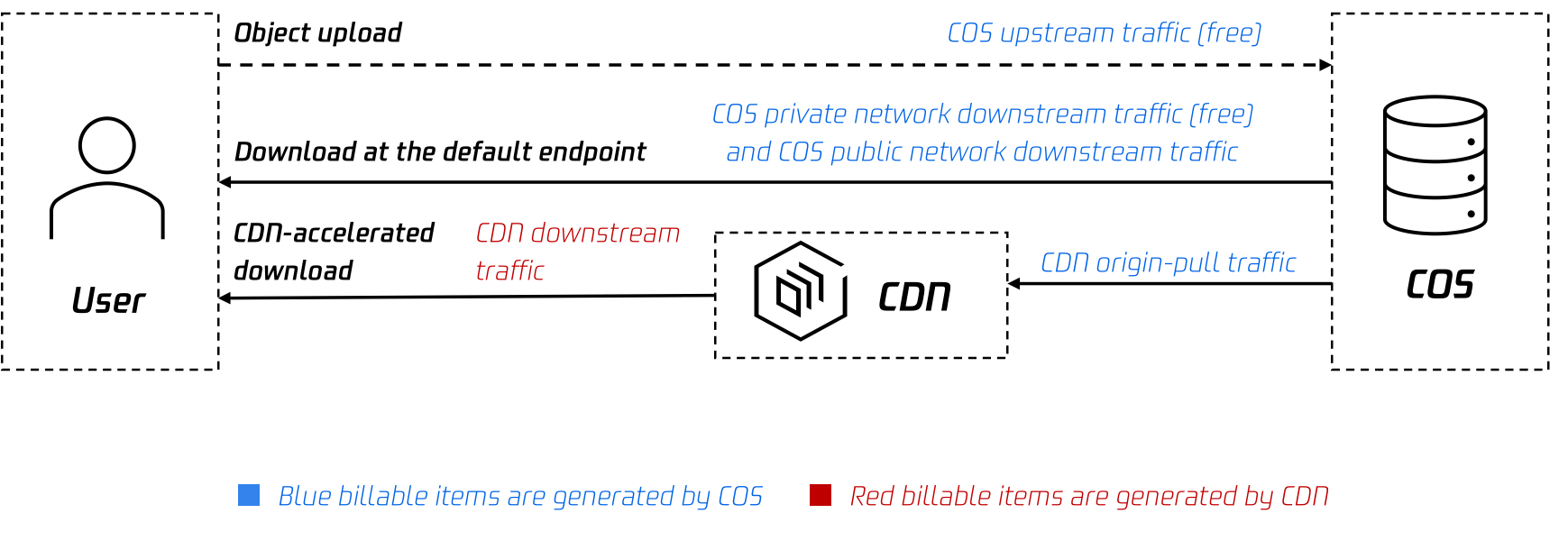
Traffic is the accumulated value of data traffic generated when you use and access COS, including public network upstream traffic, public network downstream traffic, private network upstream traffic, private network downstream traffic, and CDN origin-pull traffic. COS charges you by the accumulated traffic usage.
Note:
For more information on storage classes, see Overview.
The billing unit of the traffic billing item and traffic packages is GB, and the traffic unit conversion ratio is 1:1,024.For example, 1 TB of public network downstream traffic equals 1,024 GB. A public network downstream traffic package of 1 TB can deduct fees of 1,024 GB of public network downstream traffic.This conversion rule will take effect from April 1, 2025.
Traffic Fees Billable Item
Billable Item
Applicable Storage Class
Description
Applicable Billing Mode
Public network downstream traffic
All Storage Class
Traffic generated by data download from COS to the local system or client over the public network (internet).
Pay-as-you-go: Public network downstream traffic (GB) * unit price per GB
Public network upstream traffic
Traffic generated by data upload from the local system or client to COS over the public network (internet).
Free of charge
Private network upstream traffic
Traffic generated by data transfer from the client to COS over the Tencent Cloud private network.Note: Tencent Cloud products within the same region access each other over the private network by default, with no traffic fees incurred. For more information on how to identify private network access, see Overview > Private Network Access.
Free of charge
Private network downstream traffic
Traffic generated by data transfer from COS to the client over the Tencent Cloud private network.Note: Tencent Cloud products within the same region access each other over the private network by default, with no traffic fees incurred. For more information on how to identify private network access, see Overview > Private Network Access.
Free of charge
CDN origin-pull traffic
Origin-pull traffic generated by data transfer from COS to the CDN edge node when COS is used as the CDN origin.
Pay-as-you-go: CDN origin-pull traffic (GB) * unit price per GB
Cross-region replication traffic
Traffic generated by replicating objects from a bucket in one region to a bucket in another region.Note: Replicating objects across buckets in the same region will not incur traffic fees. The traffic fees will vary by source bucket region.
Pay-as-you-go: Cross-region replication traffic (GB) * unit price per GB
Global acceleration traffic
When you enable the global acceleration feature, the traffic generated from data transfers through the acceleration domain, including public network global acceleration traffic and private network global acceleration traffic.
This traffic consists of upstream acceleration traffic and downstream acceleration traffic:
Upstream acceleration traffic is the traffic generated by uploading data to COS at an acceleration endpoint. Upstream acceleration traffic fees will be incurred if you upload files at a global acceleration endpoint and data goes through the private network acceleration linkage.
Downstream acceleration traffic is the traffic generated by viewing or downloading COS data at an acceleration endpoint. Downstream acceleration traffic fees will be incurred if you download files at a global acceleration endpoint and data goes through the private network acceleration linkage.
Pay-as-you-go: Global acceleration traffic (GB) * unit price per GB
Note:
If data is downloaded using a global acceleration domain, both global acceleration outbound traffic fees and public outbound traffic fees will be incurred. If a global acceleration domain is used as the origin domain for CDN/EdgeOne back-to-origin, both global acceleration outbound traffic fees and CDN back-to-origin traffic fees will be incurred.
Billing Restrictions
1. ARCHIVED data cannot be read or downloaded until it is restored to the STANDARD storage class. Therefore, traffic generated from these requests is counted in the STANDARD storage class.
2. Public network downstream traffic is generated when the data is returned to COS through origin-pull by using a third-party CDN service.
3. Public network downstream traffic is generated when a user downloads objects through object links or browses objects through a static website endpoint.
4. Cross-region replication traffic is generated when you replicate data from a bucket in one region to a bucket in another region using APIs or the cross-region replication feature. The traffic fees will vary depending on the region where the source bucket resides.
5. For INTELLIGENT TIERING, traffic fees are subject to those of the storage class after object movement.
Traffic Generated by Using COS as CDN Origin
After you enable the CDN acceleration domain name, data downloads and access through it will incur fees:
Billable Item
Description
CDN origin-pull traffic
When users utilize COS as the origin for CDN/EdgeOne, the back-to-origin traffic generated from transferring data from COS to Tencent Cloud CDN/EdgeOne edge nodes.
CDN Downstream Traffic
When users use COS as the origin for CDN/EdgeOne, the traffic generated when data is downloaded from CDN/EdgeOne edge nodes to the user's local or client is considered CDN/EdgeOne outbound traffic.
COS request
When users utilize COS as the origin server for CDN/EdgeOne, data transmission from COS to Tencent Cloud CDN/EdgeOne edge nodes generates COS request counts. Request fees are calculated based on the number of request instructions sent to COS.
Billing Modes and Calculation Formulas for Traffic Fees
Billing Mode
Applicable Billable Items
Calculation Formula
Pay-as-you-go
Public network downstream traffic fees
CDN origin-pull traffic fees
Cross-region replication traffic fees
Global acceleration traffic fees
Daily billing cycle
Traffic fees = unit price per GB * daily accumulated traffic
Traffic Resource Packages (Prepaid)
Public network Downstream Traffic Fees
Global Acceleration Traffic Fees
Traffic packages are classified according to the type of traffic as follows:
Public network downstream traffic package: Used to deduct public network downstream traffic.
Global acceleration traffic package: Used to deduct global acceleration traffic. According to the data transfer acceleration direction, it is divided into the following types:
Chinese mainland only: It can deduct global acceleration traffic (both upstream and downstream traffic) fees for the transfer direction 'Chinese mainland - Chinese mainland', excluding traffic in the financial cloud regions.
Hong Kong (China) and overseas: It can deduct global acceleration traffic (both upstream and downstream traffic) fees for transfer directions 'Chinese mainland - Hong Kong (China) and overseas', 'Hong Kong (China) and overseas - Hong Kong (China) and overseas', and 'Hong Kong (China) and overseas - Chinese mainland'.
Within the validity period of the traffic package, the traffic generated in each cycle (including the purchase day) can be deducted from the specifications of the resource package. The insufficient part will be billed on a pay-as-you-go basis.
Sample: STANDARD storage fees + STANDARD request fees + Public downstream traffic fees
Assume that on November 1, 2020, user A uploaded a 10 GB object to a bucket residing in Guangzhou region in the STANDARD storage class, generating 100 requests. On November 2 and November 3, user A downloaded the object of 10 GB to the local file system over the public network with CDN disabled, generating 100 requests daily. Apart from these operations, user A did not perform any other operations. As storage usage, request, and traffic fees are settled daily, then:
STANDARD storage usage fees: Settled daily starting from November 2, 2020.
STANDARD request fees: Settled on November 2, 3, and 4, 2020.
Traffic fees: Settled on November 3 and 4, 2020.
Fees analysis:
STANDARD storage usage fees = 0.024 USD/GB/month / 30 * 10 GB * 30 days = 0.24 USD