tencent cloud

Tencent Kubernetes Engine

Release Notes and Announcements
Release Notes
Announcements
Release Notes
Product Introduction
Overview
Strengths
Architecture
Scenarios
Features
Concepts
Native Kubernetes Terms
Common High-Risk Operations
Regions and Availability Zones
Service Regions and Service Providers
Open Source Components
Purchase Guide
Purchase Instructions
Purchase a TKE General Cluster
Purchasing Native Nodes
Purchasing a Super Node
Getting Started
Beginner’s Guide
Quickly Creating a Standard Cluster
Examples
Container Application Deployment Check List
Cluster Configuration
General Cluster Overview
Cluster Management
Network Management
Storage Management
Node Management
GPU Resource Management
Remote Terminals
Application Configuration
Workload Management
Service and Configuration Management
Component and Application Management
Auto Scaling
Container Login Methods
Observability Configuration
Ops Observability
Cost Insights and Optimization
Scheduler Configuration
Scheduling Component Overview
Resource Utilization Optimization Scheduling
Business Priority Assurance Scheduling
QoS Awareness Scheduling
Security and Stability
TKE Security Group Settings
Identity Authentication and Authorization
Application Security
Multi-cluster Management
Planned Upgrade
Backup Center
Cloud Native Service Guide
Cloud Service for etcd
TMP
TKE Serverless Cluster Guide
TKE Registered Cluster Guide
Use Cases
Cluster
Serverless Cluster
Scheduling
Security
Service Deployment
Network
Release
Logs
Monitoring
OPS
Terraform
DevOps
Auto Scaling
Containerization
Microservice
Cost Management
Hybrid Cloud
AI
Troubleshooting
Disk Full
High Workload
Memory Fragmentation
Cluster DNS Troubleshooting
Cluster kube-proxy Troubleshooting
Cluster API Server Inaccessibility Troubleshooting
Service and Ingress Inaccessibility Troubleshooting
Common Service & Ingress Errors and Solutions
Engel Ingres appears in Connechtin Reverside
CLB Ingress Creation Error
Troubleshooting for Pod Network Inaccessibility
Pod Status Exception and Handling
Authorizing Tencent Cloud OPS Team for Troubleshooting
CLB Loopback
API Documentation
History
Introduction
API Category
Making API Requests
Elastic Cluster APIs
Resource Reserved Coupon APIs
Cluster APIs
Third-party Node APIs
Relevant APIs for Addon
Network APIs
Node APIs
Node Pool APIs
TKE Edge Cluster APIs
Cloud Native Monitoring APIs
Scaling group APIs
Super Node APIs
Other APIs
Data Types
Error Codes
TKE API 2022-05-01
FAQs
TKE General Cluster
TKE Serverless Cluster
About OPS
Hidden Danger Handling
About Services
Image Repositories
About Remote Terminals
Event FAQs
Resource Management
Service Agreement
TKE Service Level Agreement
TKE Serverless Service Level Agreement
Contact Us
Glossary

qGPU Overview

PDF
Modo Foco
Tamanho da Fonte
Última atualização: 2024-06-27 11:09:15

TKE GPU Virtualization

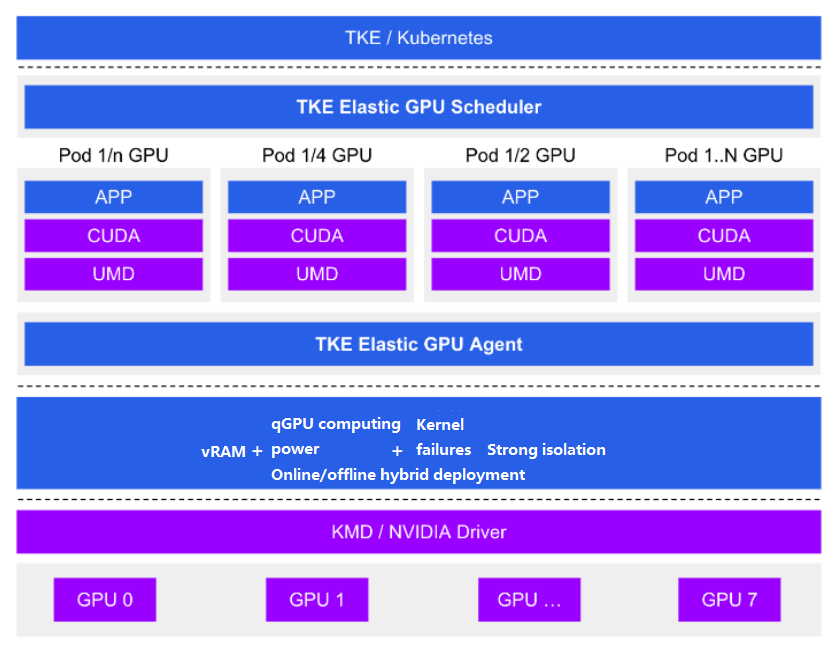
Tencent Kubernetes Engine qGPU (TKE qGPU) is a GPU virtualization service launched by Tencent Cloud. It supports sharing a GPU card among multiple containers and provides the capacity to finely isolate the vRAM and computing power among containers. Also, it provides the unique online/offline hybrid deployment capability to increase GPU utilization and help users significantly save their GPU resource costs on the basis of finely segmenting GPU resources and on the premise of ensuring their business stability.
Based on TKE's open-source Elastic GPU framework, qGPU can schedule GPU computing power and vRAM at a fine granularity, share a GPU card among multiple containers, and allocate GPU resources across GPU cards. Plus, relying on the powerful underlying isolation technology, it can strongly isolate vRAM and computing power to ensure that business performance and resource use are not affected by GPU sharing.
Note:
The qGPU feature is available only for TKE native nodes. No guarantee of effective service is provided for other node types.

Solution Framework Diagram


qGPU Strengths

Flexibility: Finely configure GPU computing capacity and vRAM size.
Strong isolation: vRAM and computing power can be strictly isolated.
Hybrid deployment: Supports online and offline hybrid deployment to maximize the GPU utilization.
Coverage: Supports popular architectures including Volta (such as V100), Turing (such as T4) and Ampere (such as A100 and A10).
Cloud nativeness: Standard Kubernetes and NVIDIA Docker solutions are supported.
Compatibility: No need to rewrite application code or replace CUDA libraries, and it is easily deployed in a way imperceptible to the application.
High performance: Virtualization is applied at the underlying layer of GPU devices, realizing efficient convergence and nearly zero loss of throughput.
Ajuda e Suporte

Esta página foi útil?

comentários