An open-source project requires maintaining a user-friendly and readable CHANGELOG.md so that users can quickly know whether they will be affected by the version and assess the upgrade risk if applicable.
You need to submit a .txt change file to the .changelog directory to describe the change when sending a pull request. The file will then be parsed via the go-changelog tool to generate a CHANGELOG.md file subject to the following update rules:
Changelog Format
Naming
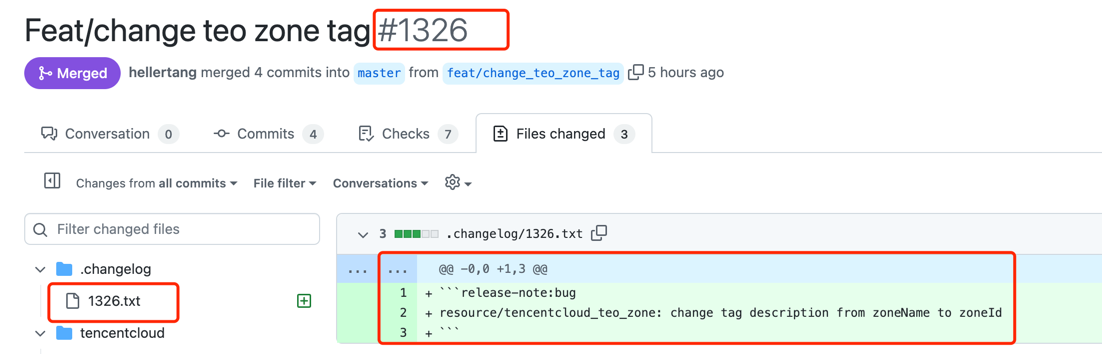
The changelog involved in the current pull request should be submitted to the .changelog directory and named in the format of {PR-NUMBER}.txt. For example, if the pull request number is 1326, the changelog should be named .changelog/1326.txt.
Format
The changelog.txt has the following format, where {HEADER} is the changelog type, and {ENTRY} is the changelog details.
```release-note:{HEADER}
{ENTRY}
```
If a pull request contains multiple changelog entries, you can add multiple blocks to the same changelog file as follows:
```release-note:bug
resource/tencentcloud_teo_zone: change tag description from zoneName to zoneId.
```
```release-note:enhancement
resource/tencentcloud_redis_instance: support update `security_groups`.
```
Changelog Rule Categorization
A changelog presents only changes to the code repository of a specific version affecting the operator. The following are general principles and samples of a change to be recorded in a changelog.
New resource
The changelog of a new resource should contain only the resource name and be named release-note:new-resource.
```release-note:new-resource
tencentcloud_postgresql_instance
```
New data source
The changelog of a new data source should contain only the data source name and be named release-note:new-data-source.
```release-note:new-data-source
tencentcloud_sqlserver_zone_config
```
Bug fix
The changelog of a new bug fix should be named release-note:bug, with a prefix indicating the corresponding resource or data source, a colon, and a summary.
Note:
Use the provider prefix for a provider-level fix.
```release-note:bug
resource/tencentcloud_cdn_domain: Fix `https_config` inconsistency after apply
```
Feature enhancement
The changelog of a new feature enhancement should be named release-note:enhancement, with a prefix indicating the corresponding resource or data source, a colon, and a summary.
Note:
Use the provider prefix for a provider-level feature enhancement.
```release-note:enhancement
resource/tencentcloud_cdn_domain: Support follow redirect and authentication
```
Feature disuse
The changelog of a feature disuse should be named release-note:deprecation, with a prefix indicating the corresponding resource or data source, a colon, and a summary.
Note:
Use the provider prefix for a provider-level feature disuse.
```release-note:deprecation
resource/tencentcloud_kubernetes_cluster: The `as_enabled` attribute is being deprecated.