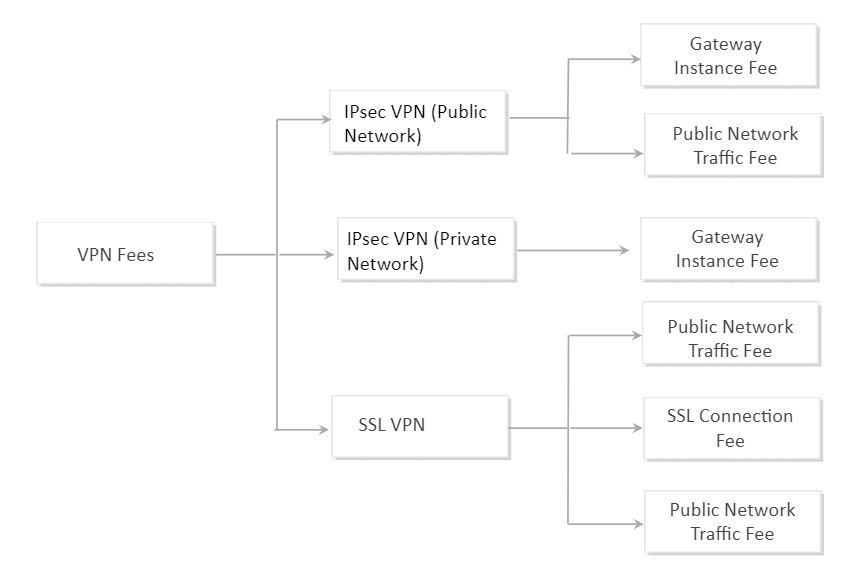
This document describes IPSec VPN and SSL VPN billing items and pricing.
Note:
The price information presented in the tables of this document is for reference only. When it is inconsistent with the price information on the purchase page, the later shall prevail.
Currently, adjustments to VPN gateway bandwidth are supported only within specific ranges. Please plan your bandwidth in advance based on your business requirements.
IPSec VPN (which supports only pay-as-you-go) supports scaling up or down within its respective bandwidth ranges (that is, [5, 100] Mbps, [200, 1000] Mbps, [2000, 3000] Mbps), but does not support scaling across different ranges currently.
SSL VPN (which supports only pay-as-you-go) supports scaling up or down within its respective bandwidth ranges (that is, [5, 100] Mbps, [200, 500] Mbps). The 1000 Mbps SSL VPN gateway specification does not currently support scaling down.
For IPSec VPN, the customer gateways are free of charge. For SSL VPN, the VPN servers and clients are free of charge.
Private network VPNs do not incur traffic charges from the VPN gateway to the dedicated line gateway.
IPSec VPN Pricing
IPSec VPN supports the traffic-based billing (pay-as-you-go).
Traffic-based billing
Traffic-based billing contains two parts, traffic fee (for access to the public network) and gateway fee (hourly billing, with a minimum usage of one hour). The private VPN includes only fees for gateway instances.
For details regarding fees for gateway instances, see the table below:
VPN gateway is your target gateway on Tencent Cloud side. The traffic flowing through the VPN gateway incurs fees. The gateway fee is billed by traffic.
The traffic here refers to the outbound traffic of the VPN gateway, which is also called the downstream traffic.
Billing Example
Suppose a user purchases a 50 Mbps IPSec VPN gateway in the Beijing region, with the billing mode set to pay-as-you-go. If the user consumes a total of 5 GB of traffic during the period from 07:00:00 to 07:29:59, the fees to be settled for the next hour (08:00:00-08:59:59) are as follows:
Traffic fee: Traffic unit price (0.12 USD/GB for Beijing) × Traffic Usage (in GB) = 0.12 × 5 = 0.6 USD
Gateway fee: The unit price for a 50 Mbps IPSec VPN gateway in the Beijing region is USD 0.078 per hour. Gateway fee = Unit price × Duration = USD 0.078/hour × 1 hour (billed by the hour, with a minimum of one hour) = USD 0.078.
SSL VPN is a pay-as-you-go service. It contains three parts of fee: traffic fee (for access to the public network), gateway fee (hourly billing, with a minimum usage of one hour), and SSL connection fee (hourly billing, with a minimum usage of one hour).
Silicon Valley, Frankfurt, Seoul, Virginia, Bangkok, Singapore, Tokyo, Taipei (China), Hong Kong (China), Jakarta,Sao Paulo,Riyadh
5 Mbps/10 Mbps/20 Mbps/50 Mbps/100 Mbps
0.078 USD/hour
0.12 USD/hour
200 Mbps/500 Mbps/1,000 Mbps
0.46 USD/hour
0.6 USD/hour
For the SSL connection fee, see the following table:
SSL connection fees are billed using a cumulative tiered pricing model. Each tier corresponds to a different price, and resources exceeding a tier are billed at the next tier's price. This is a fixed-resource charge, and the fee is based on the actual number of SSL connections used. For example, if you purchase 100 SSL connections but only use 50, you will be charged for 50 SSL connections. Plan your required number of SSL connections before creation, as the quota cannot be adjusted after creation to avoid resource waste.
For example, if the number of SSL connections exceeds 10, the excess will be charged at the second-tier price. Suppose you have 20 SSL connections; the SSL connection fees would be calculated as 10 ×0.003USD/hour + 10× 0.002 USD/hour = 0.05 USD/hour.
Number of connections
Price (USD/hour)
(0,10]
0.003
(10,1000]
0.002
Note:
The 200 Mbps and 500 Mbps specifications support a maximum of 500 connections, while the 1000 Mbps specification supports a maximum of 1000 connections.
Billing Example
Suppose a user purchases a SSL VPN gateway in the Beijing region with a specification of 50 Mbps and 5 SSL connections, and the billing mode is pay-as-you-go. If the user consumes a total of 5 GB of traffic during the period from 07:00:00 to 07:29:59, the fees to be settled for the next hour (08:00:00-08:59:59) are as follows:
Traffic fee: Traffic unit price (0.12 USD/GB for Beijing) × Traffic Usage (in GB) = 0.12 × 5 = 0.6 USD
Gateway fee: The unit price for a 50 Mbps SSL VPN gateway in the Beijing region is USD 0.078 per hour. Gateway fee = Unit price × Duration = USD 0.078/hour × 1 hour (billed by the hour, with a minimum of one hour) = USD 0.078.
SSL connection fee: Connection unit price (0.003 USD/connection/hour for Beijing) × Number of SSL connections × Usage period (in hour) = 0.003 × 5 × 1 (Usage less than one hour is rounded up to one hour) = 0.015 USD