Technical Principles
Download
フォーカスモード
フォントサイズ
GWLB provides layer-3 load balancing services. You can use GWLB to distribute business traffic to multiple real servers, eliminating single points of failure and guaranteeing business availability. GWLB adopts cluster deployment to eliminate single points of failure of servers, improve system redundancy, and ensure service stability. It can be deployed in multiple data centers in the same region to implement intra-city disaster recovery.
Architecture
Tencent Cloud's gateway load balancing is implemented based on its own GWLB gateway, which features high reliability, strong scalability, high performance, and strong anti-attack capability. A single cluster can handle Tbps-level traffic and support millions of QPS, easily responding to various traffic distribution scenarios.
Forwarding Path
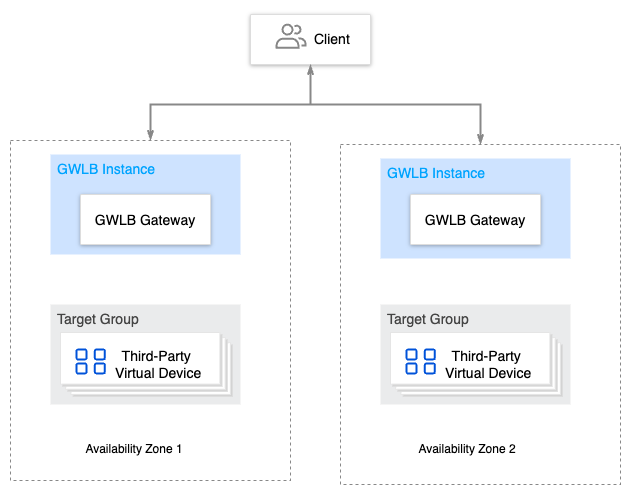
GWLB forwards business traffic and real servers process business requests. GWLB communicates with the backend CVM via the Tencent Cloud private network. The GWLB gateway is deployed on multiple servers and provides load balancing services through clusters. The forwarding path of GWLB is as shown below:
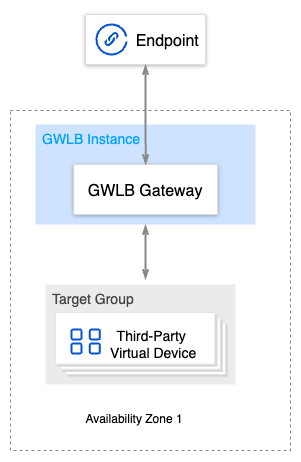
When the GWLB gateway receives data packets from the GWLB endpoint service, GWLB uses the triplet (source IP, destination IP, and transport protocol) of the incoming data packets to select a specified real server as the destination according to the scheduling algorithm.
After GWLB forwards the encapsulated data packets to a specified third-party virtual device, the third-party virtual device should be configured with an IP interface that can receive UDP/IP data packets. All data packets forwarded to the device are routed through this IP interface. The third-party virtual device encapsulates the original data packets with the GENEVE header and embeds the same metadata initially received for this data stream.
After receiving data packets from the third-party virtual device, GWLB will remove the GENEVE encapsulation and then verify, query, and forward the incoming (internal) data packets along with the metadata extracted from GENEVE. If the forwarding query fails, GWLB will discard the incoming data packets.
Finally, the data packets traverse through the underlying PrivateLink technology to the GWLB endpoint service, which then transmits them to the destination based on the next hop in the route table.
フィードバック