With the continuous development of information technology, many retail enterprises use a variety of internal systems for enterprise IT construction. For example, they use ERP, CRM and other business systems to manage information such as commodity and user information, and use OA, finance systems, and other internal systems to provide service support. However, these systems are isolated from each other and difficult to be managed in a unified manner. A midplatform is a perfect solution to the situation.
A midplatform can receive events from different internal systems of an enterprise, enable information sharing within the enterprise, and forward the events to corresponding downstream services for consumption processing, so as to connect more systems together. EventBridge is a secure, stable, and efficient serverless event management platform. It can receive real-time events and related data streams from custom applications, Software-as-a-Service (SaaS) services, and enable quick distribution and real-time consumption of the events by integrating delivery targets such as message push services and Serverless Cloud Function (SCF). EventBridge simplifies the event-driven midplatform architecture design and reduce R&D costs.
Architecture Design
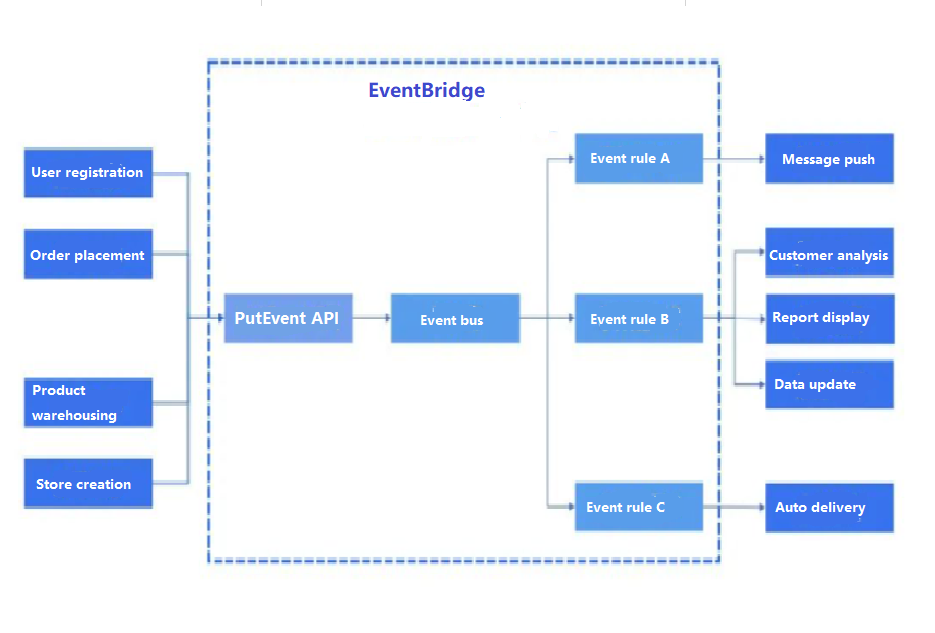
As shown in the figure, taking the retail midplatform as an example, EventBridge provides a unified specification for delivering different types of events (such as user order, commodity warehousing, and order update events) generated by the business side through the EventBridge API. After filtering and extracting events, EventBridge delivers the events to corresponding processing targets according to different routing rules configured, completing the automatic processing of the events. In this scenario, EventBridge implements the basic capabilities of the business midplatform, and the enterprise can also use EventBridge as the underlying architecture for more complex business midplatform building based on the API specifications and routing rules provided by EventBridge, thus simplifying development and reducing costs.
Solution Strengths
Unified event specification
EventBridge provides a unified and standard event specification for complex and diverse service systems to ensure event consistency and facilitate subsequent processing.
Simplified development process
With simple configuration, developers can use the built-in rule matching and event processing features of EventBridge to distribute events from different sources, lowering the development threshold and improving system building efficiency.
Real-time processing of massive data
As a stream data processing pipeline, EventBridge can route data between different data warehouses, between data processing applications, and between data analysis and processing systems, implementing the real-time processing of a massive number of business events.
Rich extensible capabilities
The events processed by EventBridge comply with the same format specification and can be directly pushed to different business systems for consumption and business logic processing. At present, EventBridge has integrated SCF, which allows you to develop data processing logic through any programming language based on functions to connect different systems and services.
Directions
Step 1: Bind event sources
EventBridge currently supports three types of event sources:
Tencent Cloud services
Events generated by Tencent Cloud services, such as monitoring alarm events and cloud operation auditing events, are delivered to the Tencent Cloud service event bus by default by the business side. This default event bus cannot be modified or deleted. To view the Tencent Cloud service events currently supported, go to the details page of the Tencent Cloud service event bus in the EventBridge console.
SaaS services
Currently, the Queqiao iPaaS enterprise application platform has been connected to EventBridge, and the events generated by all the over 50 SaaS applications supported by Queqiao iPaaS can be delivered to EventBridge.
Custom services
In addition to default event sources, EventBridge supports custom event sources. You can configure to use message queue messages such as CKafka and TDMQ to deliver events generated by the business side by using API gateway URL callbacks or direct API calls.
For the retail midplatform architecture, events generated by the business platform are custom events and they can be delivered to EventBridge via API calls or callbacks. For operation details, see here.
Step 2: Configure routing rules
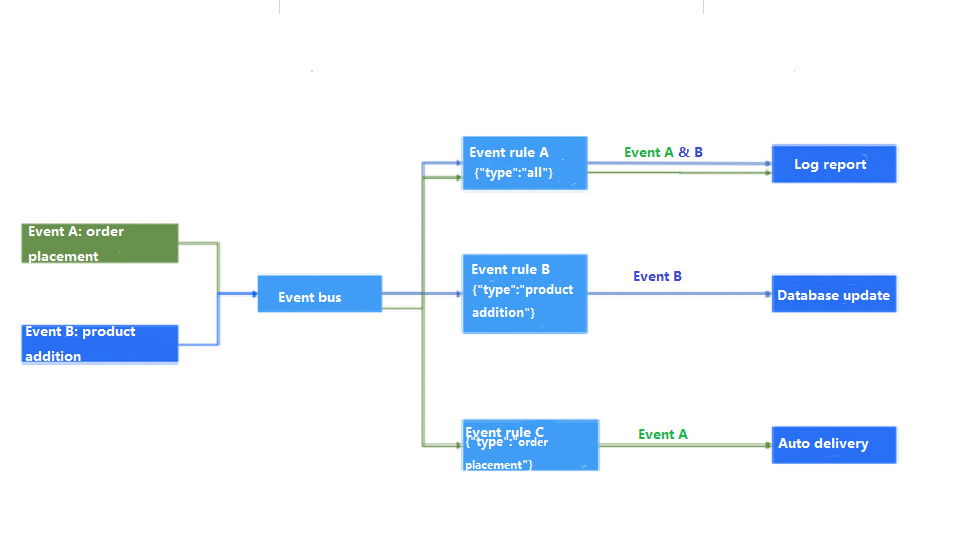
How to classify the events collected from different business sources is another concern of a midplatform system. This problem can be effectively solved by EventBridge's rule filtering capability. Based on EventBridge's standard event format, developers can customize different field matching rules to filter different events and perform simple event analysis and conversion to achieve efficient classification and processing of massive amount of data. For how to configure routing rules, see here.
Step 3: Bind delivery targets
After configuring routing rules are configured, the business side can deliver different events to specified downstream platforms for consumption based on the corresponding business logic. The event targets currently supported by EventBridge include SCF and CKafka.