Message Lifecycle
Download
포커스 모드
폰트 크기
When a general message is sent to a general message queue, its initial status is Active. After it is fetched out, its status will become Inactive within the time period specified by
VisibilityTimeout. If the message is not deleted after the period specified by VisibilityTimeout elapses, its status will become Active again; otherwise, its status will become Deleted. The maximum retention period of the message is subject to the MessageRetentionPeriod attribute value specified when the queue is created. After this period elapses, the message will become Expired and be repossessed.Consumers can read Active messages only, which ensures that a message will not be repeatedly consumed simultaneously but can be repeatedly consumed sequentially.
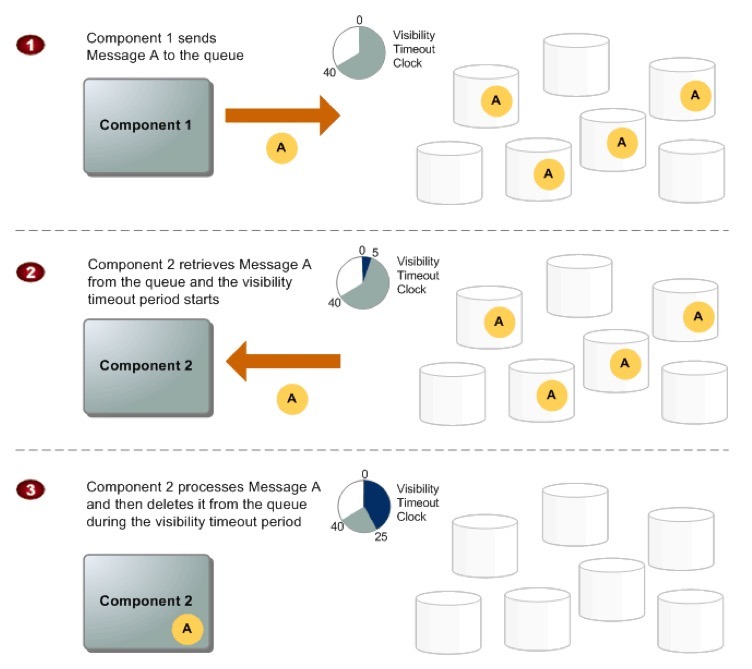
Component 1 sends message A, which has multiple redundancies across TDMQ for CMQ servers, to a queue.
After getting ready to process messages, component 2 will retrieve messages from the queue, and message A will be returned. When being processed, message A still stays in the queue. Within the hidden duration of fetched messages, other businesses cannot get message A.
Component 2 can delete message A from the queue to avoid receiving and processing it again after the hidden duration of fetched messages elapses. It can also retain message A so that other businesses can consume message A repeatedly.
피드백