tencent cloud

TencentDB for SQL Server

Release Notes and Announcements
Release Notes
Product Announcements
User Guide
Product Introduction
Overview
Product Architecture
Strengths
Use Cases
Regions and AZs
Major Version Lifecycle Explanation
Features and Differences
Instance Types
Instance Specifications
Storage Types
Common Concepts
Network Environment
License Statement
Purchase Guide
Billing Overview
Product Pricing
Purchase Methods
Renewal Instructions
Payment Overdue
Refund
From Pay-as-You-Go to Monthly Subscription
Instance Adjustment Fees Description
Local Backup Space Billing
Cross-Region Backup Billing
Viewing Bill Details
Getting Started
Creating TencentDB for SQL Server Instance
Connecting to TencentDB for SQL Server Instance
Managing TencentDB for SQL Server Instance
Operation Guide
Constraints and Limits
Usage Specifications and Suggestions
Maintaining Instance
Adjusting Instance Configuration
Read-Only Instance
Network and Security
Account Management
Database Management
Data Security
Parameter Configuration
Monitoring and Alarms
Backup and Restoration 
Log Management
Publish-Subscribe
SSIS
Data Migration (New)
Data Migration (Legacy)
Data Synchronization (DTS) 
Practical Tutorial
TencentDB for SQL Server Methods for Regular Maintenance
TencentDB for SQL Server Optimization of Slow SQL
How to Better Use Tempdb
Cross-Account Backup Restoration
Creating VPC for TencentDB for SQL Server
Connecting Kingdee K/3 WISE to TencentDB for SQL Server
Account Permissions and Permission Control
Enabling and Disabling the CDC Feature
Shrinking a Database
API Documentation
History
Introduction
API Category
Making API Requests
Sales and fee related APIs
Instance Management related APIs
Operation and maintenance management related APIs
Network management related APIs
Account management related APIs
Database management related APIs
Security group management related APIs
Data security encryption related APIs
Parameter configuration related APIs
Extended Event related APIs
Log management related APIs
Read only instance management related APIs
Publish and subscribe related APIs
Backup related APIs
Rollback related APIs
Data migration (cold standby migration) related APIs
SQL Server Integration Services (SSIS) related APIs
Data migration (DTS old version) related APIs
Data Types
Error Codes
FAQs
Overview
Model Selection
Pricing and Selection
Connection and Network
Account and Permission
Backup and Rollback
Data Migration
Publish/Subscribe
Read-Only Instance
Version and Architecture Upgrade
Disk Space and Specification Adjustment
Monitoring and Alarms
Log-Related
Parameter Modification
Features
Performance, Space, and Memory-Related FAQs
Service Agreement
Service Level Agreement
Terms of Service
Performance Evaluation
Performance Test Report
Glossary
Contact Us

Configure Backup Task

PDF
포커스 모드
폰트 크기
마지막 업데이트 시간: 2026-01-27 16:16:42
TencentDB for SQL Server supports configuring backup tasks (setting backup file format, backup task execution options). This document describes how to configure backup tasks through the console.

Supported Versions

Currently, only instances with database versions 2017/2019/2022 Enterprise and dual-node instance architectures are supported for backup task configuration.

Operation Steps

1. Log in to the SQL Server console.
2. Select a region above, locate the target instance, click Instance ID or Manage in the Operation column to go to the instance management page.

3. On the Instance Management page, select the Backup Management page, choose More > Backup Task Settings.

4. Complete the following configurations in the pop-up dialog box and click OK.
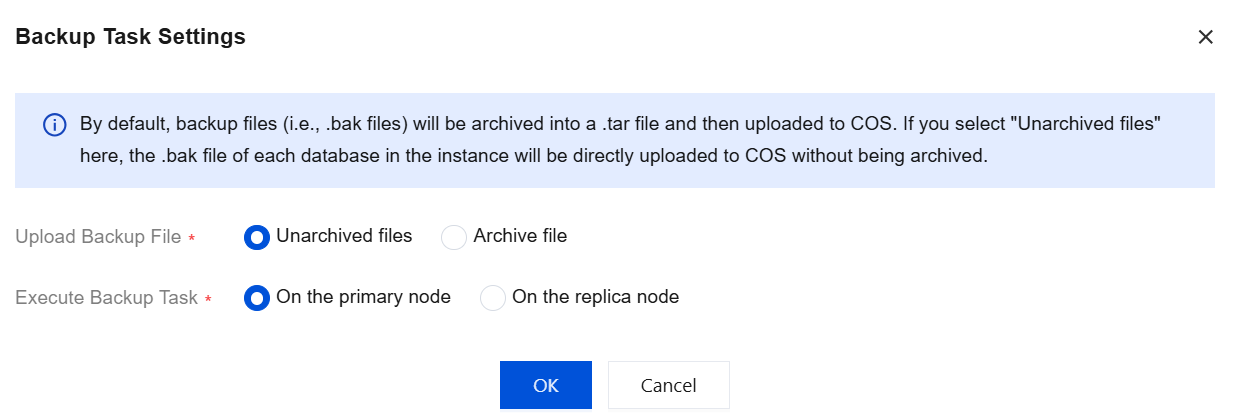
Parameter
Description
Upload Backup File
Select the backup file format.
Unarchived files: an unpacked .bak file for each database in the instance.
Archive file: a file containing all databases (non-system) in the instance after archiving.
Execution Backup Task
Select the execution instance for the backup task. By default, the backup task is performed on the primary node.
On the primary node.
On the replica node.

Related APIs

API
Description
This API (DescribeBackupFiles) is used to query single-database backup details.

도움말 및 지원

문제 해결에 도움이 되었나요?

피드백