tencent cloud

Cloud Access Management

Product Introduction
CAM Overview
Features
Scenarios
Basic Concepts
Use Limits
User Types
Purchase Guide
Getting Started
Creating Admin User
Creating and Authorizing Sub-account
Logging In to Console with Sub-account
User Guide
Overview
Users
Access Key
User Groups
Role
Identity Provider
Policies
Permissions Boundary
Troubleshooting
Downloading Security Analysis Report
CAM-Enabled Role
Overview
Compute
Container
Microservice
Essential Storage Service
Data Process and Analysis
Data Migration
Relational Database
Enterprise Distributed DBMS
NoSQL Database
Database SaaS Tool
Database SaaS Service
Networking
CDN and Acceleration
Network Security
Data Security
Application Security
Domains & Websites
Big Data
Middleware
Interactive Video Services
Real-Time Interaction
Media On-Demand
Media Process Services
Media Process
Cloud Real-time Rendering
Game Services
Cloud Resource Management
Management and Audit Tools
Developer Tools
Monitor and Operation
More
CAM-Enabled API
Overview
Compute
Edge Computing
Container
Distributed cloud
Microservice
Serverless
Essential Storage Service
Data Process and Analysis
Data Migration
Relational Database
Enterprise Distributed DBMS
NoSQL Database
Database SaaS Tool
Networking
CDN and Acceleration
Network Security
Endpoint Security
Data Security
Business Security
Application Security
Domains & Websites
Office Collaboration
Big Data
Voice Technology
Image Creation
Tencent Big Model
AI Platform Service
Natural Language Processing
Optical Character Recognition
Middleware
Communication
Interactive Video Services
Real-Time Interaction
Stream Services
Media On-Demand
Media Process Services
Media Process
Cloud Real-time Rendering
Game Services
Education Sevices
Medical Services
Cloud Resource Management
Management and Audit Tools
Developer Tools
Monitor and Operation
More
Use Cases
Security Practical Tutorial
Multi-Identity Personnel Permission Management
Authorizing Certain Operations by Tag
Supporting Isolated Resource Access for Employees
Enterprise Multi-Account Permissions Management
Reviewing Employee Operation Records on Tencent Cloud
Implementing Attribute-Based Access Control for Employee Resource Permissions Management
During tag-based authentication, only tag key matching is supported
Business Use Cases
TencentDB for MySQL
CLB
CMQ
COS
CVM
VPC
VOD
Others
API Documentation
History
Introduction
API Category
Making API Requests
User APIs
Policy APIs
Role APIs
Identity Provider APIs
Data Types
Error Codes
FAQs
Role
Key
Others
CAM Users and Permissions
Glossary

Creating Custom Policy

PDF
포커스 모드
폰트 크기
마지막 업데이트 시간: 2024-09-29 16:19:22

Overview

This document describes how to create a custom policy in different ways. A custom policy allows granular permission division and can flexibly meet your differentiated permission management needs.

Directions

Creating by policy generator

With a policy created by the policy generator, you can create policy syntax automatically by selecting services and actions (operations) and defining resources. This method is highly recommended for its simplicity and flexibility.
1. On the Policy page in the CAM console, click Create Custom Policy in the top-left corner.
2. In the selection window that pops up, click Create by Policy Generator to enter the Edit Policy page.
3. Select the service in the Visual Policy Generator, enter the following information, and edit an authorization statement. (You can also choose JSON to use the policy syntax method to edit the policy, and the authorization effect is the same as the Visual Policy Generator).
Effect (required): select Allow or Deny.
Service (required): select the service you want to authorize.
Action (required): select the operations you want to authorize.
Resource (required): select all resources or specific resources you want to authorize. Tencent Cloud products with operation-level or service-level authorization granularity do not support six-segment resource descriptions. For such products, simply select all resources. For Tencent Cloud products with resource-level authorization granularity, you can select specific resources. For more information on the resource description method, please see the corresponding CAM Guide in CAM-Enabled Products. For more information on the authorization granularities of Tencent Cloud products, please see the Authorization Granularity section in CAM-Enabled Products.
Condition (optional): set the conditions that must be met for the authorization to take effect. For more information, please see Condition.
Note:
If you want to authorize multiple services, you can click Add Permission to add multiple authorization statements and configure authorization policies for other services.
Multiple statements can be added in one policy.
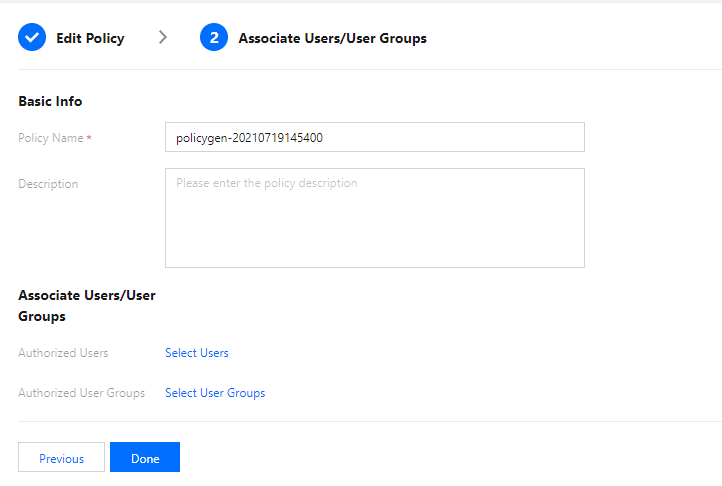
4. After editing the policy authorization statement, click Next to enter the Associate with User/User Group page.
5. On the Associate with User/User Group page, add the policy name and description, and you can associate users or user groups for quick authorization at the same time.
Note:
The policy name is automatically generated by the console and is policygen suffixed with the creation time by default, which is customizable.
6. Click Done to complete the custom policy creation.


도움말 및 지원

문제 해결에 도움이 되었나요?

피드백