tencent cloud

Tencent Cloud Observability Platform

Release Notes and Announcements
Release Notes
Product Introduction
Overview
Strengths
Basic Features
Basic Concepts
Use Cases
Use Limits
Purchase Guide
Tencent Cloud Product Monitoring
Application Performance Management
Mobile App Performance Monitoring
Real User Monitoring
Cloud Automated Testing
Prometheus Monitoring
Grafana
EventBridge
PTS
Quick Start
Monitoring Overview
Instance Group
Tencent Cloud Product Monitoring
Application Performance Management
Real User Monitoring
Cloud Automated Testing
Performance Testing Service
Prometheus Getting Started
Grafana
Dashboard Creation
EventBridge
Alarm Service
Cloud Product Monitoring
Tencent Cloud Service Metrics
Operation Guide
CVM Agents
Cloud Product Monitoring Integration with Grafana
Troubleshooting
Practical Tutorial
Application Performance Management
Product Introduction
Access Guide
Operation Guide
Practical Tutorial
Parameter Information
FAQs
Mobile App Performance Monitoring
Overview
Operation Guide
Access Guide
Practical Tutorial
Tencent Cloud Real User Monitoring
Product Introduction
Operation Guide
Connection Guide
FAQs
Cloud Automated Testing
Product Introduction
Operation Guide
FAQs
Performance Testing Service
Overview
Operation Guide
Practice Tutorial
JavaScript API List
FAQs
Prometheus Monitoring
Product Introduction
Access Guide
Operation Guide
Practical Tutorial
Terraform
FAQs
Grafana
Product Introduction
Operation Guide
Guide on Grafana Common Features
FAQs
Dashboard
Overview
Operation Guide
Alarm Management
Console Operation Guide
Troubleshooting
FAQs
EventBridge
Product Introduction
Operation Guide
Practical Tutorial
FAQs
Report Management
FAQs
General
Alarm Service
Concepts
Monitoring Charts
CVM Agents
Dynamic Alarm Threshold
CM Connection to Grafana
Documentation Guide
Related Agreements
Application Performance Management Service Level Agreement
APM Privacy Policy
APM Data Processing And Security Agreement
RUM Service Level Agreement
Mobile Performance Monitoring Service Level Agreement
Cloud Automated Testing Service Level Agreement
Prometheus Service Level Agreement
TCMG Service Level Agreements
PTS Service Level Agreement
PTS Use Limits
Cloud Monitor Service Level Agreement
API Documentation
History
Introduction
API Category
Making API Requests
Monitoring Data Query APIs
Alarm APIs
Legacy Alert APIs
Notification Template APIs
TMP APIs
Grafana Service APIs
Event Center APIs
TencentCloud Managed Service for Prometheus APIs
Monitoring APIs
Data Types
Error Codes
Glossary

SCF Target

PDF
Modo Foco
Tamanho da Fonte
Última atualização: 2024-11-01 21:00:14
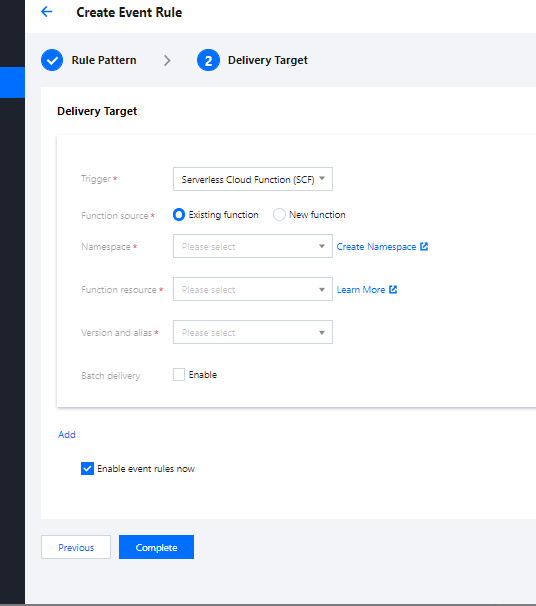
By using an event rule, you can deliver collected events to the specified delivery target for processing and consumption. Currently, EventBridge allows you to set Serverless Cloud Function (SCF) as a delivery target and provides multiple preconfigured templates to help you deliver events.
Note:
By default, the number of events delivered to a target cannot exceed 2,000 per day.

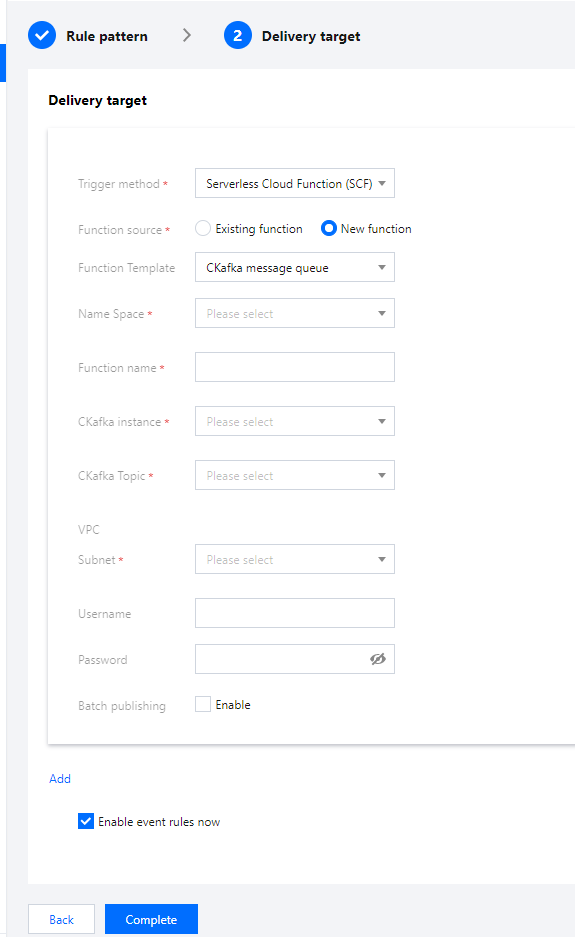
Template Function-based Delivery

You can select a function template, so that EventBridge will create a target function for event delivery for you based on the template. Currently, CKafka function templates are available. To select and configure templates, choose Event rule > Delivery target.
Note:
If your target CKafka instance has a username and password, please ensure that the entered information is correct; otherwise, event delivery may fail.


Custom Function Delivery

In addition to using templates, you can deliver events to your created custom functions to implement more business logic.


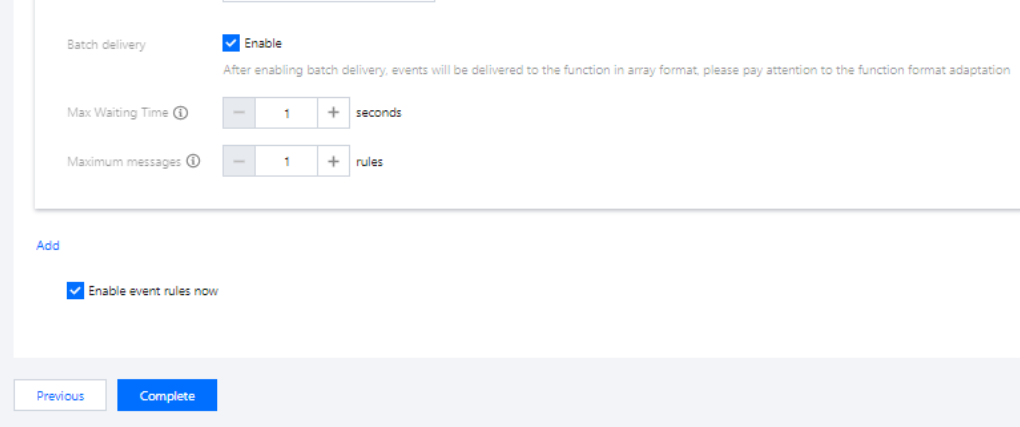
Enabling Batch Delivery

EventBridge supports batch delivery to SCF. You can specify the parameters of batch delivery as needed.


Batch delivery parameter description:
Maximum waiting time: The maximum waiting time for each function trigger. Value range: 0–60s. Default value: 0.
Maximum messages: The maximum number of messages that can be pulled and batch delivered to the current function at a time, which can be up to 10,000 currently. Depending on the message size and writing speed, the number of messages delivered when the function is triggered each time may not always reach the maximum number; instead, it is a variable value between 1 and the maximum number.
Note
After the batch delivery feature is enabled, events will be delivered together as an array. Ensure that the event consumer is compatible with such format.
Event format with batch delivery disabled
Event format with batch delivery enabled
{
"specversion": "1.0.2",
"id": "13a3f42d-7258-4ada-da6d-023a333b4662",
"type": "connector:apigw",
"source": "apigw.cloud.tencent",
"subject": "qcs::apigw:ap-guangzhou:uid1250000000/appidxxx:Serverid/Appid",
"time": "1615430559146",
"region": "ap-guangzhou",
"datacontenttype": "application/json;charset=utf-8",
"data":{
$data_value
}
}

{
"EventList":[
{
"specversion": "1.0.2",
"id": "13a3f42d-7258-4ada-da6d-023a333b4662",
"type": "connector:apigw",
"source": "apigw.cloud.tencent",
"subject": "qcs::apigw:ap-guangzhou:uid1250000000/appidxxx:Serverid/Appid",
"time": "1615430559146",
"region": "ap-guangzhou",
"datacontenttype": "application/json;charset=utf-8",
"data":{
$data_value
}
},
{
"specversion": "1.0.2",
"id": "13a3f42d-7258-4ada-da6d-023a333b4662",
"type": "connector:apigw",
"source": "apigw.cloud.tencent",
"subject": "qcs::apigw:ap-guangzhou:uid1250000000/appidxxx:Serverid/Appid",
"time": "1615430559146",
"region": "ap-guangzhou",
"datacontenttype": "application/json;charset=utf-8",
"data":{
$data_value
}
}
]
}


Ajuda e Suporte

Esta página foi útil?

comentários