Metric Description of the kube-apiserver Component
Download
Mode fokus
Ukuran font
Prerequisites
Metric List
Feature Category | Metric | Type | Description |
Request overview | apiserver_request_duration_seconds_bucket | Histogram | Statistics on the latency distribution of requests from clients to API Server. Requests are classified based on the following dimensions: Verb: Type of a request, such as GET, POST, PUT, and DELETE. Group: API group, which is a collection of relevant APIs for extending Kubernetes APIs. Version: API version, such as v1 and v1beta1. Resource: Type of the resource a request is sent to access, such as Pod, Service, and Lease. Subresource: Subresources of a resource, such as Pod details and Pod logs. Scope: Scope of a request, such as Namespace-scope (access resources at the namespace level) or Cluster-scope (access resources at the cluster level). Component: Name of the component that initiates a request, such as kube-controller-manager, kube-scheduler, and cloud-controller-manager. Client: Client that initiates a request, which might be an internal component or external service. The bucket thresholds in the histogram of API Server are defined as the set {0.05, 0.1, 0.15, 0.2, 0.25, 0.3, 0.35, 0.4, 0.45, 0.5, 0.6, 0.7, 0.8, 0.9, 1.0, 1.25, 1.5, 1.75, 2.0, 2.5, 3.0, 3.5, 4.0, 4.5, 5, 6, 7, 8, 9, 10, 15, 20, 25, 30, 40, 50, 60}. Unit: seconds. |
Request overview | apiserver_request_total | Counter | Number of different requests received by API Server. Requests are classified based on Verb, Group, Version, Resource, Scope, Component, HTTP contentType, HTTP code (HTTP status code in the response) and Client. |
Resource request | apiserver_request_count | Counter | Total number of requests received by API Server. |
Resource analysis | apiserver_storage_objects | Gauge | Number of resource objects. |
Request overview | apiserver_watch_events_total | Counter | Total number of resource objects. They are classified based on resource types, such as nodes and pods. |
Request overview | apiserver_current_inflight_requests | Gauge | Number of requests currently being processed by API Server. Requests are classified into the following types: ReadOnly: Such requests will not change the cluster status. They are typically operations for accessing resources, such as obtaining the Pod list and querying the node status. Mutating: Such requests will change the cluster status. They are typically operations for creating, updating, or deleting resources, such as creating a Pod and updating Service configurations. |
Resource analysis | pod_core_usage | Gauge | CPU usage. Unit: %. |
Resource analysis | pod_mem_usage | Gauge | Memory usage. Unit: %. |
Resource analysis | container_network_receive_bytes_total | Counter | Network inbound traffic. Unit: bytes. Note: The original metric k8s_pod_network_receive_bytes_bw is charged. Map the metric name to use the free metric. |
Resource analysis | container_network_transmit_packets_total | Counter | Network outbound traffic. Unit: bytes. Note: The original metric k8s_pod_network_transmit_bytes_bw is charged. Map the metric name to use the free metric. |
Resource Analysis
Monitoring Metric Display
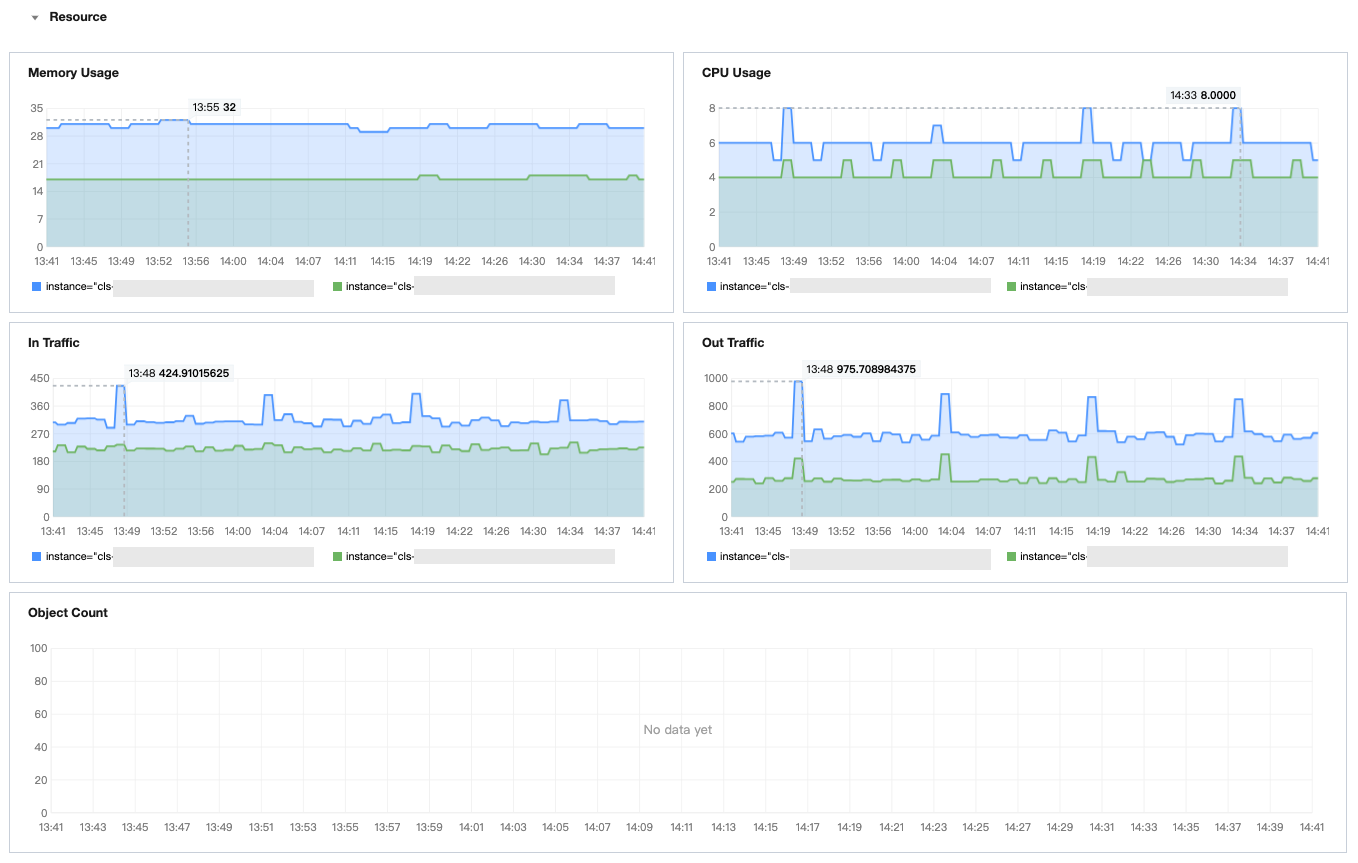
Feature Description
Metric Display Name | Metric | Used Metric | Metric Description |
Memory Usage | Memory usage | pod_mem_usage | Memory usage of API Server. Unit: %. |
Cpu Usage | CPU usage | pod_core_usage | CPU usage of API Server. Unit: %. |
In Traffic | Inbound traffic | container_network_receive_bytes_total | Network inbound traffic of API Server. Unit: bytes/s. |
Out Traffic | Outbound traffic | container_network_transmit_packets_total | Network outbound traffic of API Server. Unit: bytes/s. |
Object Count | Number of etcd resource objects | apiserver_storage_objects | Number of resource objects. |
Request Overview
Monitoring Metric Display
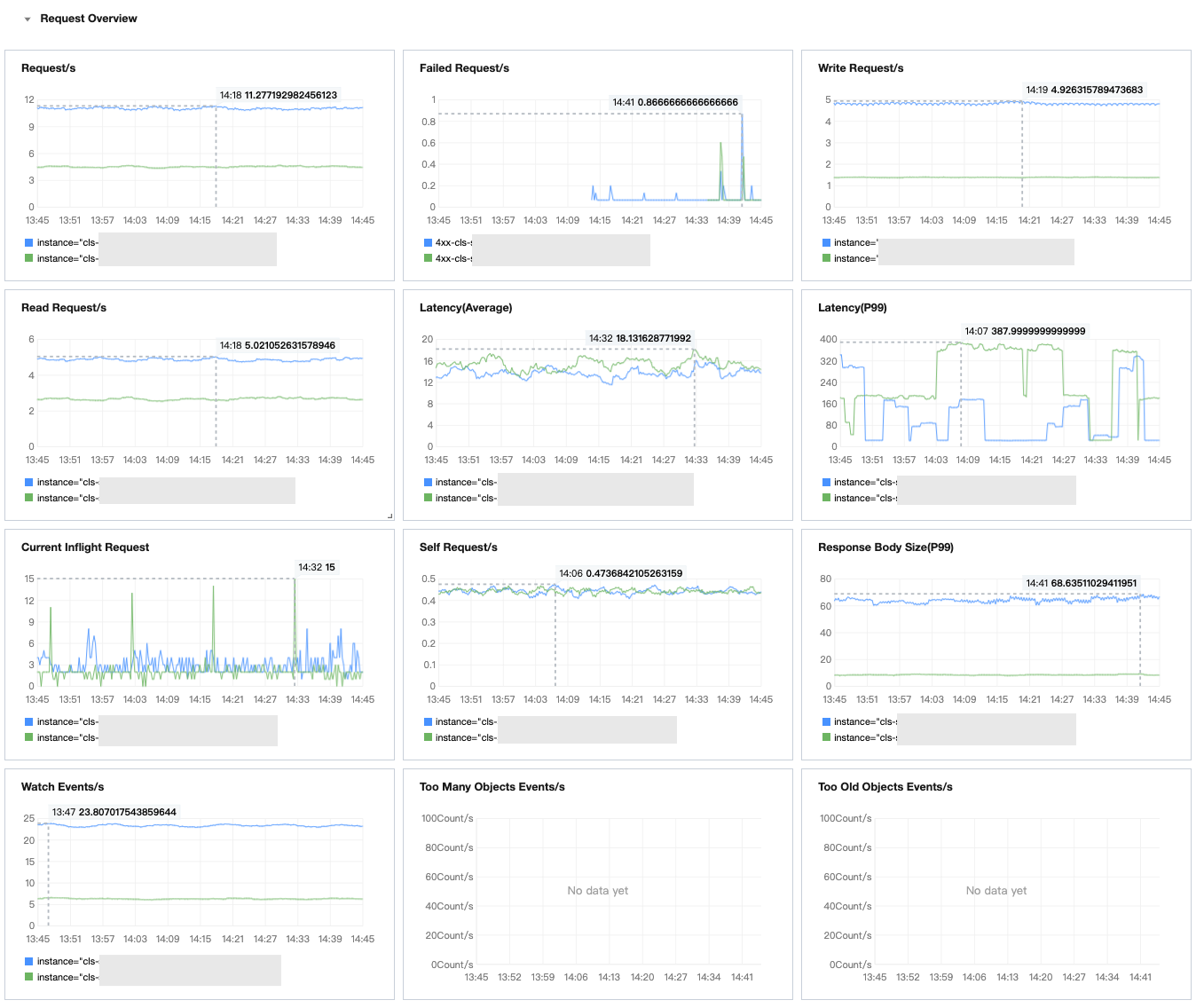
Feature Description
Metric Display Name | Metric | Used Metric | Metric Description |
Request/s | Total number of requests processed by API Server per second | apiserver_request_count apiserver_request_total | Total number of requests processed by API Server per second. Unit: req/s. |
Failed Request/s | Number of requests with a response failure by API Server per second | apiserver_request_count apiserver_request_total | Number of requests with a response failure by API Server per second. Unit: req/s. |
Write Request/s | Number of write requests processed by API Server per second | apiserver_request_count apiserver_request_total | Number of write requests processed by API Server per second. Unit: req/s. |
Read Request/s | Number of read requests processed by API Server per second | apiserver_request_count apiserver_request_total | Number of read requests processed by API Server per second. Unit: req/s. |
Latency(Average) | Average API Server access latency | apiserver_request_latencies_summary_sum apiserver_request_latencies_summary_count | Average API Server access latency. Unit: ms. |
Latency(P99) | API Server request P99 latency | apiserver_request_duration_seconds_bucket | Statistics on the latency distribution of requests from clients to API Server. Unit: ms. |
Current Inflight Request | Number of requests being processed by API Server | apiserver_current_inflight_requests | Number of requests currently being processed by API Server. |
Self Request/s | API Server self-request QPS | apiserver_selfrequest_total | API Server self-request QPS. |
Response Body Size(P99) | P99 response package size of API Server | apiserver_response_sizes_bucket | P99 distribution of API Server response package sizes. Unit: bytes. |
Watch Events/s | QPS of API Server watch event push | apiserver_watch_events_total | Total number of resource objects. The objects are classified by resource type, such as nodes and pods. Unit: count/s. |
Too Many Objects Events/s | list_too_many_objects_events_total | list_too_many_objects_events_total | Number of list_too_many_objects events. Unit: count/s. |
Too Old Objects Events/s | watch_too_old_objects_events_total | watch_too_old_objects_events_total | Number of watch_too_old_objects events. Unit: count/s. |
Resource Request
Monitoring Metric Display
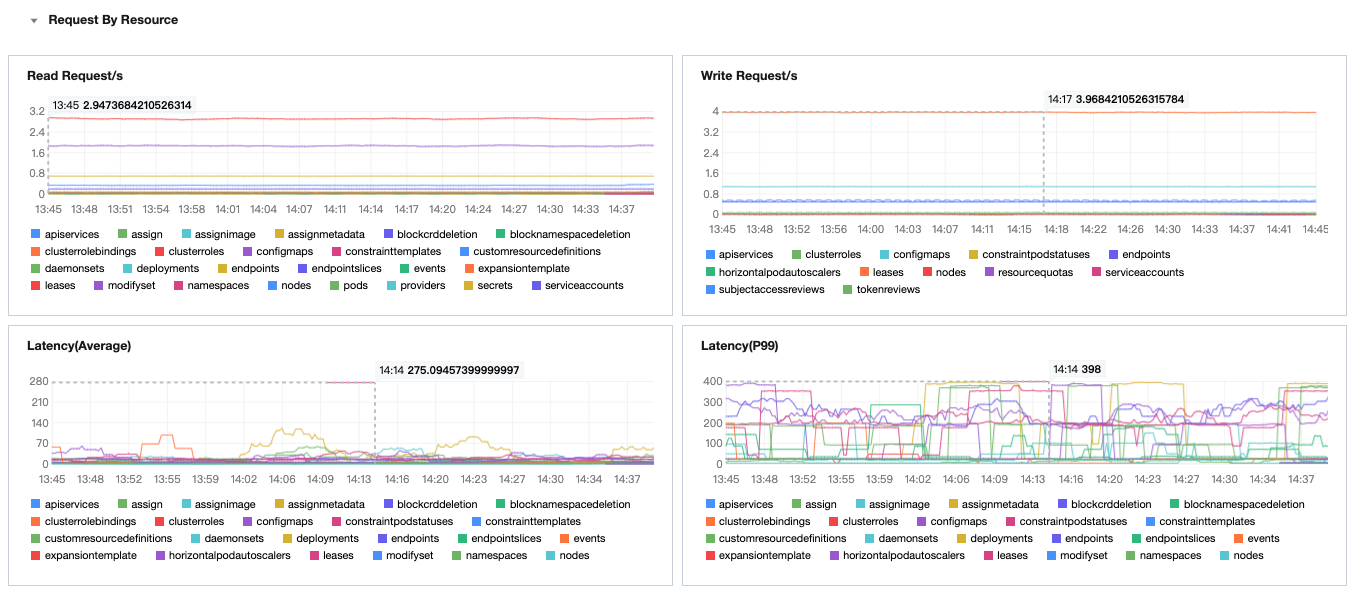
Feature Description
Metric Display Name | Metric | Used Metric | Metric Description |
Read Request/s | Number of read requests processed by API Server per second | apiserver_request_count apiserver_request_total | Number of read requests processed by API Server per second (classified by resource). Unit: req/s. |
Write Request/s | Number of write requests processed by API Server per second | apiserver_request_count apiserver_request_total | Number of write requests processed by API Server per second (classified by resource). Unit: req/s. |
Latency(Average) | Average API Server access latency | apiserver_request_duration_seconds_sum apiserver_request_duration_seconds_count | Average API Server access latency (classified by resource). Unit: ms. |
Latency(P99) | API Server request P99 latency | apiserver_request_duration_seconds_bucket | API Server request P99 latency (classified by resource). Unit: ms. |
Bantuan dan Dukungan
Apakah halaman ini membantu?
Anda juga dapat Menghubungi Penjualan atau Mengirimkan Tiket untuk meminta bantuan.
masukan