tencent cloud

TencentDB for MariaDB

Release Notes and Announcements
Release Notes
Announcements
Product Introduction
Overview
Strengths
Use Cases
System Architecture
Instance Types
Instance Architecture
TDSQL Edition
Database Version
Purchase Guide
Billing Overview
Pricing
Refund
Payment Overdue
Upgrade Pricing
Backup Space Billing
Getting Started
Creating Instance
Managing Account
Accessing Instance
Operation Guide
Precautions
Instance Management
Disaster Recovery Read-Only Instance
Account Management
Read/Write Separation
Changing Networks
Backup and Rollback
Migrating Data
Database Sync(Legacy)
Security Management
Monitoring and Alarms
Killing Threads
Parameter Templates and Settings
Database Audit
Practical Tutorial
Programming and Usage Specification
Programming and Usage Specification of Distributed Version
Using Hotspot Update for Flash Sales
Security White Paper
Platform Security Features
Tenant Security Features
Development Guide
Functional Limitations
Performance Test
Intra-city Active-Active Solution
Binlog Consumption Format
Slow Query Analysis
Database Audit
Syntax Supported
API Documentation
History
Introduction
API Category
Making API Requests
Security Group APIs
Other APIs
Account APIs
Parameter Management APIs
Monitoring Management APIs
Instance Management APIs
Backup and Restoration APIs
Data Types
Error Codes
FAQs
Product
Account Login
Features
Performance
Backup
Ops
Disk Overuse
IO Metric Exception
General References
Standards and Certification
Main Specification Performance Description
Performance Comparison Data for Strong Sync
Glossary

Rolling back Databases

PDF
フォーカスモード
フォントサイズ
最終更新日: 2024-01-11 15:28:38

Rollback description

TencentDB for MariaDB can roll back data to any time point in the last 30 days based on the retention of backups and logs. With the database rollback feature, system loss can be minimized. This rollback feature doesn't affect a production instance and can directly roll back data to a newly created pay-as-you-go instance. The new rollback instance is a standard one that can be configured as needed.

Limits

When a temp instance is being rolled back or created, some management features of the production instance are unavailable until the operation is completed.
The binlogs may be forcibly sharded during the rollback operation, and files smaller than 100 MB in size will be backed up separately.
The newly purchased instance after rollback will have the parameter information of the production instance (such as account and database parameters). Therefore, you must pay attention to account management.

Instance rollback

1. Log in to the TencentDB for MariaDB console and click an instance ID to enter the instance management page.
2. On the instance management page, select the Backup and Restoration > Rollback Instance tab and click Create Rollback Instance.

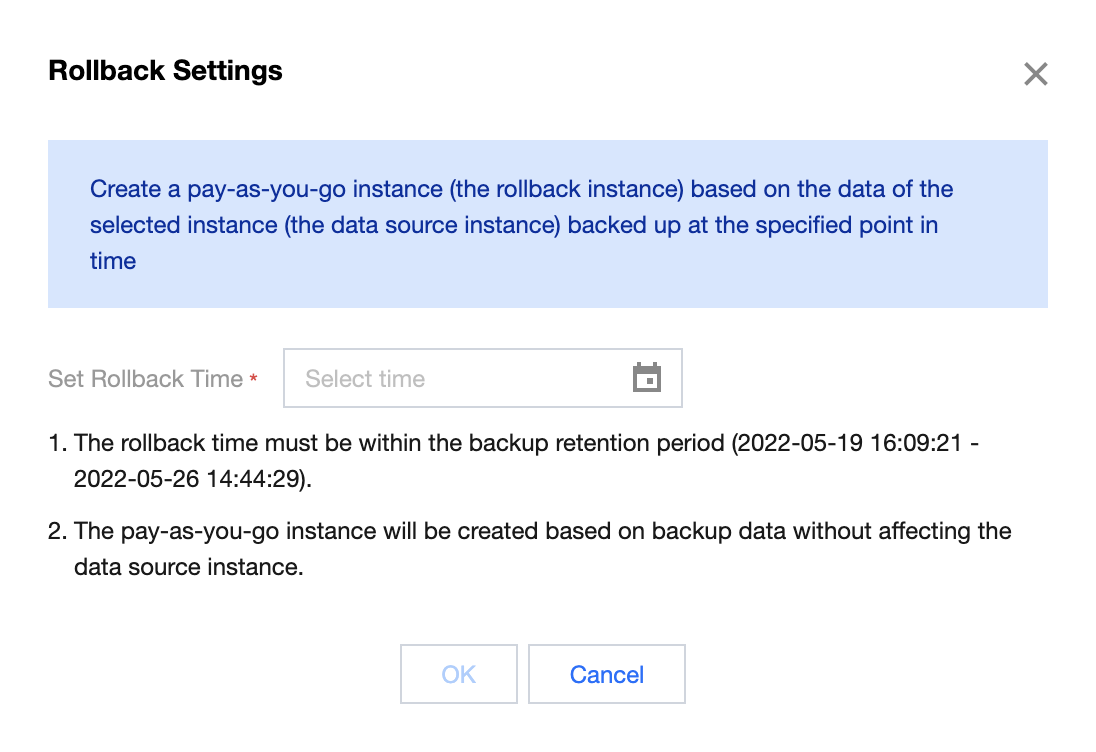
3. In the pop-up window, set the rollback time and click OK.

4. On the instance purchase page, adjust configuration based on your needs, click Buy Now, and wait for instance rollback to be completed.
5. After the rollback is completed, you can view the generated rollback instance on the Backup and Restoration > Rollback Instance page or in the instance list.

ヘルプとサポート

この記事はお役に立ちましたか?

フィードバック