tencent cloud

TencentDB for MongoDB

Release Notes and Announcements
Release Notes
Announcements
User Guide
Product Introduction
Overview
Strengths
Use Cases
Cluster Architecture
Product Specifications
Features
Regions and AZs
Terms
Service Regions and Service Providers
Purchase Guide
Billing Overview
MongoDB Pricing
Billing Formula
Payment Overdue
Backup Space Billing
Configuration Adjustment Billing
Getting Started
Quickly Creating an Instance
Connecting to a TencentDB for MongoDB Instance
Reading/Writing Database
Operation Guide
Access Management
Instance Management
Node Management
Version Upgrade
Network Configuration
Monitoring
Backup and Rollback
Database Audit
Data Security
SSL Authentication
Log Management
Database Management
Multi-AZ Deployment
Disaster Recovery/Read-Only Instances
Parameter Configuration
Recycle Bin
Task Management
Performance Optimization
Data Migration Guide
Practical Tutorial
Optimizing Indexes to Break Through Read/Write Performance Bottlenecks
Troubleshooting Mongos Load Imbalance in Sharded Cluster
Considerations for Using Shard Clusters
Sample of Reading and Writing Data in MongoDB Instance
Methods for Importing and Exporting Data Based on CVM Connected with MongoDB
What to Do for Errors of Repeated Instance Creation and Deletion of Databases with the Same Names?
Troubleshooting MongoDB Connection Failures
Shard Removal Task: Guide for Confirming the Progress and Troubleshooting Issues
Performance Fine-Tuning
Ops and Development Guide
Development Specifications
Command Support in Sharded Cluster v3.2
Command Support in v3.6
Development Ops
Troubleshooting
Increased Slow Queries
Number of Connections Exceeding Limit
API Documentation
History
Introduction
API Category
Making API Requests
Instance APIs
Backup APIs
Account APIs
Other APIs
Task APIs
Introduction
Data Types
Error Codes
Instance Connection
Shell Connection Sample
PHP Connection Sample
Node.js Connection Sample
Java Connection Sample
Python Connection Sample
Python Read/Write Sample
Go Connection Sample
PHP Reconnection Sample
Product Performance
Test Environment
Test Method
Test Result
FAQs
Cost
Features
Sharded Cluster
Instance
Rollback and Backup
Connection
Data Migration
Others
Service Agreement
Service Level Agreement
Terms of Service
Glossary
Contact Us

Description of Consistency Verification Function

PDF
フォーカスモード
フォントサイズ
最終更新日: 2024-10-10 15:28:56

Overview

During data consistency check, DTS compares the collection data between the source and target databases and outputs the comparison result and inconsistency details for you to perform a business cutover stably and reliably.

Notes

1. Data consistency check compares only the objects selected in the source database and objects migrated to the target database. If you write data into the target database during migration, then the written data will not be included in the consistency check.
2. A data consistency check task may increase the load in the source database instance. Therefore, you need to perform such tasks during off-peak hours.
3. A data consistency check task can be executed repeatedly, but one DTS instance can initiate only one such task at any time.
4. If you choose to complete or terminate a DTS task before a data consistency check task is completed, the check task will fail.
5. When creating a consistency check, the system will automatically create the dts_verify_result library on the target end to record content related to the consistency check. The table styles created under the dts_verify_result library are as follows:
diff_5xxxxxxxx4231: Saves inconsistent data detected
diff_meta_5xxxxxxxxx4231: Saves inconsistent metadata detected
result_5xxxxxxxxx4231: Records the results after phase validation
status_5xxxxxxxxx4231: Records validation progress

Restrictions

Currently, check tasks are imperceptible to the DDL operations. If you perform DDL operations in the source database during migration, the check result will be inconsistent with the actual data, and you need to initiate another check task to get the accurate comparison result.

Check Scheme

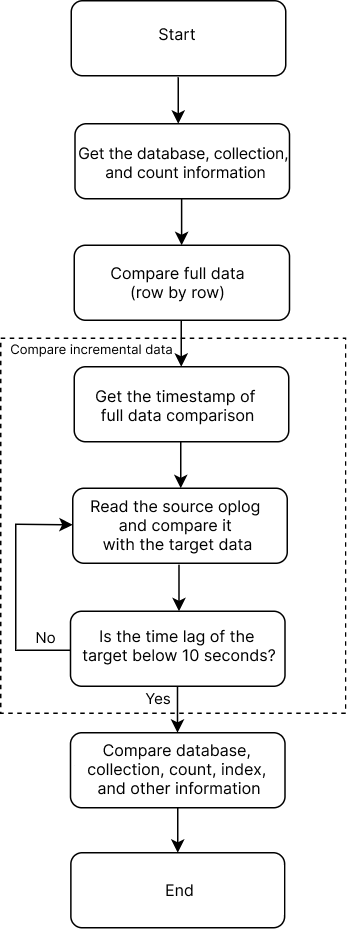
DTS checks and compares all the data migrated during full migration and incremental migration from the source database. A full data check compares the data in the source and target databases row by row. Once the thread of the incremental data check finds that the full data comparison is completed, it immediately starts the incremental data check to get the start timestamp of the full data check, get the incremental oplog in the source database in a loop, and compare the differences between the source and target databases. When the time lag of data in the source and target databases is below 10 seconds, the comparison ends, and the check result is output.


ヘルプとサポート

この記事はお役に立ちましたか?

フィードバック