tencent cloud

Elastic MapReduce

Release Notes and Announcements
Release Notes
Announcements
Security Announcements
Product Introduction
Overview
Strengths
Architecture
Features
Use Cases
Constraints and Limits
Technical Support Scope
Product release
Purchase Guide
EMR on CVM Billing Instructions
EMR on TKE Billing Instructions
EMR Serverless HBase Billing Instructions
Getting Started
EMR on CVM Quick Start
EMR on TKE Quick Start
EMR on CVM Operation Guide
Planning Cluster
Administrative rights
Configuring Cluster
Managing Cluster
Managing Service
Monitoring and Alarms
TCInsight
EMR on TKE Operation Guide
Introduction to EMR on TKE
Configuring Cluster
Cluster Management
Service Management
Monitoring and Ops
Application Analysis
EMR Serverless HBase Operation Guide
EMR Serverless HBase Product Introduction
Quotas and Limits
Planning an Instance
Managing an Instance
Monitoring and Alarms
Development Guide
EMR Development Guide
Hadoop Development Guide
Spark Development Guide
Hbase Development Guide
Phoenix on Hbase Development Guide
Hive Development Guide
Presto Development Guide
Sqoop Development Guide
Hue Development Guide
Oozie Development Guide
Flume Development Guide
Kerberos Development Guide
Knox Development Guide
Alluxio Development Guide
Kylin Development Guide
Livy Development Guide
Kyuubi Development Guide
Zeppelin Development Guide
Hudi Development Guide
Superset Development Guide
Impala Development Guide
Druid Development Guide
TensorFlow Development Guide
Kudu Development Guide
Ranger Development Guide
Kafka Development Guide
Iceberg Development Guide
StarRocks Development Guide
Flink Development Guide
JupyterLab Development Guide
MLflow Development Guide
Practical Tutorial
Practice of EMR on CVM Ops
Data Migration
Practical Tutorial on Custom Scaling
API Documentation
History
Introduction
API Category
Cluster Resource Management APIs
Cluster Services APIs
User Management APIs
Data Inquiry APIs
Scaling APIs
Configuration APIs
Other APIs
Serverless HBase APIs
YARN Resource Scheduling APIs
Making API Requests
Data Types
Error Codes
FAQs
EMR on CVM
Service Level Agreement
Contact Us

Adding Components

PDF
포커스 모드
폰트 크기
마지막 업데이트 시간: 2023-12-27 11:09:22

Feature Description

This document describes how to add components in the EMR console.
Caution
You need to manage the components through Cluster Service. Component changes made directly by logging in to a node (such as adding a component) will not be synced to the console and thus cannot be further managed.
Components on a different EMR version or component version cannot be added. Instead, you can only add components on the current EMR version.

Directions

1. Log in to the EMR console and click the ID/Name of the target cluster in the cluster list to enter the cluster details page.
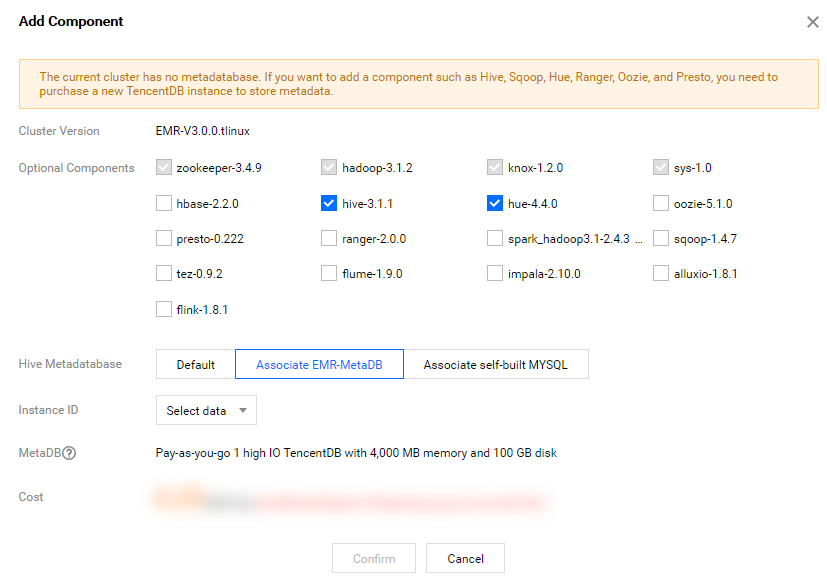
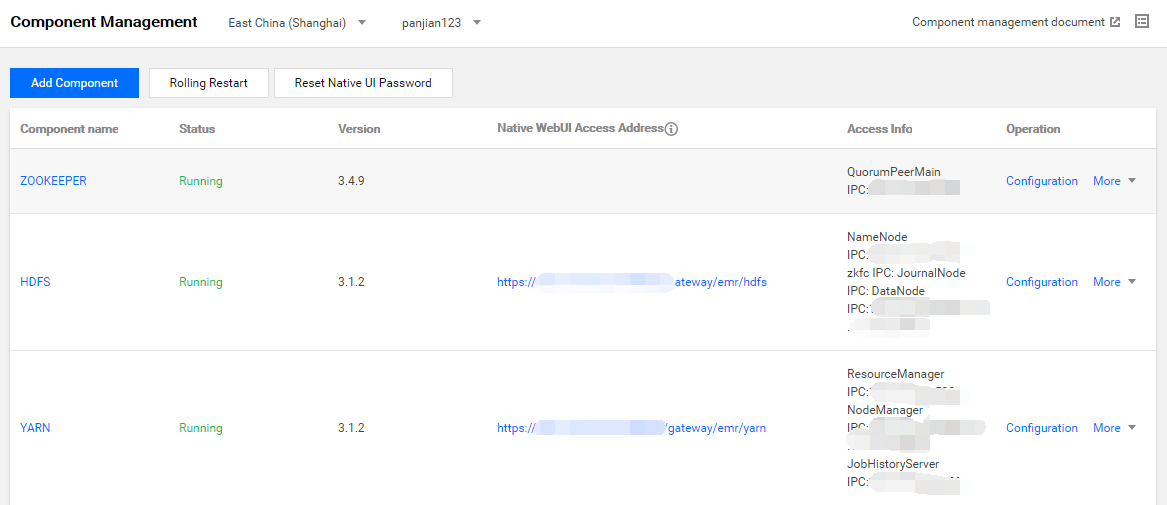
2. On the cluster details page, select Cluster Service > Add Component to add a component not installed in the cluster.


3. If there is no metadatabase in the cluster and Hue, Ranger, Oozie, Druid, and Superset components are to be installed, you need to purchase a TencentDB instance as the metadata store. You cannot add the Kudu component to a non-HA cluster.
4. There are two storage options for Hive metadata: you can store the metadata in the MetaDB (default option) or associate the metadata with EMR-MetaDB or a self-built MySQL database. In the latter case, metadata will be stored in the associated database and will not be deleted when the cluster is terminated.


5. The selection for MetaDB purchase and Hive metadatabase is the same as when you purchase a new cluster.
6. After selecting the component, click OK.

도움말 및 지원

문제 해결에 도움이 되었나요?

피드백