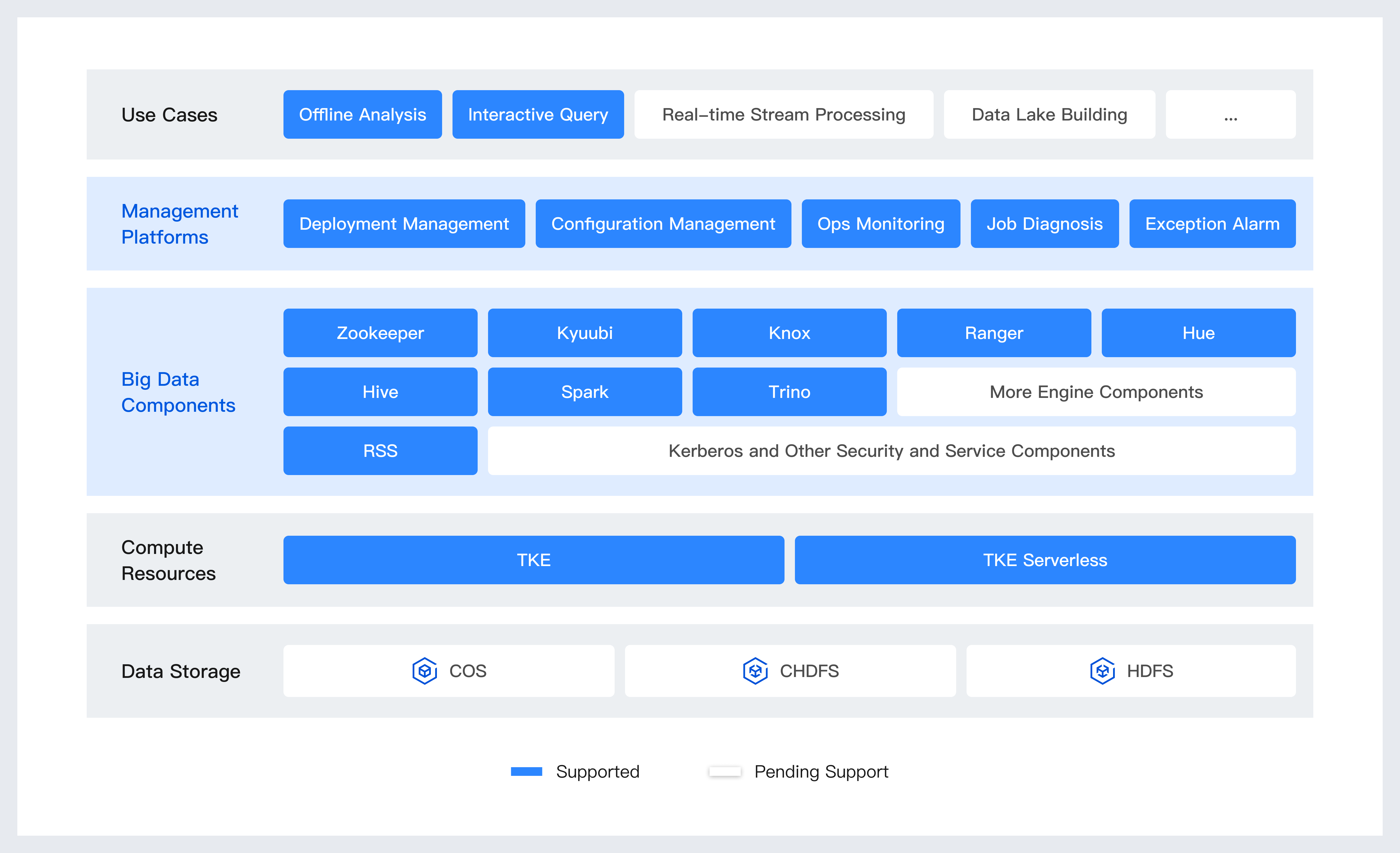
Tencent Cloud EMR on TKE is a big data service deployment platform based on containerized services and open-source big data engines, offering rapid deployment, flexible scaling, and efficient, secure services. Through features like application management in the console, users can focus more on business applications. The service engine includes big data components such as Spark, Hive, and Trino, allowing users to easily run, manage, and scale containerized applications.
Product Architecture
Description
Data storage: In the compute-storage separation scene applicable to EMR on TKE, multiple data storage products such as COS, CHDFS, and HDFS are provided for integration. Users can store data in these sources and perform processing and analysis using the EMR on TKE big data processing engine.
Computing resources: EMR on TKE supports deployment on Tencent Cloud TKE General Clusters and Serverless Clusters.
Big data components: EMR on TKE provides optional services including Hive, Spark, Trino, Zookeeper, Kyuubi, Knox, Ranger, Hue, and RSS.
Management platform: EMR on TKE provides a user-friendly interface through the EMR console for easy component deployment, configuration management, Ops monitoring, and exception alerts. It also offers advanced job analysis and diagnostics to help users gain insights into job costs.
Product Advantages
1. High resource utilization: EMR on TKE container services can automatically scale the number of cluster containers up or down based on preset policies, ensuring stable service operation while saving on resource costs. Flexible application resource configuration in offline scenes effectively improves resource utilization and optimizes costs.
2. Stability and reliability: EMR on TKE relies on the high-reliability features of TKE clusters, such as container self-check and self-healing. When a service pod node fails, the pod is automatically rebuilt, and the image is reloaded.
3. Simplified deployment: EMR on TKE can start a complete multi-service cluster in just a few minutes. Additionally, it allows users to easily and quickly adjust the number of service pods through console operations.
4. Granular security: EMR on TKE integrates with CAM to implement cluster access control. It also connects with COS using minimized storage permissions to achieve refined permission management in compute-storage separation scenes, ensuring the security of data access at the cluster usage level.