tencent cloud

Elastic MapReduce

Release Notes and Announcements
Release Notes
Announcements
Security Announcements
Product Introduction
Overview
Strengths
Architecture
Features
Use Cases
Constraints and Limits
Technical Support Scope
Product release
Purchase Guide
EMR on CVM Billing Instructions
EMR on TKE Billing Instructions
EMR Serverless HBase Billing Instructions
Getting Started
EMR on CVM Quick Start
EMR on TKE Quick Start
EMR on CVM Operation Guide
Planning Cluster
Administrative rights
Configuring Cluster
Managing Cluster
Managing Service
Monitoring and Alarms
TCInsight
EMR on TKE Operation Guide
Introduction to EMR on TKE
Configuring Cluster
Cluster Management
Service Management
Monitoring and Ops
Application Analysis
EMR Serverless HBase Operation Guide
EMR Serverless HBase Product Introduction
Quotas and Limits
Planning an Instance
Managing an Instance
Monitoring and Alarms
Development Guide
EMR Development Guide
Hadoop Development Guide
Spark Development Guide
Hbase Development Guide
Phoenix on Hbase Development Guide
Hive Development Guide
Presto Development Guide
Sqoop Development Guide
Hue Development Guide
Oozie Development Guide
Flume Development Guide
Kerberos Development Guide
Knox Development Guide
Alluxio Development Guide
Kylin Development Guide
Livy Development Guide
Kyuubi Development Guide
Zeppelin Development Guide
Hudi Development Guide
Superset Development Guide
Impala Development Guide
Druid Development Guide
TensorFlow Development Guide
Kudu Development Guide
Ranger Development Guide
Kafka Development Guide
Iceberg Development Guide
StarRocks Development Guide
Flink Development Guide
JupyterLab Development Guide
MLflow Development Guide
Practical Tutorial
Practice of EMR on CVM Ops
Data Migration
Practical Tutorial on Custom Scaling
API Documentation
History
Introduction
API Category
Cluster Resource Management APIs
Cluster Services APIs
User Management APIs
Data Inquiry APIs
Scaling APIs
Configuration APIs
Other APIs
Serverless HBase APIs
YARN Resource Scheduling APIs
Making API Requests
Data Types
Error Codes
FAQs
EMR on CVM
Service Level Agreement
Contact Us

TensorFlow Overview

PDF
聚焦模式
字号
最后更新时间: 2025-01-03 15:02:25
TensorFlow is an end-to-end open source platform for machine learning. It has a comprehensive, flexible ecosystem of tools, libraries, and community resources that lets researchers push the state of the art in machine learning and developers easily build and deploy machine learning-powered applications.
Easy model building Build and train ML models easily using intuitive high-level APIs like Keras with eager execution, which makes for immediate model iteration and easy debugging.
Reliable machine learning production anywhere Easily train and deploy models in the cloud, on-prem, in the browser, or on-device no matter what language you use.
Powerful experimentation for research A simple and flexible architecture to take new ideas from concept to code, to state-of-the-art models, and to publication faster.

TensorFlow Architecture
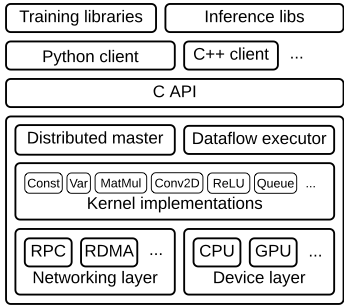

Client It defines the computation process as a data flow graph and initializes graph execution by using _Session_.
Distributed master It prunes specific subgraphs in a graph, i.e, parameters defined in Session.run(), partitions a subgraph into multiple parts that run in different processes and devices, and distributes the graph parts to different worker services, which initialize subgraph computation.
Worker service (one for each task) It schedules the execution of graph operations by using kernel implementations appropriate to the available hardware (CPUs, GPUs, etc.) and sends/receives operation results to/from other worker services.
Kernel implementation It performs the computation for individual graph operations.

EMR's Support for TensorFlow

TensorFlow version: v1.14.0
Currently, TensorFlow can only run on CPU models instead of GPU models.
TensorFlowOnSpark can be used for distributed training.

TensorFlow Development Sample

Write code: test.py
import tensorflow as tf
hello = tf.constant('Hello, TensorFlow!')
sess = tf.Session()
print sess.run(hello)
a = tf.constant(10)
b = tf.constant(111)
print sess.run(a+b)
exit()
Run the following command:
python test.py
For more usage, please visit the TensorFlow official website.

帮助和支持

本页内容是否解决了您的问题?

填写满意度调查问卷,共创更好文档体验。

文档反馈