When users access an architecture diagram, the system defaults to go to the Well-Architected Framework assessment module. Based on the Well-Architected Framework assessment system, this module conducts comprehensive and in-depth analysis of the architecture, covering three core layers, including the resource layer, architecture layer, and application layer, as well as the following six key pillars of Well-Architected Framework: security, reliability, performance, cost, operational excellence, and sustainability.
By using this multidimensional assessment process, the system accurately calculates the Well-Architected index and provides targeted governance suggestions. Users can follow the guidance of each governance suggestion to easily click and jump to the corresponding application page to perform cloud governance operations. This continuously optimizes and improves the Well-Architected index.
Calculation Method
Calculation Logic
The Well-Architected index of Tencent Cloud Smart Advisor (TSA) is calculated by using a weighted average approach that takes multiple assessment dimensions into consideration to ensure the comprehensiveness and accuracy of the index. The specific calculation logic is as follows:
Assessment item score: Each assessment item is assigned a score ranging from 1 to 5 based on its importance.
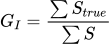
Standardized score: When the score for each layer is calculated, the standardized score (0 to 100) is derived based on the rate of the total score of assessment items that meet requirements
to the total score of all assessment items
. Therefore, the formula for calculating the score at the resource layer (
) is as follows:
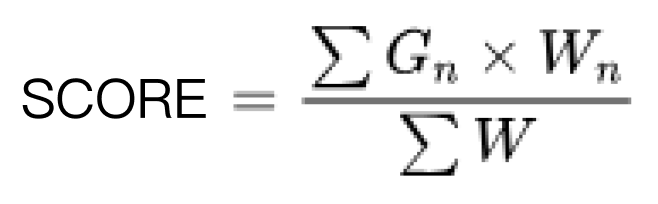
Well-Architected index: When the final Well-Architected index is calculated, the weighted average of scores at each layer is calculated. Specifically, the resource layer (
) carries a weight
of 40%, the architecture layer (
) carries a weight
of 40%, and the application layer (
) carries a weight
of 20%. Thus, the Well-Architected index is calculated as follows:
Example
Assume that the following architecture diagram exists:
At the resource layer, if 15 out of 30 assessment items meet requirements, the standardized score is 60.
At the architecture layer, if 20 out of 25 assessment items meet requirements, the standardized score is 85.
At the application layer, if 10 out of 15 assessment items meet requirements, the standardized score is 70.
The Well-Architected index is calculated as follows: