Cluster Architecture
Download
포커스 모드
폰트 크기
Architecture Overview
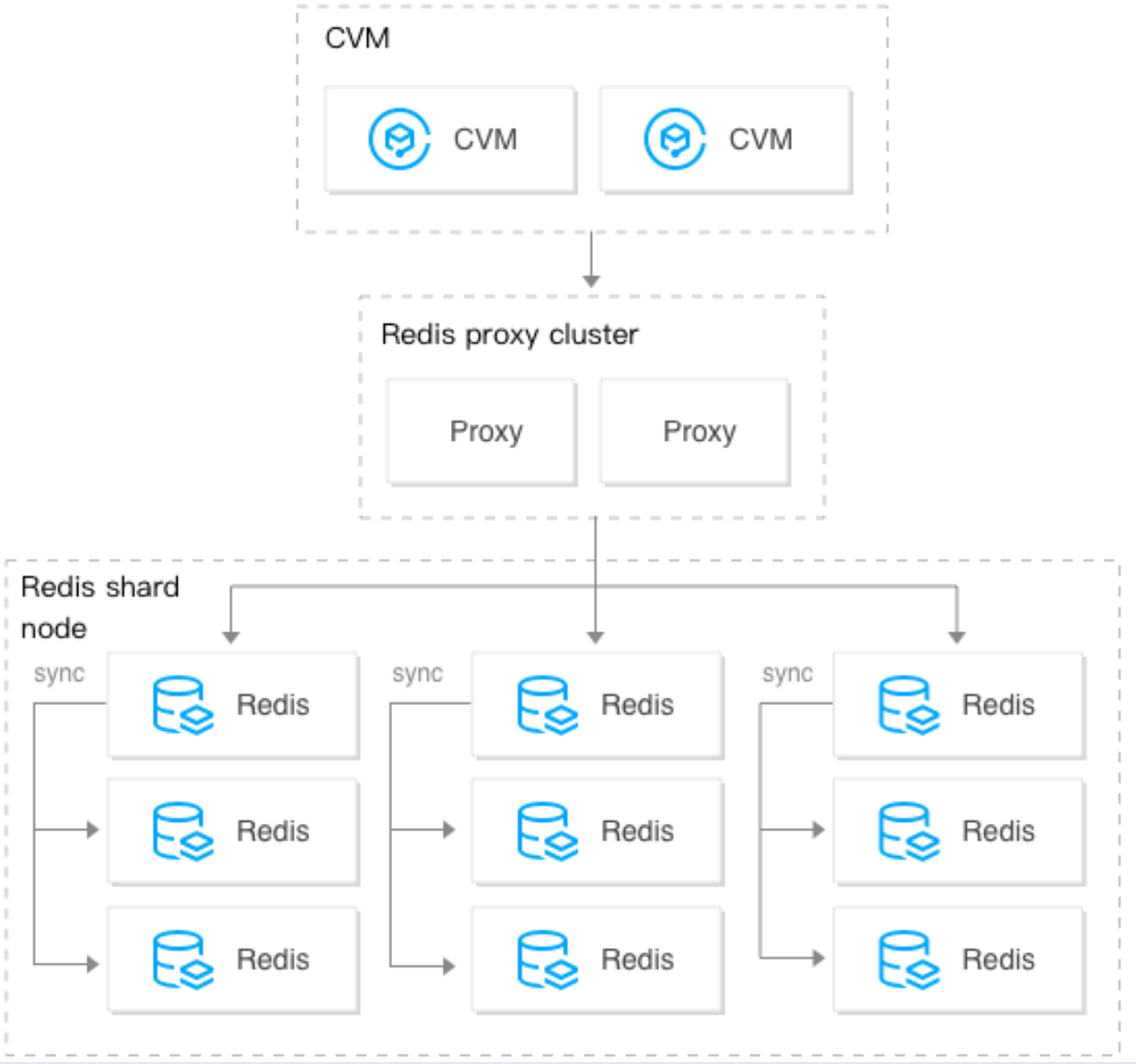
The cluster architecture is a distributed version built based on the Redis Community Edition. It is compatible with Redis 4.0, 5.0, 6.2, and 7.0, as well as Valkey 8.0 protocols. It adopts a distributed sharding design and supports horizontal scaling from 1 to 128 shards and vertical scaling from 1 to 5 replicas, delivering high performance of tens of millions of QPS. Capacity expansion, capacity reduction, and migration processes have minimal impact on businesses, ensuring high service availability. For specific performance data, see Specifications and Performance.
Core Components
Component | Description |
Shard | The smallest data storage unit, consisting of a group of master and replica nodes. The cluster evenly distributes 16,384 hash slots across shards. Each shard stores data for its assigned slots and supports online data balancing and migration. |
Master node | The node within a shard responsible for handling read/write requests and synchronizing data to replica nodes. Each shard has one master node. |
Replica node | A node within a shard responsible for data redundancy and high availability. It synchronizes data from the master node in real time and automatically takes over as the new master node upon master node failure. |
Proxy | A built-in proxy component that receives client requests and routes them to the corresponding shards. It provides load balancing, read/write separation, and cross-shard command processing capabilities, shielding cluster topology details from clients. |
Shard and Replica Configuration
A larger number of shards provides higher capacity and performance. All shards participate in data storage and request processing. When the number of shards is greater than or equal to 1, data is automatically distributed based on hash slots, enabling horizontal scaling of storage capacity and throughput.
A larger number of replicas provides higher availability. All replica nodes participate in high-availability failover. When the number of replicas is greater than or equal to 1, you can enable the read/write separation feature to vertically scale read performance. For more information, see Read/Write Separation.
Note:
Commands that span multiple hash slots have certain compatibility limitations. For details, see Command Reference Overview.
Configuration Item | Optional Specifications |
Shard specifications (GB): | 1, 2, 4, 8, 12, 16, 20, 24, 32, 40, 48, and 64 |
Shard quantity | 1, 3, 5, 8, 12, 16, 24, 32, 40, 48, 64, 80, 96, and 128 |
Replica quantity | 1, 2, 3, 4, and 5 |
Upper Limits of Specifications
Item | Upper Limit | Description |
Total storage capacity | 8TB | 128 shards x 64 GB |
Concurrent performance | Tens of millions of QPS | Tencent Cloud conducts multiple stress tests in standard testing environments and uses stable values as official references. For details, see Specifications and Performance. |
피드백