tencent cloud

TencentDB for SQL Server

Release Notes and Announcements
Release Notes
Product Announcements
User Guide
Product Introduction
Overview
Product Architecture
Strengths
Use Cases
Regions and AZs
Major Version Lifecycle Explanation
Features and Differences
Instance Types
Instance Specifications
Storage Types
Common Concepts
Network Environment
License Statement
Purchase Guide
Billing Overview
Product Pricing
Purchase Methods
Renewal Instructions
Payment Overdue
Refund
From Pay-as-You-Go to Monthly Subscription
Instance Adjustment Fees Description
Local Backup Space Billing
Cross-Region Backup Billing
Viewing Bill Details
Getting Started
Creating TencentDB for SQL Server Instance
Connecting to TencentDB for SQL Server Instance
Managing TencentDB for SQL Server Instance
Operation Guide
Constraints and Limits
Usage Specifications and Suggestions
Maintaining Instance
Adjusting Instance Configuration
Read-Only Instance
Network and Security
Account Management
Database Management
Data Security
Parameter Configuration
Monitoring and Alarms
Backup and Restoration 
Log Management
Publish-Subscribe
SSIS
Data Migration (New)
Data Migration (Legacy)
Data Synchronization (DTS) 
Practical Tutorial
TencentDB for SQL Server Methods for Regular Maintenance
TencentDB for SQL Server Optimization of Slow SQL
How to Better Use Tempdb
Cross-Account Backup Restoration
Creating VPC for TencentDB for SQL Server
Connecting Kingdee K/3 WISE to TencentDB for SQL Server
Account Permissions and Permission Control
Enabling and Disabling the CDC Feature
Shrinking a Database
API Documentation
History
Introduction
API Category
Making API Requests
Sales and fee related APIs
Instance Management related APIs
Operation and maintenance management related APIs
Network management related APIs
Account management related APIs
Database management related APIs
Security group management related APIs
Data security encryption related APIs
Parameter configuration related APIs
Extended Event related APIs
Log management related APIs
Read only instance management related APIs
Publish and subscribe related APIs
Backup related APIs
Rollback related APIs
Data migration (cold standby migration) related APIs
SQL Server Integration Services (SSIS) related APIs
Data migration (DTS old version) related APIs
Data Types
Error Codes
FAQs
Overview
Model Selection
Pricing and Selection
Connection and Network
Account and Permission
Backup and Rollback
Data Migration
Publish/Subscribe
Read-Only Instance
Version and Architecture Upgrade
Disk Space and Specification Adjustment
Monitoring and Alarms
Log-Related
Parameter Modification
Features
Performance, Space, and Memory-Related FAQs
Service Agreement
Service Level Agreement
Terms of Service
Performance Evaluation
Performance Test Report
Glossary
Contact Us

Renewal Instructions

PDF
フォーカスモード
フォントサイズ
最終更新日: 2025-09-04 11:16:06
TencentDB for SQL Server supports renewal through the console and the Renewal Management Center.

Renewing on the Console

Batch Renew

1. Log in to SQL Server console, in the instance list, select one or multiple instances that need renewal, and click Renew.

2. In the pop-up renewal dialog, select the renewal duration, and click OK.
3. After confirming the order details, click Confirm Purchase.
4. If your payment is successful, you can continue to view your order or return to the console.

Auto-renewal

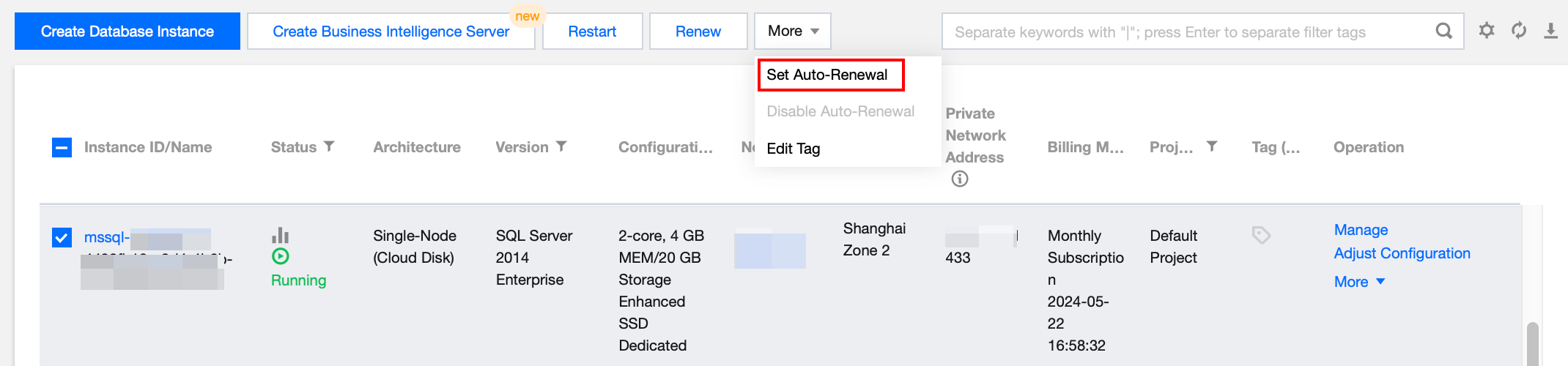
In the Instance List, select one or multiple instances for setting auto-renewal, select More options > Set Auto-Renewal.

Renewal in the Renewal Management Center

On the Renewal Management Page, features such as Batch Renewal, Set to Auto-renew, Unified Expiration Date are provided. For more information, see Renewal Management.

Related APIs

API
Description
This API is used to query the renewal price of a monthly subscription instance.
This API is used to renew instances.
This API is used to modify the instance renewal flag.

ヘルプとサポート

この記事はお役に立ちましたか?

フィードバック