tencent cloud

Cloud File Storage

Releases Notes and Announcements
Release Notes
Announcements
Product Introduction
Overview
Strengths
Storage Classes and Performance
Use Cases
Recommended Regions
Use Limits
Service Regions and Service Providers
Purchase Guide
Billing Overview
Pricing Overview
General Series Billing
Turbo Series Billing
High-Throughput CFS Billing
Billing Mode
IA ‍Storage Billing
Storage Resource Units
Resource Purchase
Viewing Bills
Arrears Reminder
Getting Started
Creating File Systems and Mount Targets
Using CFS File Systems on Linux Clients
Using CFS File Systems on Windows Clients
Using CFS Turbo on Linux Clients
Using the CFS Client Assistant to Mount File Systems
Operation Guide
Access Management
Managing File Systems
Permission Management
Using Tags
Snapshot Management
Guide for Cross-AZ and Cross-Network Access
Automatically Mounting File Systems
Data Migration Service
User Permission Management
User Quotas
Data Encryption
Data Lifecycle Management
Upgrading Standard File Systems
Practical Tutorial
Selecting Kernels for NFS Clients
Managing Turbo CFS Directories
Terminating Compute Instances
Using CFS on TKE
Using CFS on SCF
Using CFS Turbo on TKE
Using CFS Turbo on TKE Serverless Cluster
Selecting a Network for Turbo CFS
Copying Data
CFS Storage Performance Testing
API Documentation
History
Introduction
API Category
Snapshot APIs
File system APIs
Lifecycle APIs
Other APIs
Data Flow APIs
Making API Requests
Permission Group APIs
Service APIs
Scaling APIs
Data Migration APIs
Data Types
Error Codes
Troubleshooting
Client Use Bottleneck due to Large Number of Small Files or Parallel Requests
FAQs
CFS Service Level Agreement
Contact Us
Glossary
ドキュメントCloud File StorageOperation GuideGuide for Cross-AZ and Cross-Network Access

Guide for Cross-AZ and Cross-Network Access

PDF
フォーカスモード
フォントサイズ
最終更新日: 2024-01-22 22:15:47

Cross-AZ access in a VPC

If you need to have a Cloud File Storage (CFS) instance shared by multiple Cloud Virtual Machine (CVM) instances in different AZs in the same region, you can configure the CVM and CFS instances into the same VPC to achieve cross-AZ access to resources.
Assume that there is a CVM instance in Guangzhou Zone 1 that needs to use CFS, but file systems cannot be directly created in Guangzhou Zone 1 as the resources are sold out there. If the CVM instance is in the "Guangzhou Zone 1" subnet of a VPC, you can log in to the VPC console to create a subnet whose AZ is "Guangzhou Zone 3" for the VPC.
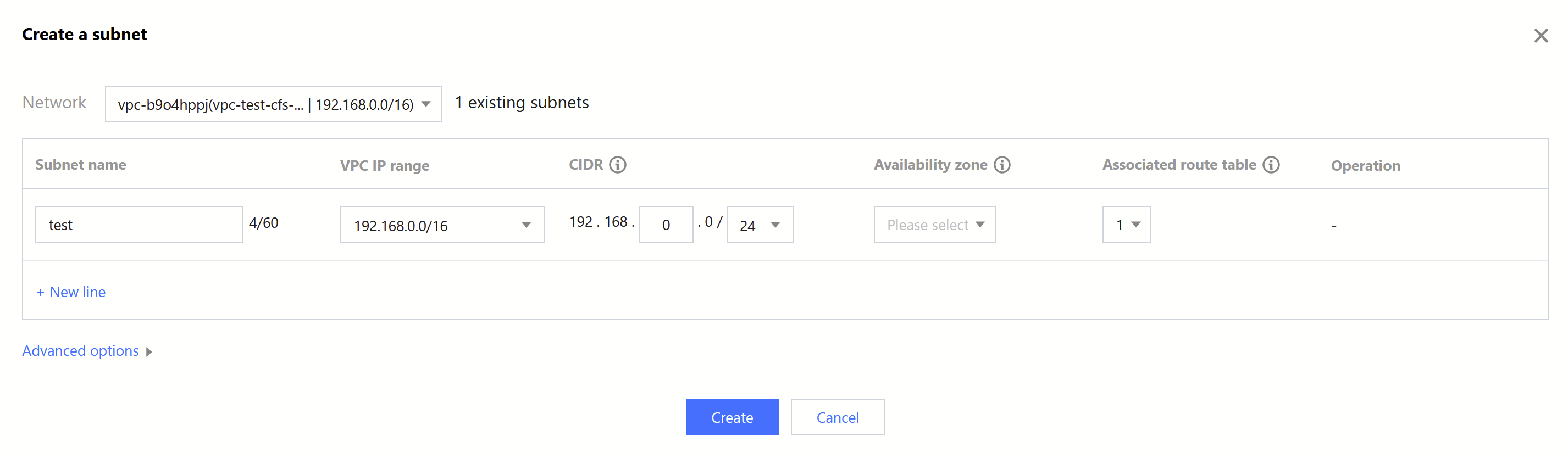
After the subnet is successfully created, go back to the CFS console and select this VPC and the subnet you just created to create resources in Guangzhou Zone 3. The CFS file system can be directly mounted to the CVM instance in the subnet of Guangzhou Zone 1 in this VPC. For more information, see Using CFS File Systems on Linux Clients.

Cross-VPC and cross-region access

CFS supports the following scenarios for resource access.
A CFS instance needs to be shared by multiple CVM instances distributed in different VPCs.
Your CVM and CFS instances are in different VPCs.
Your CVM and CFS instances are in different regions (for better access performance, it is recommended that the CVM instances and CFS be in the same region).
You can use Cloud Connect Network (CCN) to achieve resource access across the CVM instances distributed in VPC-A/VPC-B and CFS instance distributed in VPC-C. For more information, see Connecting Network Instances Under the Same Account.


ヘルプとサポート

この記事はお役に立ちましたか?

フィードバック