tencent cloud

Elastic MapReduce

Release Notes and Announcements
Release Notes
Announcements
Security Announcements
Product Introduction
Overview
Strengths
Architecture
Features
Use Cases
Constraints and Limits
Technical Support Scope
Product release
Purchase Guide
EMR on CVM Billing Instructions
EMR on TKE Billing Instructions
EMR Serverless HBase Billing Instructions
Getting Started
EMR on CVM Quick Start
EMR on TKE Quick Start
EMR on CVM Operation Guide
Planning Cluster
Administrative rights
Configuring Cluster
Managing Cluster
Managing Service
Monitoring and Alarms
TCInsight
EMR on TKE Operation Guide
Introduction to EMR on TKE
Configuring Cluster
Cluster Management
Service Management
Monitoring and Ops
Application Analysis
EMR Serverless HBase Operation Guide
EMR Serverless HBase Product Introduction
Quotas and Limits
Planning an Instance
Managing an Instance
Monitoring and Alarms
Development Guide
EMR Development Guide
Hadoop Development Guide
Spark Development Guide
Hbase Development Guide
Phoenix on Hbase Development Guide
Hive Development Guide
Presto Development Guide
Sqoop Development Guide
Hue Development Guide
Oozie Development Guide
Flume Development Guide
Kerberos Development Guide
Knox Development Guide
Alluxio Development Guide
Kylin Development Guide
Livy Development Guide
Kyuubi Development Guide
Zeppelin Development Guide
Hudi Development Guide
Superset Development Guide
Impala Development Guide
Druid Development Guide
TensorFlow Development Guide
Kudu Development Guide
Ranger Development Guide
Kafka Development Guide
Iceberg Development Guide
StarRocks Development Guide
Flink Development Guide
JupyterLab Development Guide
MLflow Development Guide
Practical Tutorial
Practice of EMR on CVM Ops
Data Migration
Practical Tutorial on Custom Scaling
API Documentation
History
Introduction
API Category
Cluster Resource Management APIs
Cluster Services APIs
User Management APIs
Data Inquiry APIs
Scaling APIs
Configuration APIs
Other APIs
Serverless HBase APIs
YARN Resource Scheduling APIs
Making API Requests
Data Types
Error Codes
FAQs
EMR on CVM
Service Level Agreement
Contact Us

Ranger Overview

PDF
포커스 모드
폰트 크기
마지막 업데이트 시간: 2025-01-03 15:02:25

Ranger Overview

Ranger is a framework for centralized security management of Hadoop components in the field of big data. Users can use Ranger to securely access data in a cluster. It is mainly designed to monitor Hadoop components, and control service launch and resource access. The major goals of Ranger include:
Centralized security management of big data components in the web UI or using RESTful APIs provided by Ranger.
Authorization to perform specific operations with big data components based on roles and attributes.
Centralized auditing of user access and administrative operations (security-related) with big data components.

Ranger Architecture

Ranger is mainly composed of Ranger Admin, Ranger UserSync, and Ranger Plugin. Both Ranger Admin and Ranger UserSync are a separate JVM process, while Ranger Plugin needs to be installed on different nodes depending on different components.
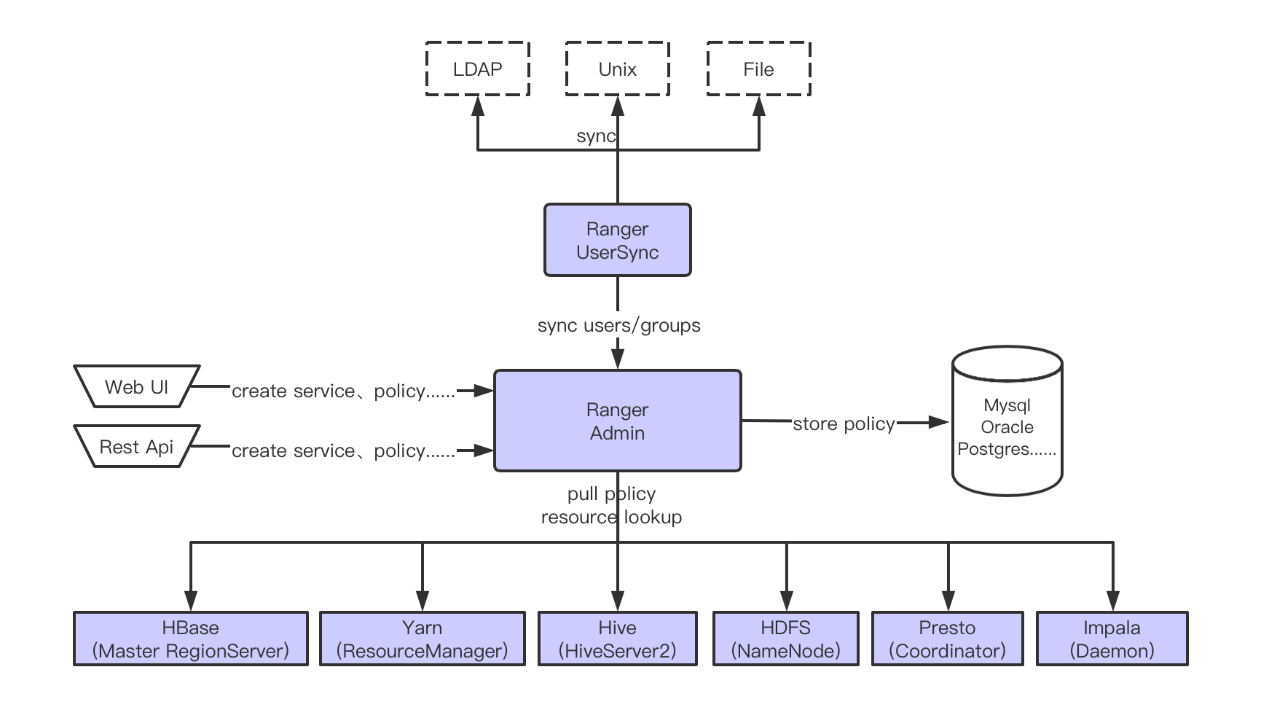
Ranger Admin is used to manage configured policies, created services, and audit logs and reports. It also persistently saves the policies and services to the database for regular queries from Ranger Plugin.
Ranger UserSync is used to synchronize information from LDAP, File, and Unix to Ranger Admin, for example, user and group information from users' Unix or LDAP directory access systems. To synchronize user and group information from Unix, you need to enable the unixAuthenticationService process and persistently store the synchronized information.
Ranger Plugin will be deployed on service nodes as needed and periodically synchronize policy information from Ranger Admin.
The following table lists the components that can be integrated with Ranger.
Service
Installation Nodes
EMR Versions
HDFS
NameNode
EMR v2.0.1 and above
HBase
Master, RegionServer
EMR v2.0.1 and above
Hive
HiveServer2
EMR v2.0.1 and above
YARN
ResourceManager
EMR v2.0.1 and above
Presto
All coordinators
EMR v2.0.1 and above
Impala
All daemons
EMR v2.2.0 and above
Kudu
All masters
EMR v3.2.0

도움말 및 지원

문제 해결에 도움이 되었나요?

피드백