tencent cloud

Elastic MapReduce

Release Notes and Announcements
Release Notes
Announcements
Security Announcements
Product Introduction
Overview
Strengths
Architecture
Features
Use Cases
Constraints and Limits
Technical Support Scope
Product release
Purchase Guide
EMR on CVM Billing Instructions
EMR on TKE Billing Instructions
EMR Serverless HBase Billing Instructions
Getting Started
EMR on CVM Quick Start
EMR on TKE Quick Start
EMR on CVM Operation Guide
Planning Cluster
Administrative rights
Configuring Cluster
Managing Cluster
Managing Service
Monitoring and Alarms
TCInsight
EMR on TKE Operation Guide
Introduction to EMR on TKE
Configuring Cluster
Cluster Management
Service Management
Monitoring and Ops
Application Analysis
EMR Serverless HBase Operation Guide
EMR Serverless HBase Product Introduction
Quotas and Limits
Planning an Instance
Managing an Instance
Monitoring and Alarms
Development Guide
EMR Development Guide
Hadoop Development Guide
Spark Development Guide
Hbase Development Guide
Phoenix on Hbase Development Guide
Hive Development Guide
Presto Development Guide
Sqoop Development Guide
Hue Development Guide
Oozie Development Guide
Flume Development Guide
Kerberos Development Guide
Knox Development Guide
Alluxio Development Guide
Kylin Development Guide
Livy Development Guide
Kyuubi Development Guide
Zeppelin Development Guide
Hudi Development Guide
Superset Development Guide
Impala Development Guide
Druid Development Guide
TensorFlow Development Guide
Kudu Development Guide
Ranger Development Guide
Kafka Development Guide
Iceberg Development Guide
StarRocks Development Guide
Flink Development Guide
JupyterLab Development Guide
MLflow Development Guide
Practical Tutorial
Practice of EMR on CVM Ops
Data Migration
Practical Tutorial on Custom Scaling
API Documentation
History
Introduction
API Category
Cluster Resource Management APIs
Cluster Services APIs
User Management APIs
Data Inquiry APIs
Scaling APIs
Configuration APIs
Other APIs
Serverless HBase APIs
YARN Resource Scheduling APIs
Making API Requests
Data Types
Error Codes
FAQs
EMR on CVM
Service Level Agreement
Contact Us

Data Migration Guide for Kudu Node Scale-In

PDF
포커스 모드
폰트 크기
마지막 업데이트 시간: 2025-01-03 15:02:25
This document describes how to migrate data when removing core nodes tservers from a Kudu cluster.
Note
Core nodes can be removed from a Kudu cluster. This feature is not available by default. If you need to use it, submit a ticket for application.
Before disconnecting tservers, you can use the rebalancing tool for data migration. Note that you can disconnect only one tserver at a time. To disconnect multiple ones, repeat the following steps.

Kudu migration based on rebalancing tool

1. Make sure that the cluster status is OK.
/usr/local/service/kudu/bin/kudu cluster ksck 10.0.1.29:7051,10.0.1.16:7051,10.0.1.36:7051

2. Run the ksck command in step 1 to get the uid of the disconnected nodes.

Take the fb9afb1b2989456cac5800bf6990dfea node as an example.
3. Switch the fb9afb1b2989456cac5800bf6990dfea node to the maintenance mode.
/usr/local/service/kudu/bin/kudu tserver state enter_maintenance 10.0.1.29:7051,10.0.1.16:7051,10.0.1.36:7051 fb9afb1b2989456cac5800bf6990dfea
4. Run the following rebalance command.
/usr/local/service/kudu/bin/kudu cluster rebalance 10.0.1.29:7051,10.0.1.16:7051,10.0.1.36:7051 --ignored_tservers fb9afb1b2989456cac5800bf6990dfea --move_replicas_from_ignored_tservers
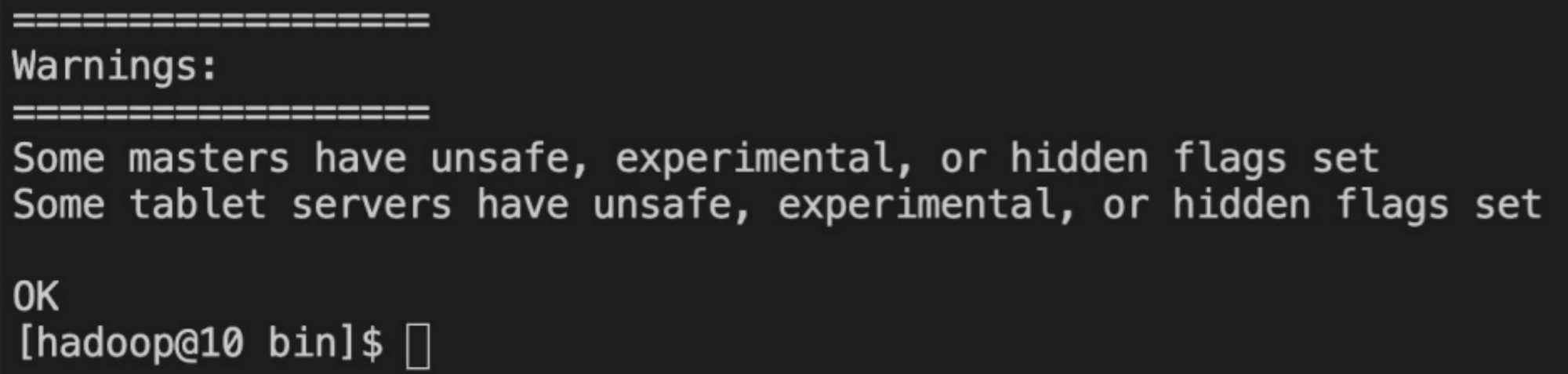
After the command is executed, run the ksck command again to check whether the status is OK before proceeding.
5. Suspend the tserver process at 10.0.1.45 on the fb9afb1b2989456cac5800bf6990dfea node. Note that at this point, if you run the ksck command, you will see that the cluster is unhealthy, and you need to restart the tmasters.

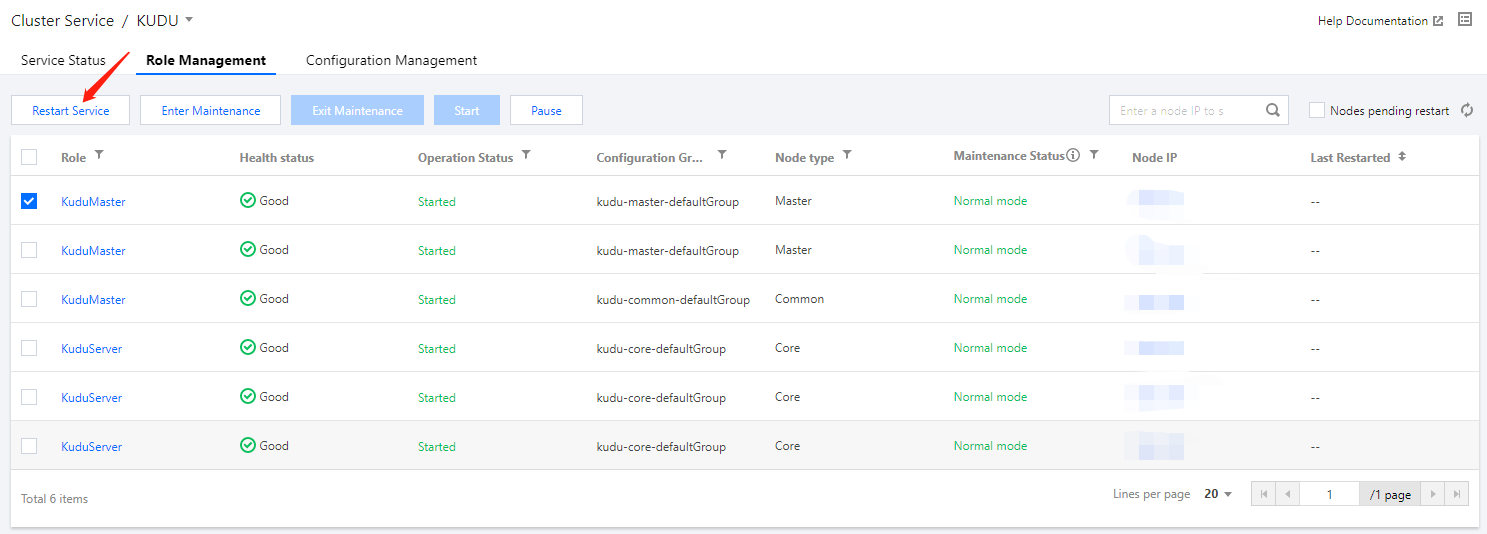
6. Restart the masters in the EMR console one by one (rolling restart in the console is not recommended). Then, run the ksck command to check whether the cluster is healthy.


도움말 및 지원

문제 해결에 도움이 되었나요?

피드백