tencent cloud

TencentDB for MongoDB

Release Notes and Announcements
Release Notes
Announcements
User Guide
Product Introduction
Overview
Strengths
Use Cases
Cluster Architecture
Product Specifications
Features
Regions and AZs
Terms
Service Regions and Service Providers
Purchase Guide
Billing Overview
MongoDB Pricing
Billing Formula
Payment Overdue
Backup Space Billing
Configuration Adjustment Billing
Getting Started
Quickly Creating an Instance
Connecting to a TencentDB for MongoDB Instance
Reading/Writing Database
Operation Guide
Access Management
Instance Management
Node Management
Version Upgrade
Network Configuration
Monitoring
Backup and Rollback
Database Audit
Data Security
SSL Authentication
Log Management
Database Management
Multi-AZ Deployment
Disaster Recovery/Read-Only Instances
Parameter Configuration
Recycle Bin
Task Management
Performance Optimization
Data Migration Guide
Practical Tutorial
Optimizing Indexes to Break Through Read/Write Performance Bottlenecks
Troubleshooting Mongos Load Imbalance in Sharded Cluster
Considerations for Using Shard Clusters
Sample of Reading and Writing Data in MongoDB Instance
Methods for Importing and Exporting Data Based on CVM Connected with MongoDB
What to Do for Errors of Repeated Instance Creation and Deletion of Databases with the Same Names?
Troubleshooting MongoDB Connection Failures
Shard Removal Task: Guide for Confirming the Progress and Troubleshooting Issues
Performance Fine-Tuning
Ops and Development Guide
Development Specifications
Command Support in Sharded Cluster v3.2
Command Support in v3.6
Development Ops
Troubleshooting
Increased Slow Queries
Number of Connections Exceeding Limit
API Documentation
History
Introduction
API Category
Making API Requests
Instance APIs
Backup APIs
Account APIs
Other APIs
Task APIs
Introduction
Data Types
Error Codes
Instance Connection
Shell Connection Sample
PHP Connection Sample
Node.js Connection Sample
Java Connection Sample
Python Connection Sample
Python Read/Write Sample
Go Connection Sample
PHP Reconnection Sample
Product Performance
Test Environment
Test Method
Test Result
FAQs
Cost
Features
Sharded Cluster
Instance
Rollback and Backup
Connection
Data Migration
Others
Service Agreement
Service Level Agreement
Terms of Service
Glossary
Contact Us

Downloading Backup Files

PDF
포커스 모드
폰트 크기
마지막 업데이트 시간: 2025-11-24 17:13:41

Feature Introduction

To ensure data security and business continuity, TencentDB for MongoDB provides a secure and convenient feature for downloading backup files. In routine Ops, you can obtain backup files quickly by using this feature in scenarios, such as emergency data recovery, development and testing environment building, or cross-environment data migration.
Core Feature
Feature Description
Backup file management view
The backup file list centrally displays the generation records and download progress of all files, and you can directly download or delete files.
Public network download
You can enable public network download with one click and set passwords for backup files to ensure secure access.
Download permission control
You can configure the download and access permissions for backup files through IP addresses and VPCs, effectively preventing unauthorized access and ensuring data security.

Operation Steps

2. In the left sidebar, choose MongoDB > Replica Set Instance or Shard Instance. The operations for replica set instances and sharded cluster instances are similar.
3. At the top of the instance list page on the right, select a region.
4. In the instance list, locate the target instance.
5. Click the target instance ID to go to the Instance Details page.
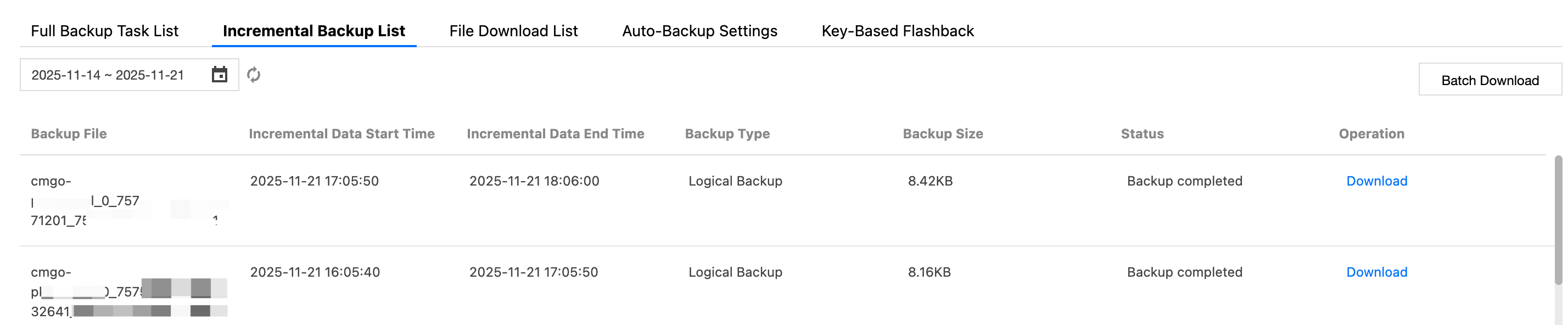
6. Switch to the Backup and Rollback page, and select the Full Backup Task List tab or the Incremental Backup List tab, as shown in the following figure.
Full Backup Task List

Incremental Backup List

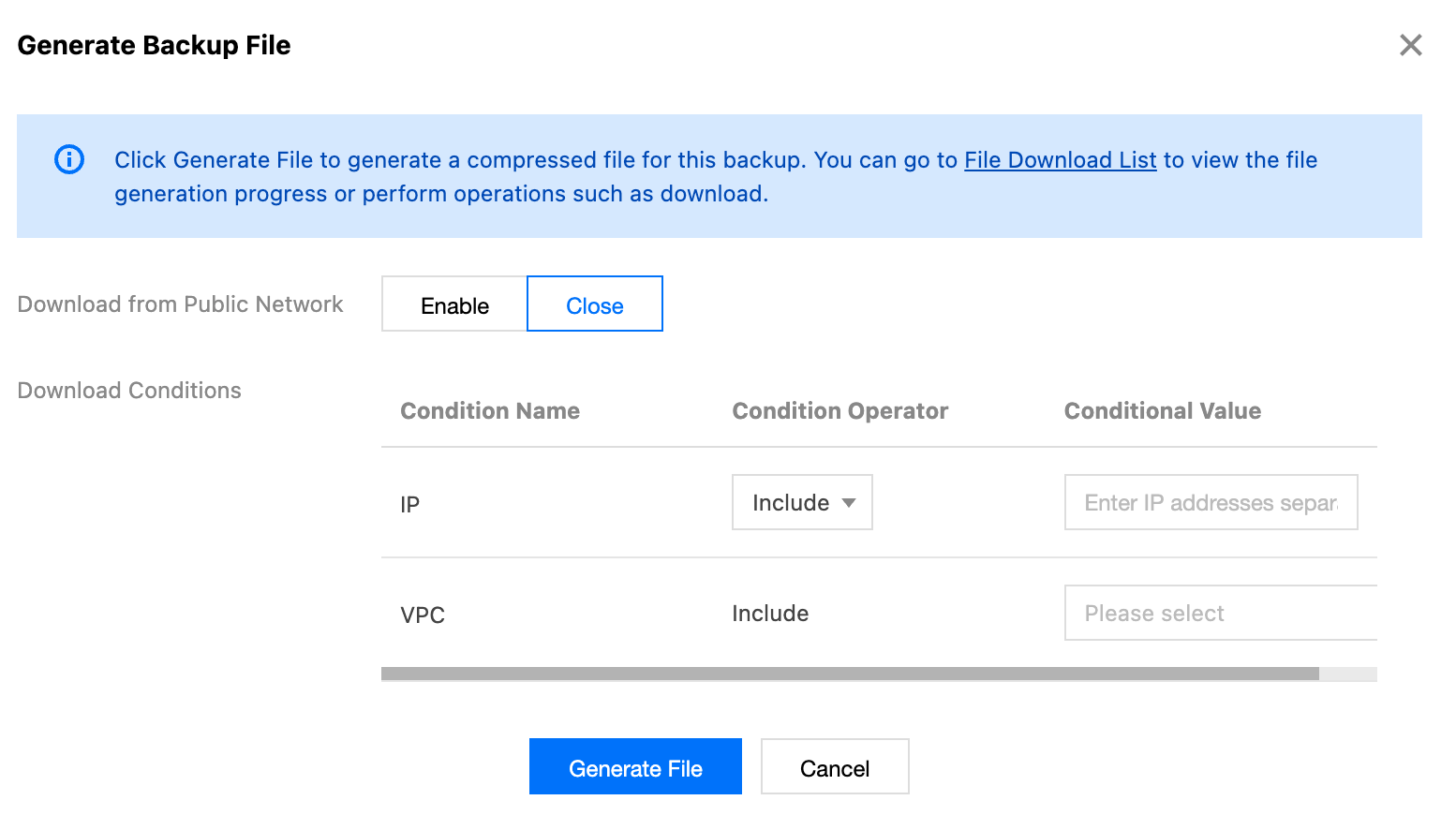
7. In the backup file list, click Download in the Operation column. In the Generate Backup File dialog box, configure the conditions for generating backup files.

Parameter
Description
Public network download
Sets whether to enable public network download.
Public Network File Encryption
To enable public network download, click

. You can enable file encryption in the download process.
Set Password
In the input box, set the password for file encryption. Click Generate Random Password to randomly generate a password in the input box.
Note:
In the encryption process, the PBKDF2 algorithm is used to derive a high-strength key based on the set password, and then the AES-256 algorithm is used to encrypt the file, strengthening file security. For details about decryption instructions, see Decrypting Encrypted Files.
Download Conditions
IP
Restricts the client access source IP addresses that are allowed to download backup files in the condition operator and condition value. Only when the client IP address matches the preset IP range, can backup files be downloaded.
VPC
Restricts the client access source VPCs that are allowed to download backup files in the condition operator and condition value. The download permission is available only when a request is from the specified VPC.
8. Switch to the File Download List tab to view the list of generated backup files. In the Operation column, click Copy Download Link and use the copied link in the browser to directly download backup files.


Decrypting Encrypted Files

Use the OpenSSL command line for decryption. The decryption command format is as follows.
Note:
If you develop a decryption tool, ensure that it supports the following parameters:
Algorithm: AES-256-CBC
Key derivation: PBKDF2, 10,000 iterations, SHA-256 hash
Salt value extraction: Read from the first 16 bytes of the file (Salted__ + 8-byte salt value)
Data decryption: CBC mode, PKCS7 padding

openssl enc -aes-256-cbc -d -pbkdf2 -iter 10000 \\
-in [encrypted file name] \\
-out [decrypted file name] \\
-k "[your password]"
Example: If the encrypted file name is encrypted.tar, the password is 12345, and the decrypted file is decrypted.tar, the command is as follows:
Note:
Ensure that the password is correct (case-sensitive and special characters).
The -pbkdf2 and -iter 10000 parameters should be specified.
The decrypted file will be restored to its original status.

openssl enc -aes-256-cbc -d -pbkdf2 -iter 10000 \\
-in encrypted.tar \\
-out decrypted.tar \\
-k "12345"

Related APIs

도움말 및 지원

문제 해결에 도움이 되었나요?

피드백