Features
Download
포커스 모드
폰트 크기
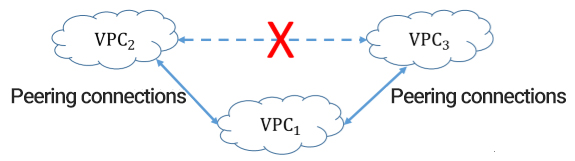
Non-transitive connectivity of peering connections
A peering connection enables connectivity between two VPCs, but the connectivity cannot be transited.
For example, as shown in the following figure, peering connections are created between VPC 1 and VPC 2, and between VPC 1 and VPC 3. However, due to the non-transitivity of peering connections, traffic cannot flow between VPC 2 and VPC 3.
Note:
Even if a peering connection is created, both ends of the connection cannot communicate with each other if routes for sending and returning packets are not configured at both ends.
Peering Connection Gateway Bandwidth Limiting
Peering Connection Gateway Bandwidth Limiting provides monitoring and controlling capabilities at the IP-gateway level. The refined and visible gateway traffic enables network operation personnel to have a clear overview of the traffic within a gateway. The capability to limit speed at the IP-gateway level can also help block abnormal traffic.
Example:
One early morning, a company's gateway traffic suddenly surged. With the help of intelligent gateway traffic monitoring, operation personnel were able to trace the IP address responsible for the surge at that particular time, enabling them to quickly identify the root cause. Moreover, gateway traffic monitoring offers bandwidth control at the IP-gateway level, limiting bandwidth from certain IP addresses to a gateway, blocking abnormal traffic, and ensuring the security of key business operations.
Primary value of gateway traffic monitoring:
Precise gateway troubleshooting capabilities can minimize network downtime. With real-time traffic query and top N ranking features, it can analyze source IP addresses and their key metrics to quickly locate abnormal traffic.
By using the monitoring and controlling capabilities at the IP-gateway level, coupled with minute-level network traffic queries, it can promptly detect abnormal traffic that monopolizes bandwidth. By setting traffic monitoring at the IP-gateway level, the stability and smooth operation of core business are ensured.
All-time, all-flow gateway traffic analysis capability helps reduce cloud network costs. By controlling costs through Quality of Service (QoS), it can limit the bandwidth of non-critical businesses under a limited network budget to reduce costs.
피드백