tencent cloud

Virtual Private Cloud

Release Notes and Announcements
Release Notes
Announcements
Tencent Cloud Network Overview
Product Introduction
Overview
Strengths
Use Cases
Concepts
Quota Limit
Service Regions and Service Providers
Purchase Guide
Billing Overview
Payment Overdue
Quick Start
Network Planning
VPC Connections
Building Up an IPv4 VPC
Operation Guide
Network Topology
Network performance dashboard
Virtual Private Cloud (VPC)
Subnets
Route Tables
Elastic IP
HAVIPs
Elastic Network Interface
Bandwidth Package
Network Connection
Security Management
Diagnostic Tools
Alarming and Monitoring
Practical Tutorial
View the Total Bandwidth for Single-Region Traffic-Based Billing
Migrating from the Classic Network to VPC
Best Practices of Security Group Change
Configuring CVM Instance as Public Gateway
Building HA Primary/Secondary Cluster with HAVIP + Keepalived
Hybrid Cloud Primary/Secondary Communication (DC and VPN)
Hybrid Cloud Primary/Secondary Communication (CCN and VPN)
CVM Access to Internet Through EIP
Troubleshooting
VPCs or Subnets Cannot Be Deleted
Network Disconnection After Connecting Two VPCs over CCN
Failed to Ping CVMs in the Same VPC
API Documentation
History
Introduction
API Category
Making API Requests
VPC APIs
Route Table APIs
Elastic Public IP APIs
Elastic IPv6 APIs
Highly Available Virtual IP APIs
ENI APIs
Bandwidth Package APIs
NAT Gateway APIs
Direct Connect Gateway APIs
Cloud Connect Network APIs
Network ACL APIs
Network Parameter Template APIs
Network Detection-Related APIs
Flow Log APIs
Gateway Traffic Monitor APIs
Private Link APIs
Traffic Mirroring APIs
Other APIs
Subnet APIs
VPN Gateway APIs
Security Group APIs
Snapshot Policy APIs
Error Codes
Data Types
FAQs
General
Connection
Security
Contact Us
Glossary

Configuration Case

PDF
Focus Mode
Font Size
Last updated: 2024-10-22 16:15:50

Parameter Template Use Cases

Parameter template is an efficient, fast, and easy-to-maintain way to add rules in security groups. For example, when you need to add multiple IP ranges, specified IPs, or protocol ports of multiple types, you can define a parameter template. You can also use the parameter template subsequently to maintain the IP sources and protocol ports in the security group rules.
Note:
All the IP addresses and protocol ports in this document are examples. Please replace them according to your actual business conditions during configuration.

Example Description

Suppose you want to configure the following security group rules and need to update the inbound source IP range and protocol port later:
Inbound rules:
Allowed source IP range: 10.0.0.16-10.0.0.30; protocol port: TCP:80,443
Allowed source CIDR block: 192.168.3.0/24; protocol port: TCP:3600-15000
Outbound rules: Rejected target IP address: 192.168.10.4; protocol port: TCP:800

Solution

Because you have the same security group policy for multiple IP ranges and protocol ports, and you need to update the source IP range later, you can use a parameter template to implement the addition and maintenance of security group rules.

Step 1. Create a parameter template

1. Log in to the VPC console.
2. Select Security > Parameter Template on the left sidebar to access the management page.
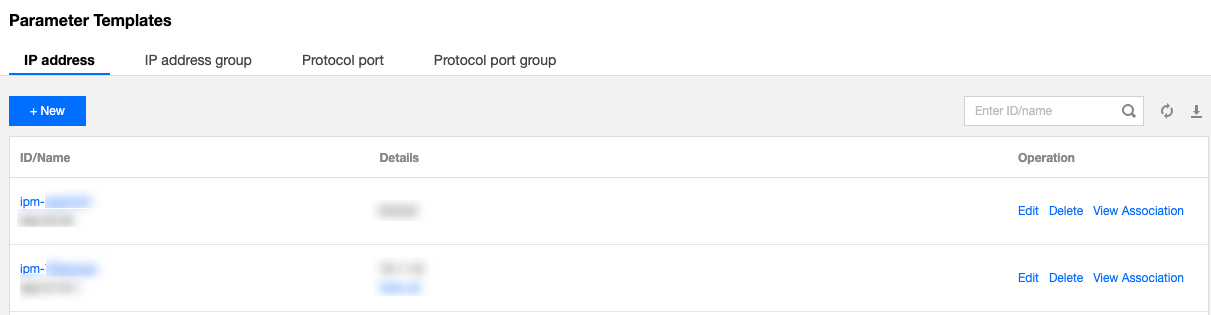
3. On the IP Address tab, click + New to create an IP address parameter template for adding inbound and outbound rules.
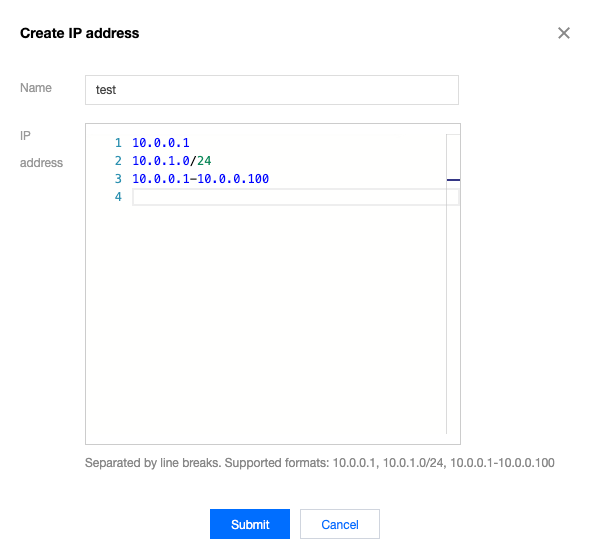
4. In the pop-up window, enter the source IP range and click Submit.

The newly created IP address parameter template is as shown below.

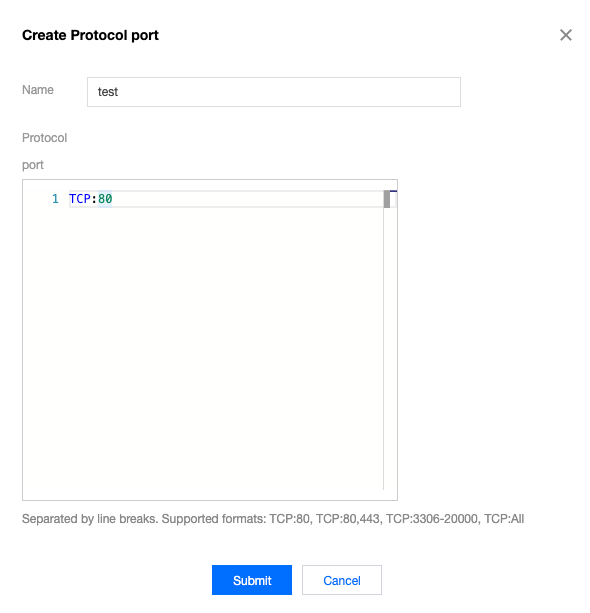
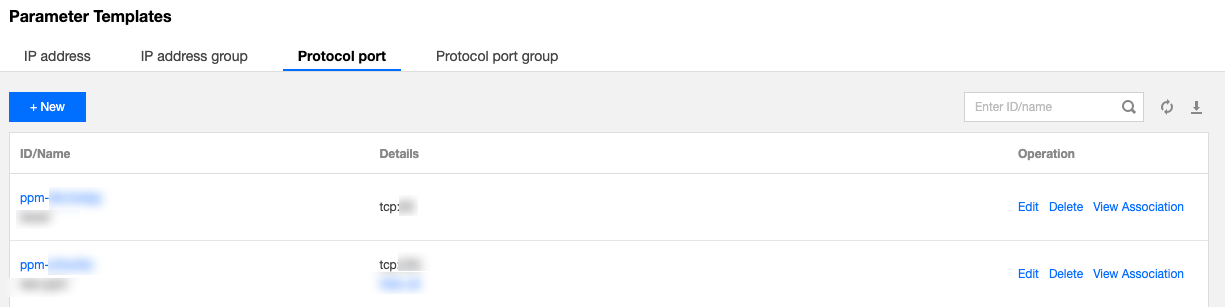
5. On the Protocol Port tab, click + New to create a protocol port parameter template for adding inbound and outbound rules.


The newly created protocol port parameter template is as shown below:


Step 2. Add a security group rule

1. Log in to the VPC console.
2. Select Security > Security Group on the left sidebar to access the management page.
3. In the list, find the security group that needs to import the parameter template and click its ID to enter the details page.
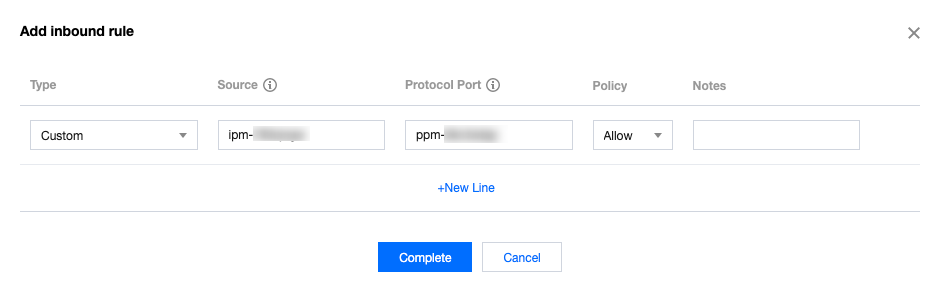
4. On the Inbound/Outbound Rules tab, click Add Rule.
5. In the pop-up window, select the custom type, select the corresponding IP address parameter template for the source/target, select the corresponding protocol port parameter template for the protocol port, and click Complete.


Step 3. Update the parameter template

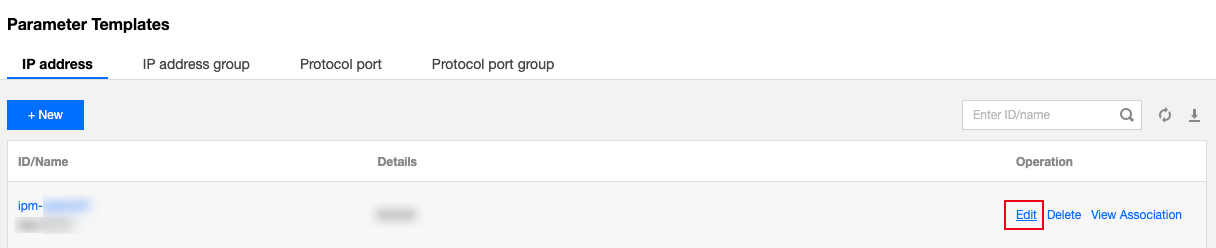
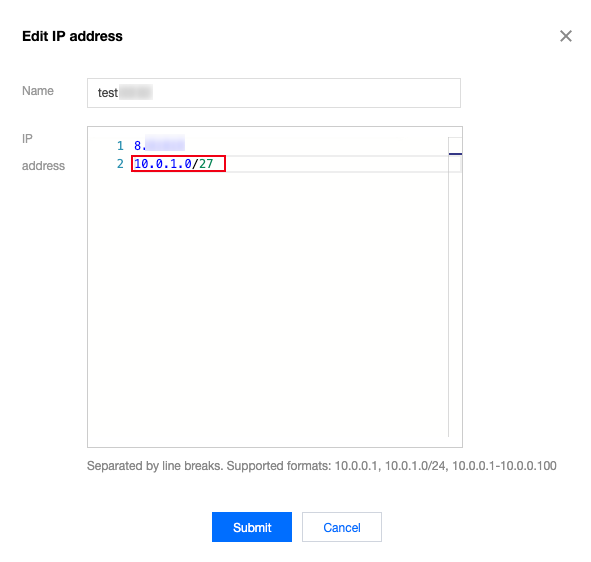
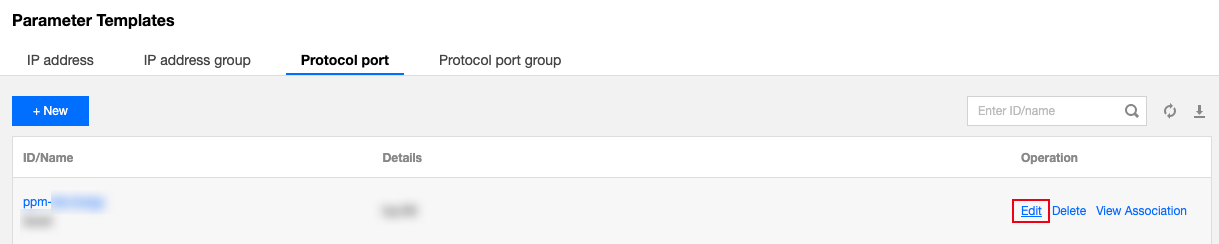
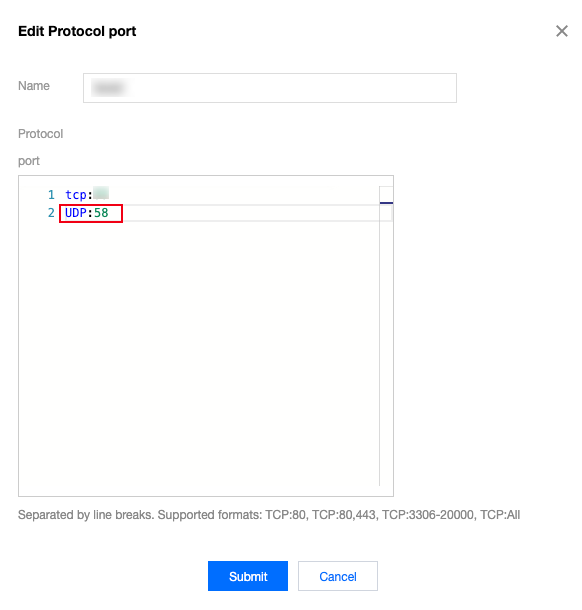
Suppose you need to add an inbound rule with the IP source being the 10.0.1.0/27 IP range and the protocol port being UDP:58. You can directly update the parameter templates of the IP address ipm-0ge3ob8e and the protocol port ppm-4ty1ck3i.
1. On the IP Address tab of the parameter template, find the ipm-0ge3ob8e parameter template.
2. Click Edit on the right.

3. In the pop-up window, add the 10.0.1.0/27 IP range in a new line and click Submit.

4. On the Protocol Port tab of the parameter template, find the ppm-4ty1ck3i parameter template.
5. Click Edit on the right.

6. In the pop-up window, add the UDP:58 inbound protocol port in a new line and click Submit.

Help and Support

Was this page helpful?

Help us improve! Rate your documentation experience in 5 mins.

Feedback