tencent cloud

Data Transfer Service

Release Notes and Announcements
Release Notes
Announcements
Product Introduction
Overview
Data Migration
Data Sync
Data Subscription (Kafka Edition)
Strengths
Supported Regions
Specification Description
Purchase Guide
Billing Overview
Configuration Change Description
Payment Overdue
Refund
Getting Started
Data Migration Guide
Data Sync Guide
Data Subscription Guide (Kafka Edition)
Preparations
Business Evaluation
Network Preparation
Adding DTS IP Addresses to the Allowlist of the Corresponding Databases
DTS Service Permission Preparation
Database and Permission Preparation
Configuring Binlog in Self-Built MySQL
Data Migration
Databases Supported by Data Migration
Cross-Account TencentDB Instance Migration
Migration to MySQL Series
Migrating to PostgreSQL
Migrating to MongoDB
Migrating to SQL Server
Migrating to Tencent Cloud Distributed Cache
Task Management
Data Sync
Databases Supported by Data Sync
Cross-Account TencentDB Instance Sync
Sync to MySQL series
Synchronize to PostgreSQL
Synchronization to MongoDB
Synchronize to Kafka
Task Management
Data Subscription (Kafka Edition)
Databases Supported by Data Subscription
MySQL series Data Subscription
Data Subscription for TDSQL PostgreSQL
MongoDB Data Subscription
Task Management
Consumption Management
Fix for Verification Failure
Check Item Overview
Cutover Description
Monitoring and Alarms
Supported Monitoring Indicators
Supported Events
Configuring Metric Alarms and Event Alarms via the Console
Configuring Indicator Monitoring and Event Alarm by APIs
Ops Management
Configuring Maintenance Time
Task Status Change Description
Practical Tutorial
Synchronizing Local Database to the Cloud
Creating Two-Way Sync Data Structure
Creating Many-to-One Sync Data Structure
Creating Multi-Site Active-Active IDC Architecture
Selecting Data Sync Conflict Resolution Policy
Using CLB as Proxy for Cross-Account Database Migration
Migrating Self-Built Databases to Tencent Cloud Databases via CCN
Best Practices for DTS Performance Tuning
FAQs
Data Migration
Data Sync
FAQs for Data Subscription Kafka Edition
Regular Expressions for Subscription
Error Handling
Common Errors
Failed Connectivity Test
Failed or Alarmed Check Item
Inability to Select Subnet During CCN Access
Slow or Stuck Migration
Data Sync Delay
High Data Subscription Delay
Data Consumption Exception
API Documentation
History
Introduction
API Category
Making API Requests
(NewDTS) Data Migration APIs
Data Sync APIs
Data Consistency Check APIs
(NewDTS) Data Subscription APIs
Data Types
Error Codes
DTS API 2018-03-30
Service Agreement
Service Level Agreements

Data Migration

PDF
Mode fokus
Ukuran font
Terakhir diperbarui: 2023-03-03 14:57:18

Feature Overview

The data migration feature refers to data replication between different data sources. It is a short-term one-time task that migrates the entire database. After migration, manual cutover will be performed to continue the task in the new database. DTS supports non-stop data migration without locks to minimize the impact of database downtime on the business.
DTS supports migration of self-built, TencentDB, and third-party cloud source databases.
Self-built database migration to the cloud: This means to migrate data from a self-built database based on a local IDC, CVM instance, or Lighthouse instance to TencentDB.
Cross-TencentDB instance migration: This includes database version upgrade, cross-region migration (including cross-border migration), and cross-account instance migration.
Third-party database migration: This means to migrate data from a database in another cloud such as Alibaba Cloud or AWS to Tencent Cloud.

How It Works

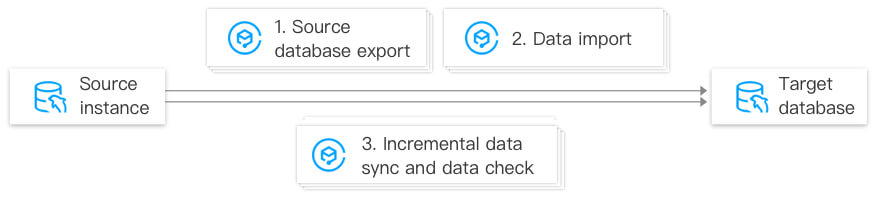
The following takes MySQL as an example to describe the data migration process:
Source database export: All existing data in the source database is exported.
Data import: Existing data is imported into the target database.
Incremental data sync and data check: Binlog takeover will begin when a migration task is started. During migration, SQL operations in the source database are written to the binlog, which DTS parses to write incremental data generated during existing data migration into the target database.


Typical Use Cases

Data migration to Tencent Cloud

It simply takes a few steps in DTS to set up data migration to Tencent Cloud without any complicated configuration. The migration process does not interrupt the service provided by your source database, thereby minimizing the impact of cloudification on your business.


Restrictions

Basic tables, views, functions, triggers, procedures, and events can be migrated (unsupported migration objects will be gradually supported in the future).
Correlated data objects must be migrated together; otherwise, migration will fail. Common correlations include table referenced by views, view referenced by views, view/table referenced by procedures/functions/triggers, and tables correlated through primary/foreign keys.

Supported Migration Types

DTS supports the following three migration types:
Structural migration: The structure of the migration objects in the source database is migrated to the target database.
Full migration: All data except system tables in the source database is migrated to the target database at a time. Full migration is one-time migration and is applicable to scenarios where the source database has no data writes.
Full + incremental migration: Full migration is performed first to initialize the target database, and then the incremental data is migrated. Technical methods such as log parsing are used to keep the data between the source and target databases consistent. Full + incremental migration is applicable to scenarios where the source instance has data writes.
Notes
If you select full data migration, do not write new data into the source instance during migration; otherwise, the data in the source and target instances will be inconsistent. In scenarios with data writes, to ensure the data consistency in real time, we recommend you select full + incremental migration.

Supported Database Types

For more information on the source and target database types, versions, and migration types supported for data migration, see Databases Supported by Data Migration.

Supported Advanced Features

Feature
Description
Documentation
Heterogeneous migration and migration from third-party cloud databases
Data migration between databases in different types is supported, such as migration from MySQL to TDSQL-C. Currently supported third-party cloud databases include Alibaba Cloud and AWS databases.
Cross-account migration
Data migration between different Tencent Cloud accounts is supported.
Cross-version migration of most databases
The target database version should be equal to or later than the source database version; for example, data on v5.5.x can be migrated to v5.5.x, v5.6.x, or later. The last digit in the version number is the minor version number, which is not restricted.
Migration of user information, views, and advanced objects
User information, views, procedures, functions, triggers, and events can be migrated.
-
Data consistency check
The data in the source and target databases can be checked for consistency.
Task progress visualization
Information such as migration steps and progress can be displayed.
Metric monitoring and default alarm policy
Data migration metrics can be monitored.
Default configuration is supported for data migration event monitoring to automatically notify you of abnormal events.
Migration without locks
Migration is implemented without locks, during which no global lock (the FTWRL lock) is added, and only tables without a primary key are locked.
-
Database/Table mapping
Databases/Tables migrated from the source database to the target database can be renamed.
Instance restart or upgrade
During incremental migration, the instances can be restarted or upgraded.
-
HA switch
HA switch from the source instance (with GTID enabled) to the target instance is supported.
-
No requirements for the super privileges
The operator does not need to have the super privileges of the source instance account (only for certain databases currently).
-


Bantuan dan Dukungan

Apakah halaman ini membantu?

masukan