When the public IP addresses automatically assigned by the system cannot meet your business needs, you can apply for Internet tunnel public IP addresses in the console. This document will show you how to apply for and manage public IP addresses in the console.
Notice of Billing Changes
Dear Tencent Cloud users,
To further improve the user experience of the product, the billing mode of Internet tunnel public IP resources for Tencent Cloud DC has been optimized:
1. Internet tunnel public IP resource fees: After November 29, 2021, the charging mode will change from offline charging to online charging.
2. The charging mode will continue to be the offline monthly pay-as-you-go mode, with the price of 16 USD per unit per month.
3. For questions regarding public IP resource discounts and specific charging matters, consult the relevant business manager.
Thank you for your continued support.
Sincerely,
Tencent Cloud Team
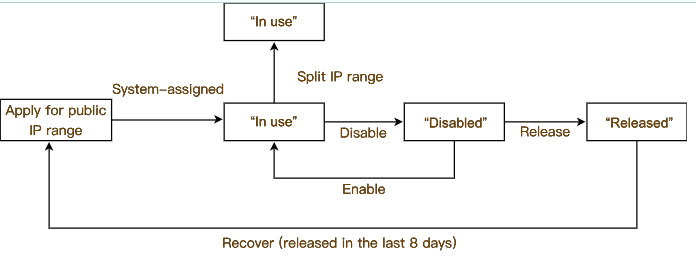
Public IP Lifecycle
1. Applying for Public IP Addresses: After you apply for a public IP in the console, the system will automatically assign an IP address, and the public IP status will change to "in use". 2. A public IP in the "in use" state can undergo network segment splitting and disabling operations.
Network Segment Splitting: Suitable for scenarios where network segments need to be refined. After the operation, the public IP status will remain "in use". 3. A public IP in the "disabled" state can undergo enabling and returning operations.
4. Retrieving Public IP Addresses: A public IP with the state of "returned" can be retrieved within 8 days. After retrieval, the public IP will be reassigned by the system and its status will be "in use". Prerequisites
Applying for Public IP Addresses
The public IP you applied for will be automatically bound to the Internet dedicated tunnel in the region. If there are multiple tunnels in a certain region, all tunnels will share the public IP you applied for.
1. In the left navigation bar, select Internet Tunnel > Internet Tunnel Public IP.
2. At the top of the Internet Tunnel Public IP page, select a region and then click Apply for.
3. In the Apply for IP Addresses dialog box, configure the following information.
|
Protocol type | You can choose to apply for IPv4 or IPv6. If you need to apply for an IPv6 address, the Internet dedicated tunnel needs to enable IPv6. |
Address type | If the protocol type is IPv4: The address type can be BGP or static. After selecting the static, you also need to select the single line type as CTCC, CUCC, or CMCC. If the protocol type is IPv6: The address type can only be BGP. |
Quantity | Each Tencent Cloud account can apply for a maximum of 512 IPv4 addresses, with a minimum of 4 addresses you apply for at a time. |
Mask | When applying for IPv6 addresses, you can customize the IPv6 address mask. The maximum mask length is 64 bits. |
Billing mode | The Internet tunnel currently only supports the monthly pay-as-you-go mode. |
IP resource fees | |
4. Click OK.
Network Segment Splitting
The network segment splitting is suitable for scenarios where network segments need to be refined. For IPv4 addresses, splitting can only be performed when the mask is less than 30; for IPv6 addresses, splitting can only be performed when the mask is less than 64. The specific steps are as follows:
1. Log in to the DC console and select Internet Tunnel > Internet Tunnel Public IP in the left navigation bar. 2. At the top of the Internet dedicated tunnel public IP page, select a region.
3. In the Internet tunnel public IP list, click Network Segment Splitting in the operation column to the right of the target public IP.
4. On the network segment splitting page, select the splitting quantity, check Confirm that the network segments cannot be merged after splitting and click Split.
Note
Ensure that the released network segment has been changed to the split CIDR; otherwise, it may cause network interruptions. Operate with caution.
Disabling Public IP Addresses
After the disabling operation is executed, the four IP addresses in the selected network segment will be unable to access the public network. Operate with caution.
1. Log in to the DC console and select Internet Tunnel > Internet Tunnel Public IP in the left navigation bar. 2. At the top of the Internet dedicated tunnel public IP page, select a region.
3. In the Internet tunnel public IP list, click Disable in the operation column to the right of the target public IP.
4. In the Disable IP Addresses dialog box, check Confirm to disable the above IP addresses and click Disable to disable the four IP addresses in the network segment.
Enabling Public IP Addresses
Only the disabled public IP addresses can be enabled. The enabling operation is as follows:
1. Log in to the DC console and select Internet Tunnel > Internet Tunnel Public IP in the left navigation bar. 2. At the top of the Internet dedicated tunnel public IP page, select a region.
3. In the Internet tunnel public IP list, click Enable in the operation column to the right of the target public IP.
4. In the Enable IP Addresses dialog box, check Confirm to enable the above IP addresses, and then click Enable to enable the four IP addresses in this network segment.
Returning Public IP Addresses
Only the disabled public IP addresses can be returned.
1. Log in to the DC console, and select Internet Tunnel > Internet Tunnel Public IP in the left navigation bar. 2. At the top of the Internet dedicated tunnel public IP page, select a region.
3. In the Internet tunnel public IP list, click Return in the operation column to the right of the target public IP.
4. In the Return IP Addresses dialog box, check Confirm the return of the above IP addresses, and then click Return to return the four IP addresses in the network segment.
Retrieving Public IP Addresses
You can retrieve a returned public IP within 8 calendar days. The retrieved public IP will be enabled by default.
1. Log in to the DC console, and select Internet Tunnel > Internet Tunnel Public IP in the left navigation bar. 2. At the top of the Internet dedicated tunnel public IP page, select a region.
3. In the Internet tunnel public IP list, click Retrieve IP in the operation column to the right of the target public IP.
4. In the Retrieve IP Addresses dialog box, check Confirm to retrieve the above IP address, and then click Retrieve.