tencent cloud

Data Transfer Service

Release Notes and Announcements
Release Notes
Announcements
Product Introduction
Overview
Data Migration
Data Sync
Data Subscription (Kafka Edition)
Strengths
Supported Regions
Specification Description
Purchase Guide
Billing Overview
Configuration Change Description
Payment Overdue
Refund
Getting Started
Data Migration Guide
Data Sync Guide
Data Subscription Guide (Kafka Edition)
Preparations
Business Evaluation
Network Preparation
Adding DTS IP Addresses to the Allowlist of the Corresponding Databases
DTS Service Permission Preparation
Database and Permission Preparation
Configuring Binlog in Self-Built MySQL
Data Migration
Databases Supported by Data Migration
Cross-Account TencentDB Instance Migration
Migration to MySQL Series
Migrating to PostgreSQL
Migrating to MongoDB
Migrating to SQL Server
Migrating to Tencent Cloud Distributed Cache
Task Management
Data Sync
Databases Supported by Data Sync
Cross-Account TencentDB Instance Sync
Sync to MySQL series
Synchronize to PostgreSQL
Synchronization to MongoDB
Synchronize to Kafka
Task Management
Data Subscription (Kafka Edition)
Databases Supported by Data Subscription
MySQL series Data Subscription
Data Subscription for TDSQL PostgreSQL
MongoDB Data Subscription
Task Management
Consumption Management
Fix for Verification Failure
Check Item Overview
Cutover Description
Monitoring and Alarms
Supported Monitoring Indicators
Supported Events
Configuring Metric Alarms and Event Alarms via the Console
Configuring Indicator Monitoring and Event Alarm by APIs
Ops Management
Configuring Maintenance Time
Task Status Change Description
Practical Tutorial
Synchronizing Local Database to the Cloud
Creating Two-Way Sync Data Structure
Creating Many-to-One Sync Data Structure
Creating Multi-Site Active-Active IDC Architecture
Selecting Data Sync Conflict Resolution Policy
Using CLB as Proxy for Cross-Account Database Migration
Migrating Self-Built Databases to Tencent Cloud Databases via CCN
Best Practices for DTS Performance Tuning
FAQs
Data Migration
Data Sync
FAQs for Data Subscription Kafka Edition
Regular Expressions for Subscription
Error Handling
Common Errors
Failed Connectivity Test
Failed or Alarmed Check Item
Inability to Select Subnet During CCN Access
Slow or Stuck Migration
Data Sync Delay
High Data Subscription Delay
Data Consumption Exception
API Documentation
History
Introduction
API Category
Making API Requests
(NewDTS) Data Migration APIs
Data Sync APIs
Data Consistency Check APIs
(NewDTS) Data Subscription APIs
Data Types
Error Codes
DTS API 2018-03-30
Service Agreement
Service Level Agreements

Public Network Access

PDF
フォーカスモード
フォントサイズ
最終更新日: 2024-04-30 17:10:27

Overview

To use the Public Network Access method, users must choose the region closest to their physical database's region when purchasing a DTS task, and then use DTS for the transmission task. For example, If the region of the physical database is not included in the service regions of DTS, then choose a DTS service region that is closest to the region of the physical database. This ensures the optimal transmission path for DTS, reducing the duration of data transmission.
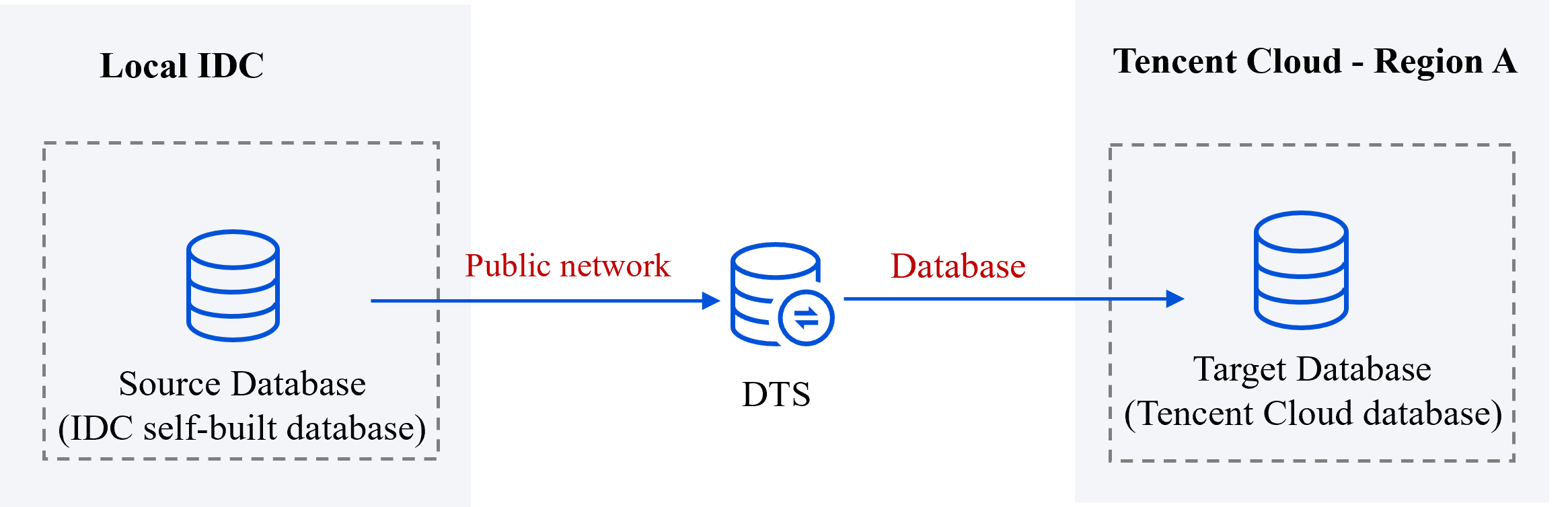
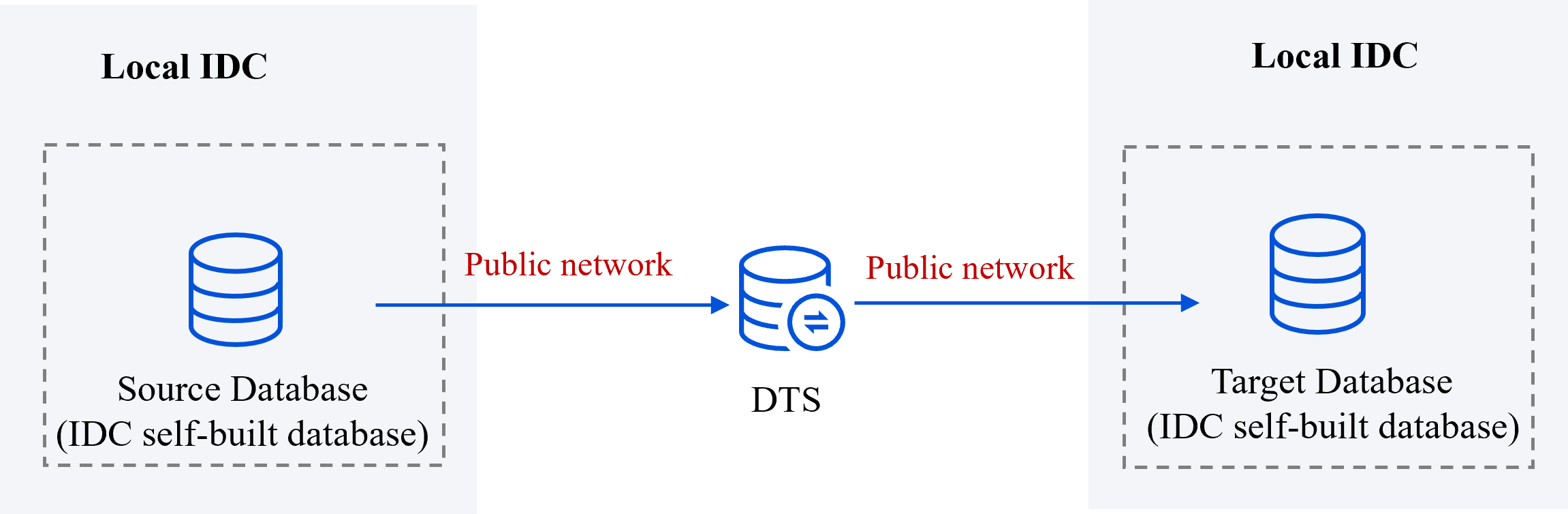
DTS supports using the local IDC database as a source/destination for data transmission, as shown in the examples below.
Scenario One: Local IDC Database (Public Network) -> Tencent Cloud Database (Database)


Scenario Two: Local IDC Database (Public Network ) -> Local IDC Database (Public Network)


DTS Task Configuration

The following explains configuration instructions using Scenario One as an example.
1. When a DTS task is purchased, select the DTS region closest to the source database as the Source Instance Region. Select the region where the target database is located as the Target Instance Region, i.e., A.
2. When a DTS task is configured, in the source database and target database settings, select public network as Access Type.
3. Connectivity Test
If the database and its associated network have configured security access rules, such as security groups, firewall, IP access restrictions, etc., it is necessary to allow DTS IP address, otherwise, connectivity test may fail.

Allow DTS Service IP

1. When the connectivity test fails, follow the instructions in the popup to access "DTS Service IP".
2. Sequentially check if the database has set the following network rules, and if yes, allow DTS Service IP in the corresponding rules.
Check if network ACLs or security groups are set for the database-associated network layer.
Check if the firewall is set for the server layer where the database resides (e.g., iptables rules for Linux systems).
Check if IP access restrictions are set for the source database layer.
ヘルプとサポート

この記事はお役に立ちましたか?

フィードバック