During the configuration or execution of data synchronization tasks in Data Transfer Service (DTS), the number of concurrent tasks and RPS can be flexibly adjusted based on the data write volume of the source database and the resource configurations of the source and target databases.
Note:
This document only describes how to use DTS performance parameters. If you want to comprehensively improve DTS transfer performance, you need to conduct an analysis based on the workloads of both the source and target and the network conditions. For details, see DTS Performance Tuning Best Practices.
Applicable Scope
Data synchronization: link between MySQL/MariaDB/Percona/TDSQL-C for MySQL/TDSQL Boundless/TDSQL for MySQL/Kafka/MongoDB.
Must-Knows
1. During task configuration or when the task status is Running, speed limit operations can be performed.
2. When reducing the task transfer speed, monitor both the amount of delayed data and the delay time. DTS caches intermediate data only for 7 days by default. Excessively high latency over an extended period may cause the cached intermediate data to expire, resulting in a complete task failure.
3. Adjusting the speed may cause the task to restart. In certain restart scenarios, the synchronization task needs to start from the beginning.
The link between MySQL/MariaDB/Percona/TDSQL-C for MySQL/TDSQL Boundless/TDSQL for MySQL/Kafka has the following specific impacts:
3.1 Restart during the full export phase.
During the structure export phase or the export phase of tables without primary keys, restarting a task requires resuming synchronization from the beginning.
During the export phase of tables with primary keys, if the interval between the original synchronization start time X and the retry time Y is less than or equal to 48 hours, resumable transfer is supported; if the interval exceeds 48 hours, synchronization restarts from the beginning. After a manual or automatic restart that triggers a full resynchronization, the start time X will be reset.
3.2 Restart during the full import or incremental synchronization phase: Resumable transfer is supported, and the data transfer will not be affected.
4. If you modify the full speed parameters (number of full export threads and RPS; number of full import threads and RPS) in speed limiting for the first time, when subsequently performing the operation to modify synchronization objects, you will first be redirected to the speed limiting parameter adjustment page. It is recommended that you increase the full speed parameters as much as possible based on a comprehensive assessment of the load on the source and target databases to avoid prolonged full synchronization for added objects.
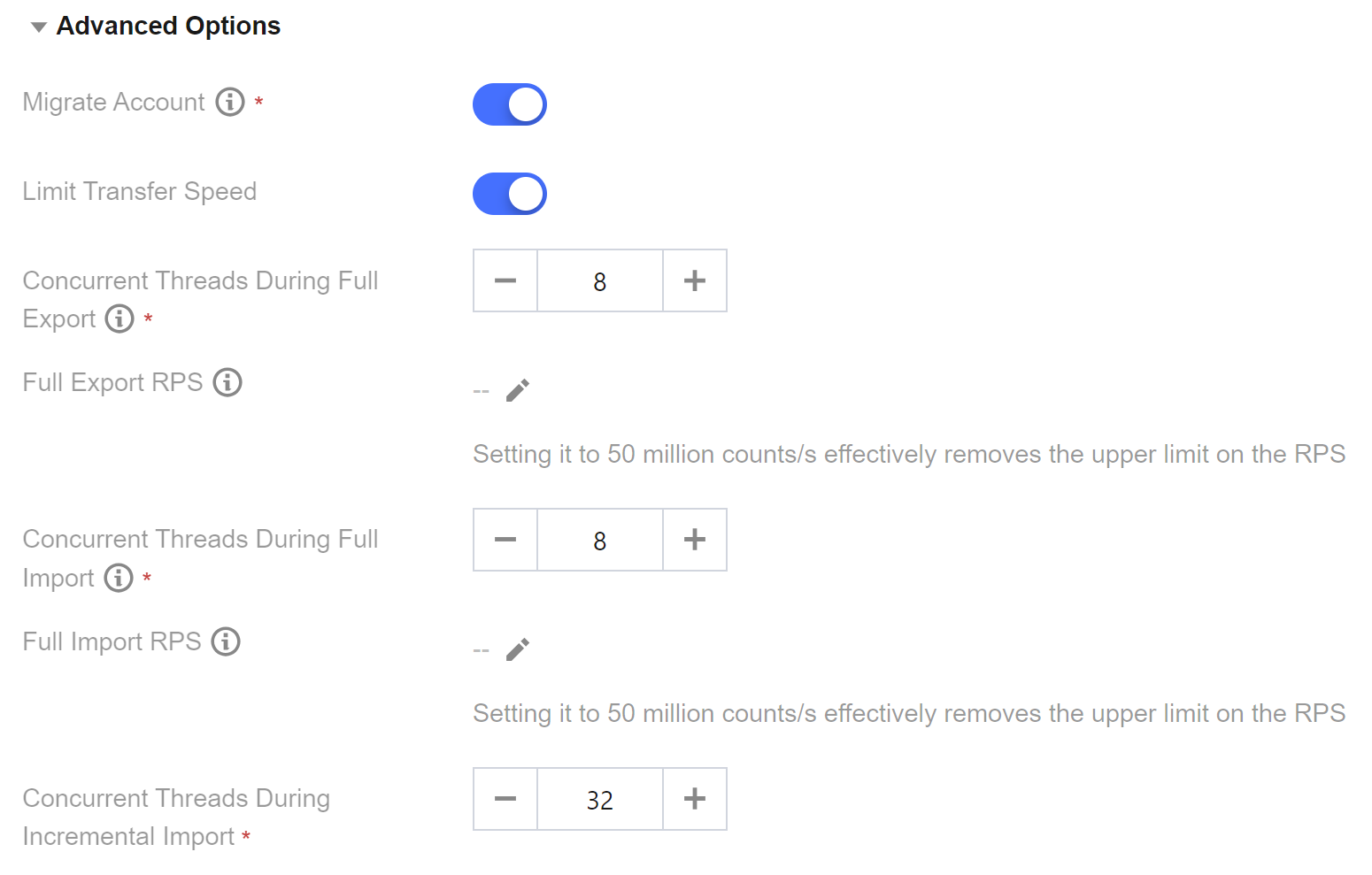
5. After speed limiting is disabled, DTS resets the speed parameters to their default values: the number of threads for full export and import is set to 8, the full export and import RPS is set to 50 million, and the number of threads for incremental import is set to 32.
6. The MongoDB link supports dynamically adjusting speed limits during full and incremental phases without affecting data transfer.
Adjustment Principles
The default number of concurrent threads for full export in DTS tasks is 8, which generally requires no modification. If adjustments are needed, refer to the monitoring metrics and the configurations of the source and target databases, and maximize the DTS transfer speed without impacting the source and target database performance.
The transfer performance of DTS is influenced by the configurations of source and target databases, the specifications of DTS tasks, network latency, bandwidth, and other factors. Therefore, simply increasing the number of threads or RPS may not effectively improve the transfer performance of DTS. Instead, you need to identify which part of the process is causing the bottleneck and address specific issues accordingly.
Note:
In synchronization tasks using the conflict resolution policy, if the target database experiences significant lock conflicts leading to increased latency, it is recommended to adjust the "target database's incremental import concurrency threads" to 1 (single-threaded writing). This can effectively avoid frequent deadlock conflicts and improve synchronization speed. However, single-threaded writing may lead to increased synchronization latency when the source write volume is high.
Task Phase
Adjustment Scenario
Adjustment Plan
Adjustment Result
Task configuration phase
The source database configuration is too low to handle the additional load imposed by DTS, causing the source database to crash after the DTS task starts.
Reduce the number of export threads of the source database and lower the export RPS.
Effective.
The target database configuration is too low to handle the additional load imposed by DTS, causing the target database to crash after the DTS task starts.
Reduce the number of import threads of the target database and lower the import RPS.
Effective.
Full migration phase
The source and target database configurations are high, but the DTS full data transfer speed is slow.
If the source database configuration is high, increase the number of export threads of the source database.
If the configuration of the target database is high, increase the number of import threads of the target database.
The default RPS in the full migration phase is very high, so it is generally unnecessary to adjust RPS when improving the transfer rate.
Not necessarily effective.
If the adjustment does not take effect, investigate factors such as network latency and bandwidth, as these may also affect transfer performance.
The target database configuration is low, and the speed of DTS writing data to the target database is too fast, which impacts the target database load (such as high CPU utilization).
Reduce the number of import threads of the target database and lower the target database import RPS.
Effective.
Incremental phase
The source database configuration is high, the amount of data written to the source database is large, and the network latency is high.
Check whether RPS has reached the upper limit. Different specifications of DTS tasks correspond to different RPS upper limits.
If RPS has reached the upper limit, upgrade the DTS task specification first (implemented through the specification change operation).
If the task upgrade does not take effect, investigate factors such as network latency and bandwidth, as these may also affect transfer performance.
The target database configuration is low, and the speed of DTS writing data to the target database is too fast, which impacts the target database load (such as high CPU utilization).
1. Lower the DTS task specification.
2. Reduce the number of concurrent import threads of the target database.
Effective.
The target Kafka configuration is low, and the speed of DTS writing data to the target database is too fast, which impacts the target database load.
In the synchronization link to TDMQ for CKafka (CKafka), if the write speed is too high, reducing the write RPS and the number of threads of the target database may not yield significant improvements. It is recommended to first adjust the bandwidth and number of partitions of CKafka.
1. Increase the network bandwidth configuration of CKafka.
2. Adjust the number of partitions of Ckafka. Concurrent writes into multiple partitions can increase the speed of writing to Ckafka.
Effective.
The target database configuration is low, and the number of DTS connections is too large, causing the target database to reach the thread upper limit.
Reduce the number of import threads of the target database.
Effective.
DTS writing to the target database causes lock contention with the target database's own write operations (such as the Lock wait timeout error).
Reduce the number of import threads of the target database to decrease lock contention.
Effective.
Speed Limiting During Task Configuration
During the initial configuration of the synchronization task, you can configure the parameters for the data transfer speed in Advanced Options on the Set Synchronization Options and Objects page.
Speed Limiting During Task Running
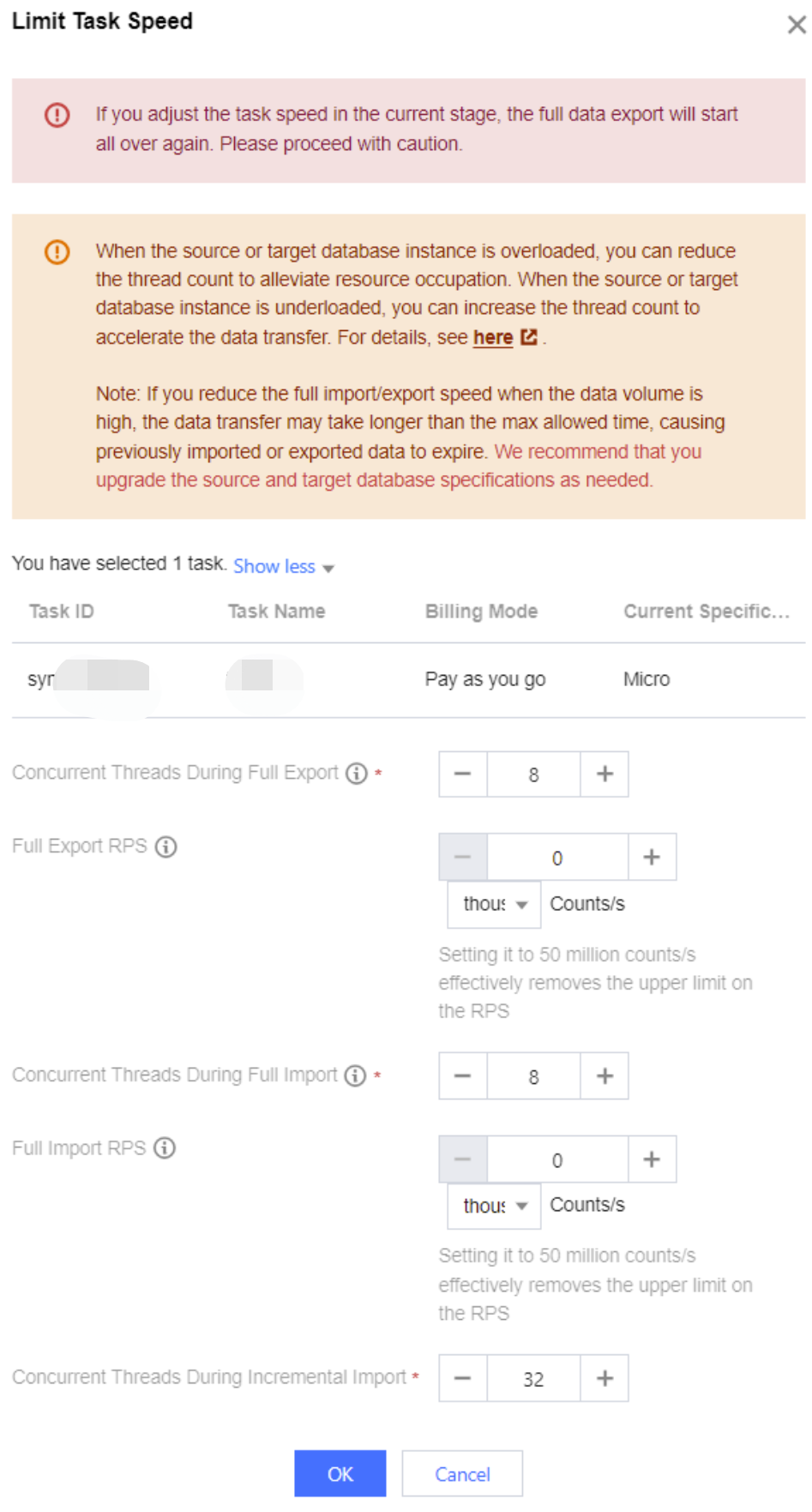
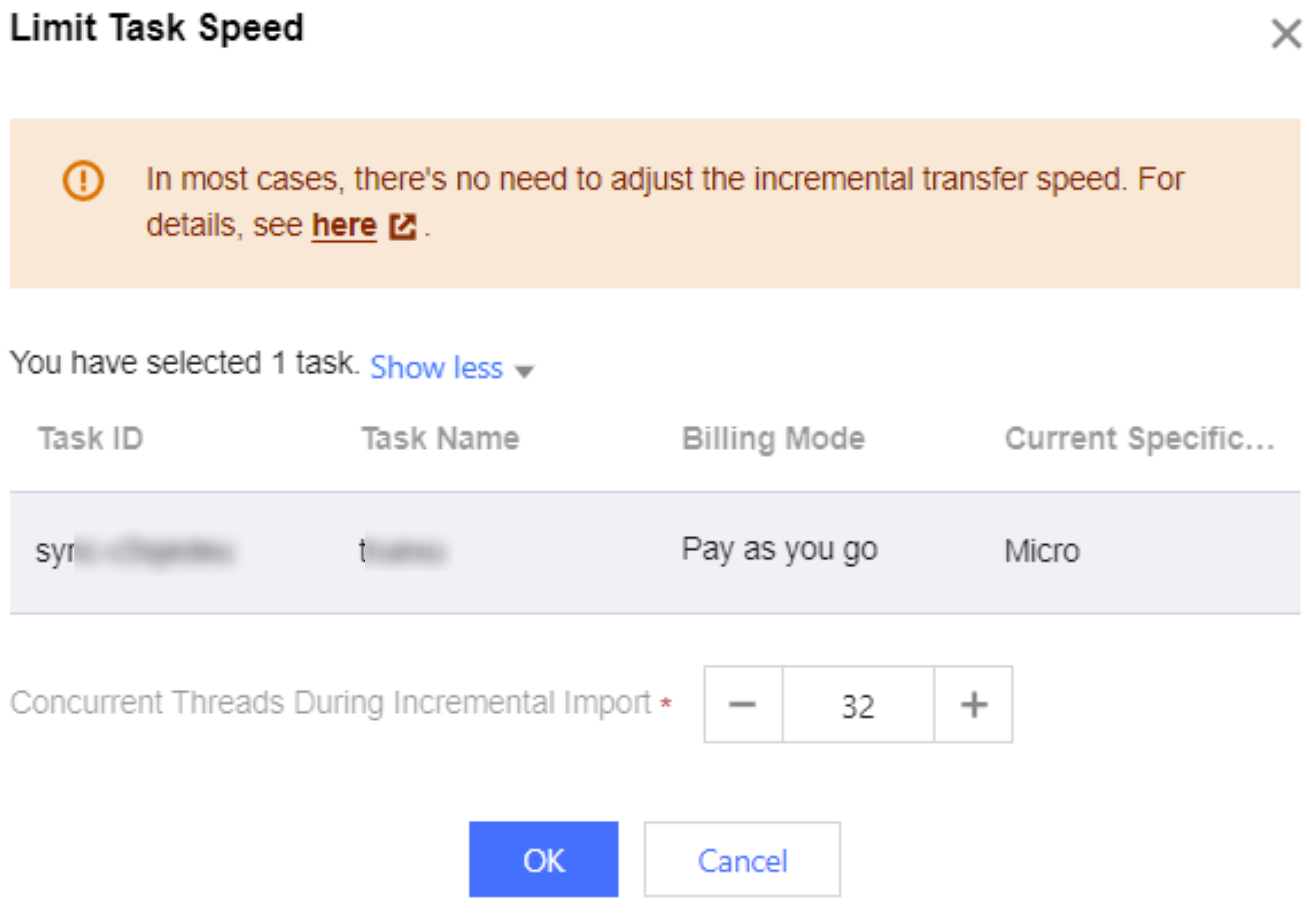
When performing speed limiting during the full data synchronization phase, you can modify speed parameters for both full and incremental synchronization (such as the number of full export threads and RPS, the number of full import threads and RPS, and the number of incremental import threads). When performing speed limiting during the incremental data synchronization phase, you can only adjust speed parameters for incremental synchronization (such as the number of incremental import threads). For details, see the following operations.
1. Log in to the DTS console, select the Data Synchronization page in the left sidebar, and select the specified synchronization task.
2. Perform speed limiting during the full data synchronization phase.
In the Operation column, choose More > Limit Speed.
In the pop-up window, adjust the speed parameters and click OK.
3. Perform speed limiting during the incremental data synchronization phase.
In the Operation column, choose More > Limit Speed.