tencent cloud

SSL Certificates

Release Notes
Announcements
Notice on price adjustment of DigiCert and its affiliated brands'SSL certificates​
Price Change to DigiCert SSL Certificates
TrustAsia Root Certificate Update
Domain Validation Policy Update
SSL Certificate Service Console
Multi-Year SSL Certificate and Automatic Review
Notice on Stopping the Issuance of 2-Year SSL Certificates by CAs Starting from September 1, 2020
Announcement on Stop Using the Symantec SSL Certificate Name After 30 April 2020
Notice on Certificate Revocation Due to Private Key Compromises
Notice on Application Limits for DV SSL Certificates
Notice on Adjustment of Free SSL Certificates Policy
Let's Encrypt Root Certificate Expired on September 30, 2021
Product Introduction
Overview
Introduction to Tencent Cloud SSL Certificates
Strengths
Advantages of HTTPS
Browser Compatibility Test Report
Multi-Year SSL Certificate and Automatic Review Overview
SSL Certificate Security
Purchase Guide
Pricing
SSL Certificate Purchase Process
SSL Certificate Selection
Paid SSL Certificates Renewal
SSL Certificate Renewal Process
SSL Certificate Refund Process
Getting Started
Certificate Application
Information Submission Process for Paid SSL Certificates
Domain Ownership Validation
Domain Validation Method Selection
Automatic DNS Addition
DNS Validation
File Validation
Automatic DNS Validation
Automatic File Validation
Validation Result Troubleshooting Guide
Operation Guide
Domain Ownership Verification
Uploading Certificates
Secured Seal
CSR Management
Certificate Installation
Installing an SSL Certificate on a Tencent Cloud Service
Installation of International Standard Certificates
Selecting an Installation Type for an SSL Certificate
Certificate Management
Instructions on SSL Certificate Auto-Renewal
Certificate Hosting
Uploading (Hosting) an SSL Certificate
Reminding Reviewers to Review an SSL Certificate Application
Revoking an SSL Certificate
Deleting an SSL Certificate
Reissuing an SSL Certificate
Ignoring SSL Certificate Notifications
Customizing SSL Certificate Expiration Notifications
API Documentation
History
Introduction
API Category
Making API Requests
Certificate APIs
Certificate Renewal (Certificate ID Unchanged) APIs
CSR APIs
Data Types
Error Codes
Use Cases
Automatic Solution for Implementing and Issuing Multi-Year Certificates and Binding Resources
Apple ATS Server Configuration
Quickly Applying for a Free SSL Certificate via DNSPod
Enabling Tencent Cloud DDNS and Installing Free Certificates for Synology NAS
Batch Applying for and Downloading Free Certificates Using Python-based API Calls
Profile Management
Adding Organization Profile
Adding Administrator
Adding Domain
Troubleshooting
Domain Validation Failed
Domain Security Review Failed
Website Inaccessible After an SSL Certificate is Deployed
404 Error After the SSL Certificate is Deployed on IIS
“Your Connection is Not Secure” is Displayed After the SSL Certificate is Installed
Message Indicating Parsing Failure Is Displayed When a Certificate Is Uploaded
Automatic DNS Validation Failed for a Domain Hosted with www.west.cn
Host Name Field Cannot Be Edited in IIS Manager When Type Is Set to https
Message Indicating Intermediate Certificates Missing in Chain Is Displayed When a Free SSL Certificate Is Deployed on IIS
FAQs
SSL Certificate Selection
SSL Certificate Application
SSL Certificate Management
SSL Certificate Installation
SSL Certificate Region
SSL Certificate Review
SSL Certificate Taking Effect
SSL Certificate Billing and Purchase
SSL Certificate Validity Period
Related Agreement
SSL Service Level Agreement
Contact Us
Glossary
DocumentationSSL CertificatesFAQsSSL Certificate Taking EffectWhat Should I Do If the Issue of a Free SSL Certificate Takes Too Long or Failed?

What Should I Do If the Issue of a Free SSL Certificate Takes Too Long or Failed?

PDF
Focus Mode
Font Size
Last updated: 2024-03-06 18:03:04
This document describes how to troubleshoot a failure to issue the free SSL certificate due to domain ownership verification timeout when you apply for the certificate from Tencent Cloud.
Note:
It generally takes up to 30 minutes to issue a free SSL certificate, after which you can troubleshoot the timeout as instructed in this document.

Checking the CAA Record

CAA records need to be checked for both file validation and DNS validation. If there are no CAA records or they contain 0 issuewild "sectigo.com" and 0 issue "sectigo.com", the check can be passed.

dig command

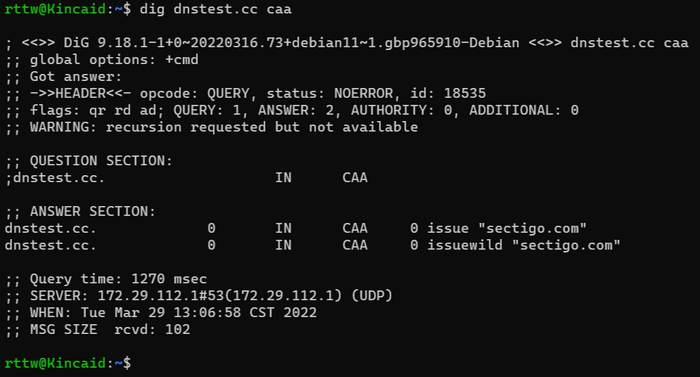
dig domain name CAA
Everything is normal if the returned value is empty or contains 0 issuewild "sectigo.com" and 0 issue "sectigo.com", as shown below:


DNS diagnosis tool

Go to the DNS diagnosis tool, enter the primary domain, select CAA, and click Check. Everything is normal if the returned value is empty or contains 0 issuewild "sectigo.com" and 0 issue "sectigo.com".
Note:
If the check fails or only certain regions can be checked, check the DNS settings of the domain.

Solution

If the returned result is not empty and does not contain 0 issuewild "sectigo.com" and 0 issue "sectigo.com", add the following records to the DNS settings:
Host
Record Type
Split Zone
Record Value
@
CAA
Default
0 issuewild "sectigo.com"
@
CAA
Default
0 issue "sectigo.com"

Checking the DNS Record

After checking the CAA record, check whether the validation record has been added. For self-built NS servers or those with DNS query limits outside the Chinese mainland, check whether the DNS query outside the Chinese mainland is normal with the DNS diagnosis tool or DNSCHCKER. In general, all monitored points can return values and their returned values are the same.
1. Determine the domain to be checked. The domain to be checked should be in the format of host.domain; for example, if the certificate's host is _26A56EBADCE479E******5D304C0D8.blog and the domain is dnspod.cn, the domain to be checked should be _26A56EBADCE479E******5D304C0D8.blog.dnspod.cn.
2. Go to the DNS diagnosis tool, enter the target domain, select CNAME, and click Check. Everything is normal if the returned value is the record value prompted in the console.

Checking Whether the Validation IP Is Blocked by the Server

If you wait a long time for the certificate to be issued by the CA after passing the file validation, it's possible that the server or data center has blocked the CA's validation IPs (64.78.193.238 and 216.168.247.9). In that case, add them to the allowlist.
Help and Support

Was this page helpful?

Help us improve! Rate your documentation experience in 5 mins.

Feedback