tencent cloud

Tencent Cloud Lighthouse

Release Notes and Announcements
Image Release Notes
Announcements
Product Introduction
Overview
Basic Concepts
Strengths
Scenarios
Use Limits
Region and Network Connectivity
Product Comparison
User Guide
Billing
Billing Overview
Instance Package
Pricing Details
Purchase Methods
Configuration Adjustment (for Upgrade Only)
Overdue Payments
Refund
Getting Started
One-Click Application Creation Using Lighthouse
Quick Instance Creation
User Guide
Instances
Cloud Disks
Images
Firewall
Private Network Interconnection
Data Backup and Restoration Using Snapshots
Cloud Access Management
OPS and Monitoring
File Transfer
Use Cases
Website Building
Development Environment Building
Cloud Storage System Building
E-commerce Platform Building
Personal Live Streaming Room Building
FTP Service Building
SSL Certificate Installation
Troubleshooting
Windows Instance: RDP Connection to the Remote Computer Fails
Windows Instance: Offline Password Resetting Fails or Invalid
Linux/Windows Instance: Online Password Resetting Fails or Invalid
API Documentation
History
Introduction
API Category
Making API Requests
Image APIs
Firewall APIs
Key APIs
Instance APIs
Snapshot APIs
CCN APIs
Other APIs
Cloud Disk APIs
Scene APIs
Package APIs
Quota APIs
Region APIs
Data Types
Error Codes
FAQs
Agreements
Privacy Policy
Data Processing And Security Agreement
Contact Us

Building a Node.js Development Environment

PDF
聚焦模式
字号
最后更新时间: 2022-06-16 16:42:25

Overview

Node.js is an event-driven I/O server-side JavaScript environment based on the Chrome V8 engine. Fast and powerful, it can be used to build all kinds of web applications and work as the backend service environment for mini programs.
Note:
In the following example, we use the Node.js application image, which is based on CentOS 8.2 64-bit. Note that application images are subject to updates from time to time, and the actual image information on the purchase page shall prevail.

Directions

1. Log in to the Lighthouse console and configure the following parameters:
Region and Availability zone: Select the region and AZ near your target users to reduce the network latency and improve their access speed.
Image: Select the Node.js application image.
Instance bundle: Select an instance bundle according to the required instance configuration (including CPU, memory, system disk, bandwidth, and monthly traffic).
Instance name: Enter a custom instance name. If it is left empty, the selected image name will be used as the name by default. When multiple instances are created in a batch, their names will be consecutive with auto-incrementing suffixes. For example, if you enter "LH" as the name and select 3 as the quantity, 3 instances "LH1", "LH2", and "LH3" will be created.
Purchase period: One month by default.
Quantity: One instance by default.
2. Click Buy now to submit your order and make the payment as prompted.
Relevant Operations

Viewing application information

1. Log in to the Lighthouse console.
2. In the instance list, select the target instance created with the Node.js application image to enter its details page.
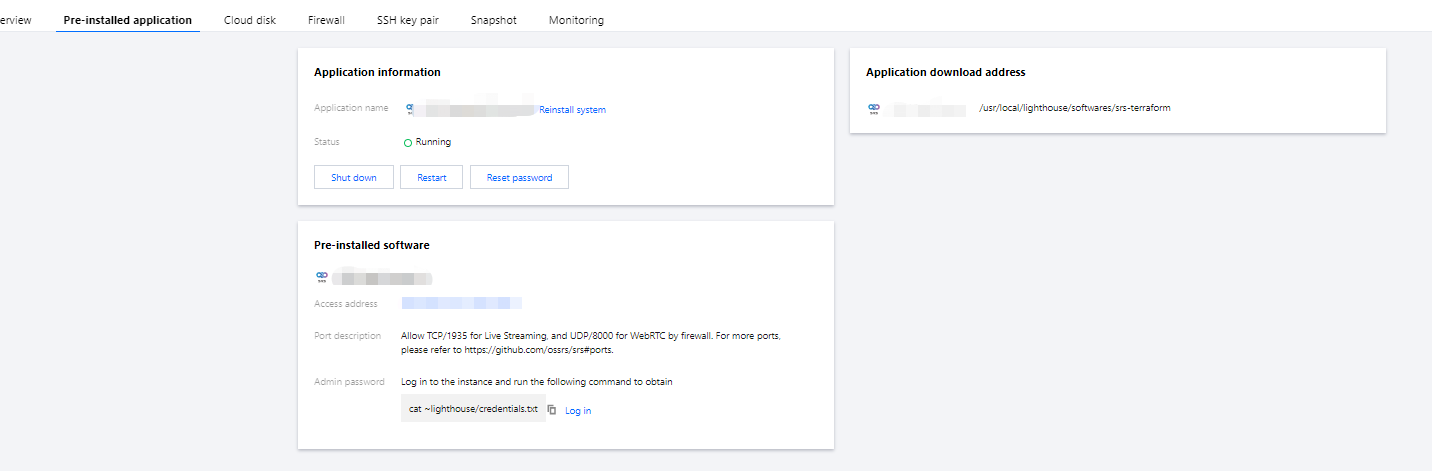
3. Select the Pre-installed application tab to enter the application details page.

You can view the configuration items of pre-installed applications.
Node.js and NGINX software installation paths.
The npm and npx paths of Node.js, and the primary configuration file path of NGINX.

Using FTP tool to upload code and debug

1. Log in to the instance created with the Node.js application image. Set up the FTP service as instructed in Building FTP Service using Linux Instance.
2. Use an FTP tool (such as WinSCP) on your local computer to upload your website code to the instance and test and debug the service.

Enabling HTTPS access

You can install an SSL certificate and enable HTTPS access for your website. See Installing Certificate on NGINX Server.

帮助和支持

本页内容是否解决了您的问题?

填写满意度调查问卷,共创更好文档体验。

文档反馈