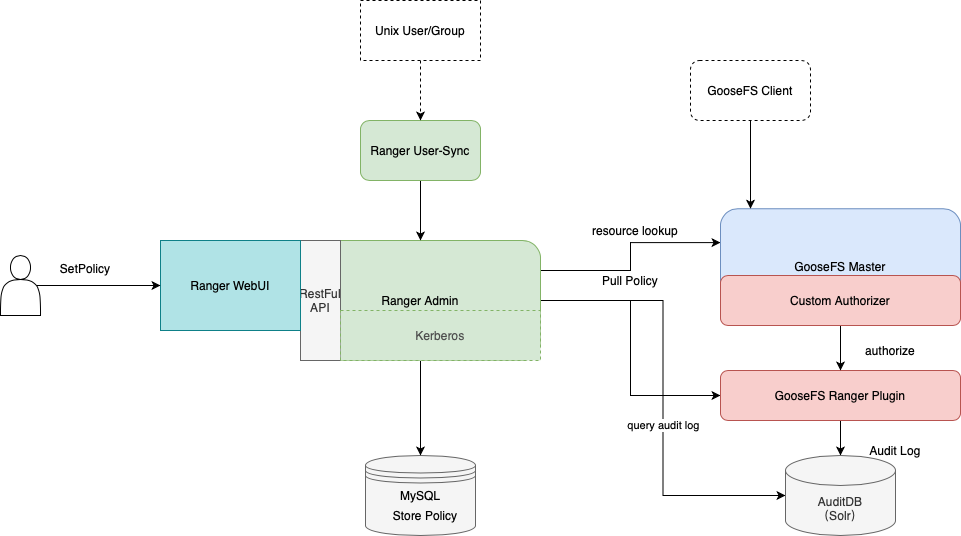
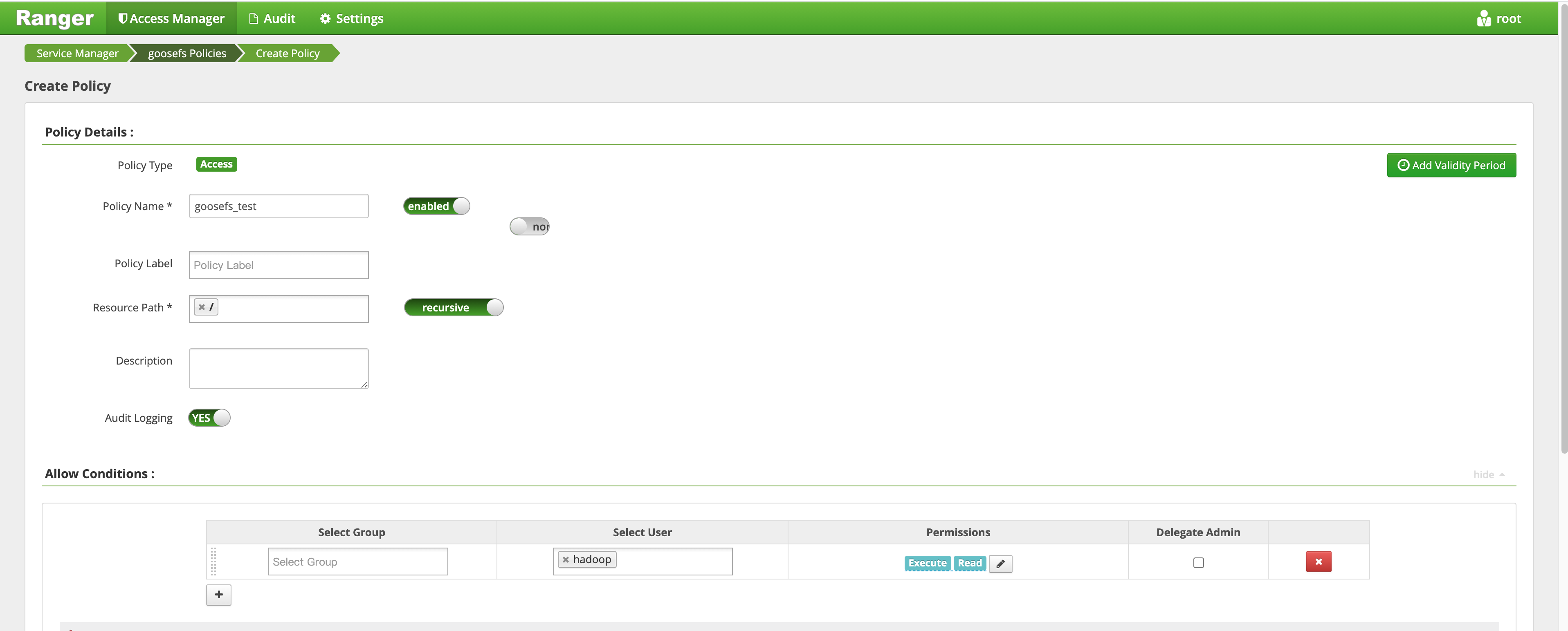
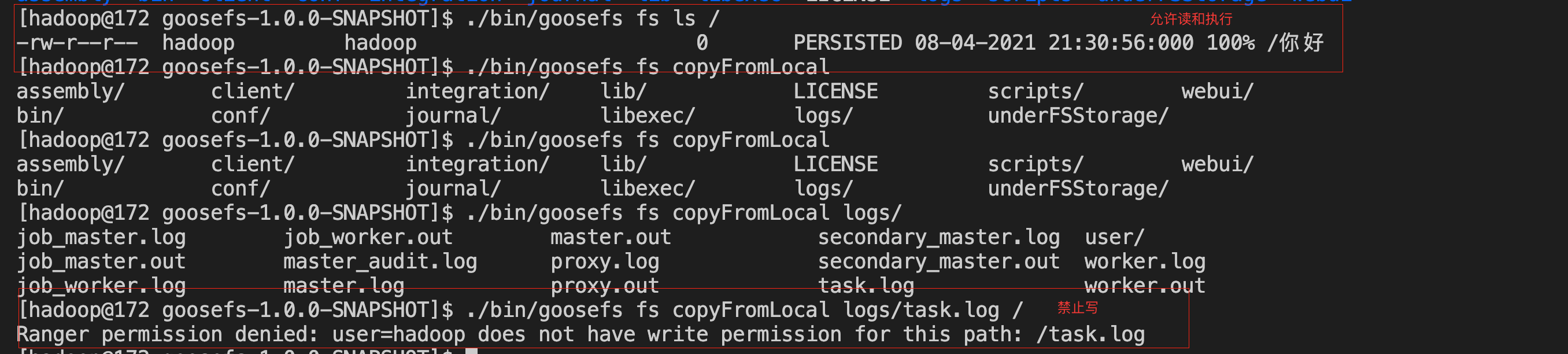
Authorizer API to authenticate each metadata request on the GooseFS master node./usr/local/service/ranger/ews/webapp/WEB-INF/classes/ranger-plugins.
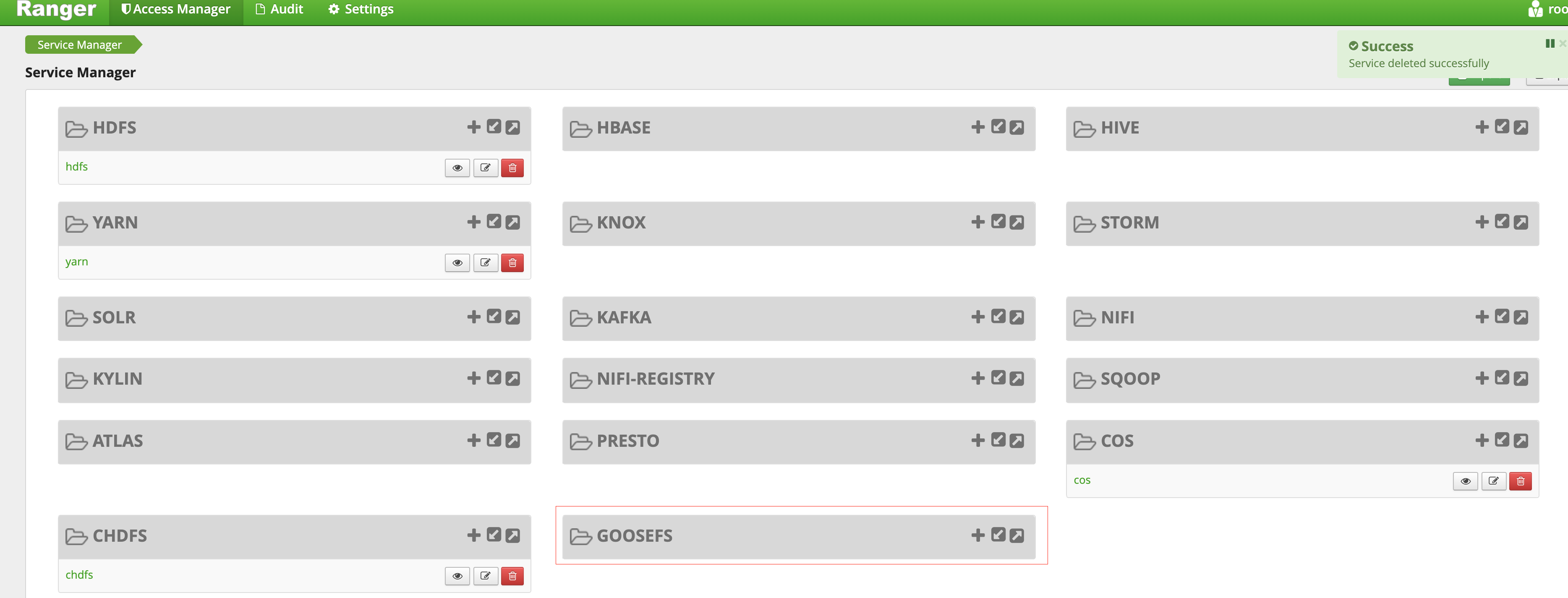
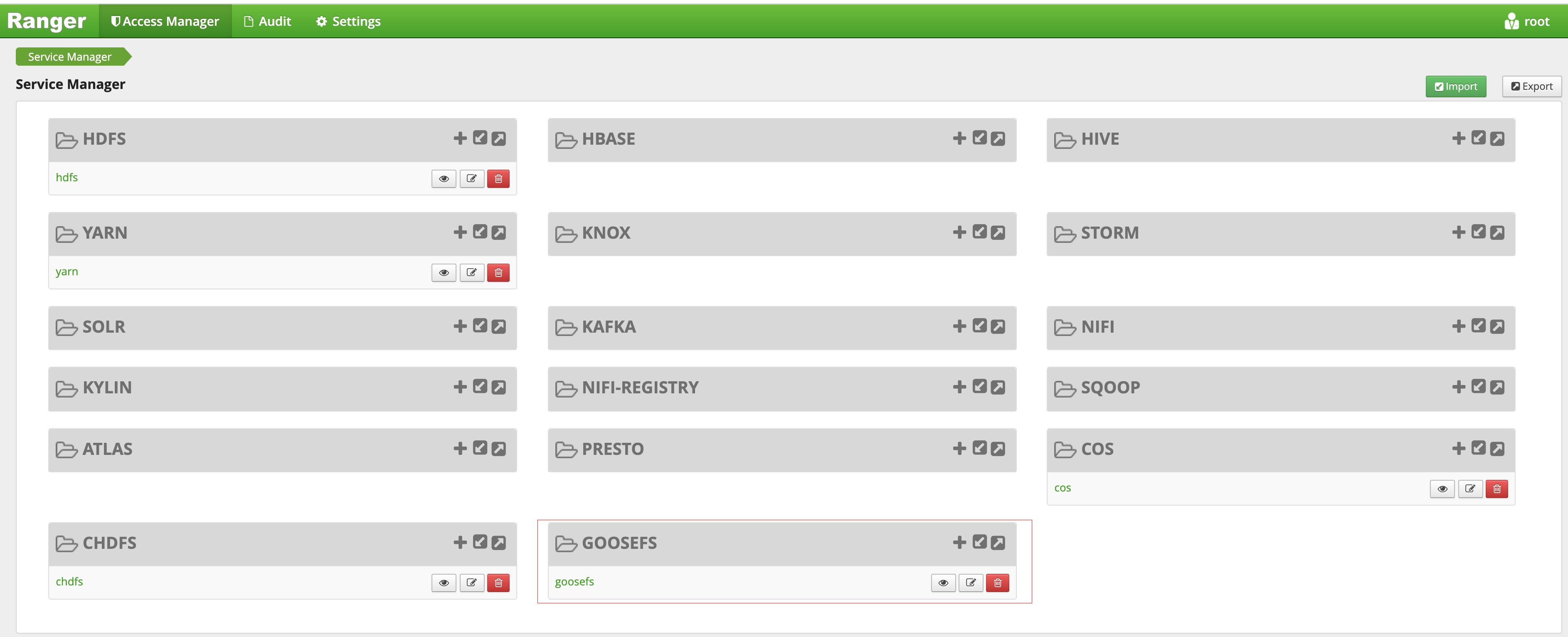
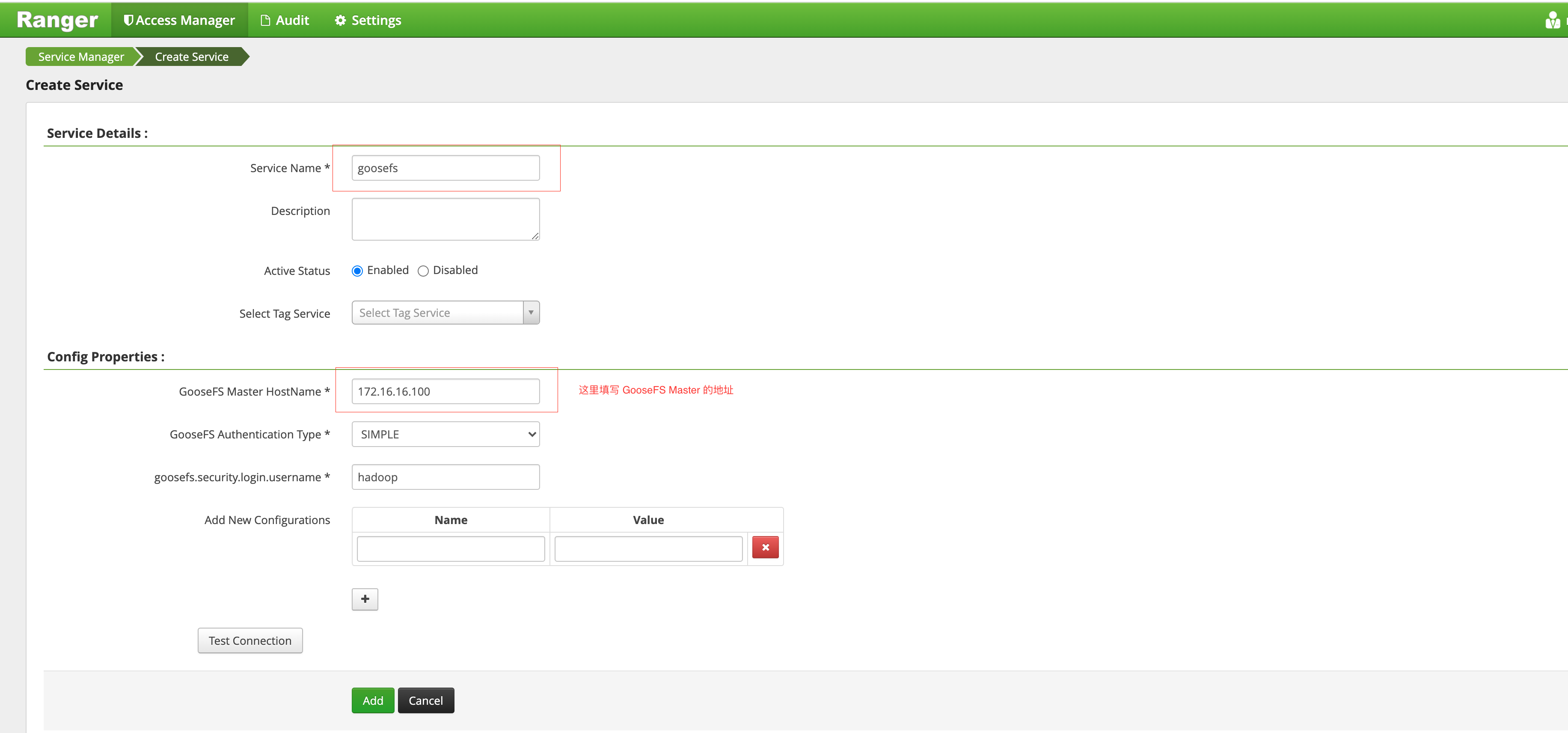
goosefs-ranger-plugin-${version}.jar and ranger-servicedef-goosefs.json in the GooseFS directory. Note that you should have read permission.# Create the service. The Ranger admin account and password, as well as the Ranger service address should be specified.# For the Tencent Cloud EMR cluster, the admin is the root, and the password is the root account’s password that is set when the EMR cluster is created. The Ranger service IP is the master node IP of the EMR.adminUser=rootadminPasswd=xxxxrangerServerAddr=10.0.0.1:6080curl -v -u${adminUser}:${adminPasswd} -X POST -H "Accept:application/json" -H "Content-Type:application/json" -d @./ranger-servicedef-goosefs.json http://${rangerServerAddr}/service/plugins/definitions# When the service is successfully registered, a service ID will be returned, which should be remembered.# To delete the GooseFS service, pass the service ID returned to run the following command:serviceId=104curl -v -u${adminUser}:${adminPasswd} -X DELETE -H "Accept:application/json" -H "Content-Type:application/json" http://${rangerServerAddr}/service/plugins/definitions/${serviceId}


goosefs-ranger-plugin-${version}.jar in the \\${GOOSEFS_HOME}/lib directory. You should at least have read permission.ranger-goosefs-audit.xml, ranger-goosefs-security.xml, and ranger-policymgr-ssl.xml to the \\${GOOSEFS_HOME}/conf directory and configure the required parameters as follows:ranger-goosefs-security.xml:<configuration xmlns:xi="http://www.w3.org/2001/XInclude"><property><name>ranger.plugin.goosefs.service.name</name><value>goosefs</value></property><property><name>ranger.plugin.goosefs.policy.source.impl</name><value>org.apache.ranger.admin.client.RangerAdminRESTClient</value></property><property><name>ranger.plugin.goosefs.policy.rest.url</name><value>http://10.0.0.1:6080</value></property><property><name>ranger.plugin.goosefs.policy.pollIntervalMs</name><value>30000</value></property><property><name>ranger.plugin.goosefs.policy.rest.client.connection.timeoutMs</name><value>1200</value></property><property><name>ranger.plugin.goosefs.policy.rest.client.read.timeoutMs</name><value>30000</value></property></configuration>
ranger-goosefs-audit.xml (you can skip it if audit is disabled):<configuration><property><name>xasecure.audit.is.enabled</name><value>false</value></property><property><name>xasecure.audit.db.is.async</name><value>true</value></property><property><name>xasecure.audit.db.async.max.queue.size</name><value>10240</value></property><property><name>xasecure.audit.db.async.max.flush.interval.ms</name><value>30000</value></property><property><name>xasecure.audit.db.batch.size</name><value>100</value></property><property><name>xasecure.audit.jpa.javax.persistence.jdbc.url</name><value>jdbc:mysql://localhost:3306/ranger_audit</value></property><property><name>xasecure.audit.jpa.javax.persistence.jdbc.user</name><value>rangerLogger</value></property><property><name>xasecure.audit.jpa.javax.persistence.jdbc.password</name><value>none</value></property><property><name>xasecure.audit.jpa.javax.persistence.jdbc.driver</name><value>com.mysql.jdbc.Driver</value></property><property><name>xasecure.audit.credential.provider.file</name><value>jceks://file/etc/ranger/hadoopdev/auditcred.jceks</value></property><property><name>xasecure.audit.hdfs.is.enabled</name><value>true</value></property><property><name>xasecure.audit.hdfs.is.async</name><value>true</value></property><property><name>xasecure.audit.hdfs.async.max.queue.size</name><value>1048576</value></property><property><name>xasecure.audit.hdfs.async.max.flush.interval.ms</name><value>30000</value></property><property><name>xasecure.audit.hdfs.config.encoding</name><value></value></property><!-- hdfs audit provider config--><property><name>xasecure.audit.hdfs.config.destination.directory</name><value>hdfs://NAMENODE_HOST:8020/ranger/audit/</value></property><property><name>xasecure.audit.hdfs.config.destination.file</name><value>%hostname%-audit.log</value></property><proeprty><name>xasecure.audit.hdfs.config.destination.flush.interval.seconds</name><value>900</value></proeprty><property><name>xasecure.audit.hdfs.config.destination.rollover.interval.seconds</name><value>86400</value></property><property><name>xasecure.audit.hdfs.config.destination.open.retry.interval.seconds</name><value>60</value></property><property><name>xasecure.audit.hdfs.config.local.buffer.directory</name><value>/var/log/hadoop/%app-type%/audit</value></property><property><name>xasecure.audit.hdfs.config.local.buffer.file</name><value>%time:yyyyMMdd-HHmm.ss%.log</value></property><property><name>xasecure.audit.hdfs.config.local.buffer.file.buffer.size.bytes</name><value>8192</value></property><property><name>xasecure.audit.hdfs.config.local.buffer.flush.interval.seconds</name><value>60</value></property><property><name>xasecure.audit.hdfs.config.local.buffer.rollover.interval.seconds</name><value>600</value></property><property><name>xasecure.audit.hdfs.config.local.archive.directory</name><value>/var/log/hadoop/%app-type%/audit/archive</value></property><property><name>xasecure.audit.hdfs.config.local.archive.max.file.count</name><value>10</value></property><!-- log4j audit provider config --><property><name>xasecure.audit.log4j.is.enabled</name><value>false</value></property><property><name>xasecure.audit.log4j.is.async</name><value>false</value></property><property><name>xasecure.audit.log4j.async.max.queue.size</name><value>10240</value></property><property><name>xasecure.audit.log4j.async.max.flush.interval.ms</name><value>30000</value></property><!-- kafka audit provider config --><property><name>xasecure.audit.kafka.is.enabled</name><value>false</value></property><property><name>xasecure.audit.kafka.async.max.queue.size</name><value>1</value></property><property><name>xasecure.audit.kafka.async.max.flush.interval.ms</name><value>1000</value></property><property><name>xasecure.audit.kafka.broker_list</name><value>localhost:9092</value></property><property><name>xasecure.audit.kafka.topic_name</name><value>ranger_audits</value></property><!-- ranger audit solr config --><property><name>xasecure.audit.solr.is.enabled</name><value>false</value></property><property><name>xasecure.audit.solr.async.max.queue.size</name><value>1</value></property><property><name>xasecure.audit.solr.async.max.flush.interval.ms</name><value>1000</value></property><property><name>xasecure.audit.solr.solr_url</name><value>http://localhost:6083/solr/ranger_audits</value></property></configuration>
ranger-policymgr-ssl.xml<configuration><property><name>xasecure.policymgr.clientssl.keystore</name><value>hadoopdev-clientcert.jks</value></property><property><name>xasecure.policymgr.clientssl.truststore</name><value>cacerts-xasecure.jks</value></property><property><name>xasecure.policymgr.clientssl.keystore.credential.file</name><value>jceks://file/tmp/keystore-hadoopdev-ssl.jceks</value></property><property><name>xasecure.policymgr.clientssl.truststore.credential.file</name><value>jceks://file/tmp/truststore-hadoopdev-ssl.jceks</value></property></configuration>
goosefs-site.properties:...goosefs.security.authorization.permission.type=CUSTOMgoosefs.security.authorization.custom.provider.class=org.apache.ranger.authorization.goosefs.RangerGooseFSAuthorizer...
\\${GOOSEFS_HOME}/libexec/goosefs-config.sh, add goosefs-ranger-plugin-${version}.jar to the GooseFS class paths:...GOOSEFS_RANGER_CLASSPATH="${GOOSEFS_HOME}/lib/ranger-goosefs-plugin-${version}.jar"GOOSEFS_SERVER_CLASSPATH=${GOOSEFS_SERVER_CLASSPATH}:${GOOSEFS_RANGER_CLASSPATH}...


Feedback