tencent cloud

Cloud Virtual Machine

Release Notes and Announcements
Release Notes
Public Image Release Notes
Official End of Support Plan for the Operating System
Announcements
Product Introduction
CVM Overview
Strengths
Basic Concepts
Regions and Zones
Tutorial
Service Regions and Service Providers
Billing
Billing Overview
Billing Modes
Billing Items
Billing Mode Conversion Overview
Purchasing Instances
Configuration Adjustment Billing Guide
Overdue Payments
Getting Started
Purchasing a Customized Linux Instance
Purchasing a Customized Windows Instance
User Guide
Operation Guide Overview
Use Limits
Instances
Spot Instances
Reserved Instances
Images
Storage
Backup and Restoration
Network
Security
Passwords/Keys
Monitoring and Alarms
Ops Management
Convenience Features
Migrating a Server
Online Migration
Migration Consultation
Troubleshooting
CVM Login Failures
Windows Instance Login Failures
Linux Instance Login Failures
Other Login Failures
Instance Running Failures
Linux Instance Memory Failures
Network Failures
Use Cases
Suggestions on CVM Model Selection
Environment Building
Website Building
Application Building
Visual GUI Building
Uploading Local Files to CVM
Network Performance Test
Other Practical Tutorials
API Documentation
History
Introduction
API Category
Making API Requests
Region APIs
Instance APIs
Cloud Hosting Cluster APIs
Image APIs
Instance Launch Template APIs
Placement Group APIs
Key APIs
Security Group APIs
Network APIs
Data Types
Error Codes
Security and Compliance
CAM
Network
FAQs
Regions and Zones
Billing
Instances
Storage
Images
Server Migration
Network
Security
Operating Systems
Ops and Monitoring
CAM
NTP Service
Scenarios
Agreements
CVM Service Level Agreements
Red Hat Enterprise Linux Image Service Agreement
Public IP Service Level Agreement
Glossary
DocumentationCloud Virtual MachineTroubleshootingLinux Instance Login FailuresLinux SSH Failure: VNC Shows "Welcome to emergency mode"

Linux SSH Failure: VNC Shows "Welcome to emergency mode"

PDF
Focus Mode
Font Size
Last updated: 2025-09-08 16:54:14

Error Description

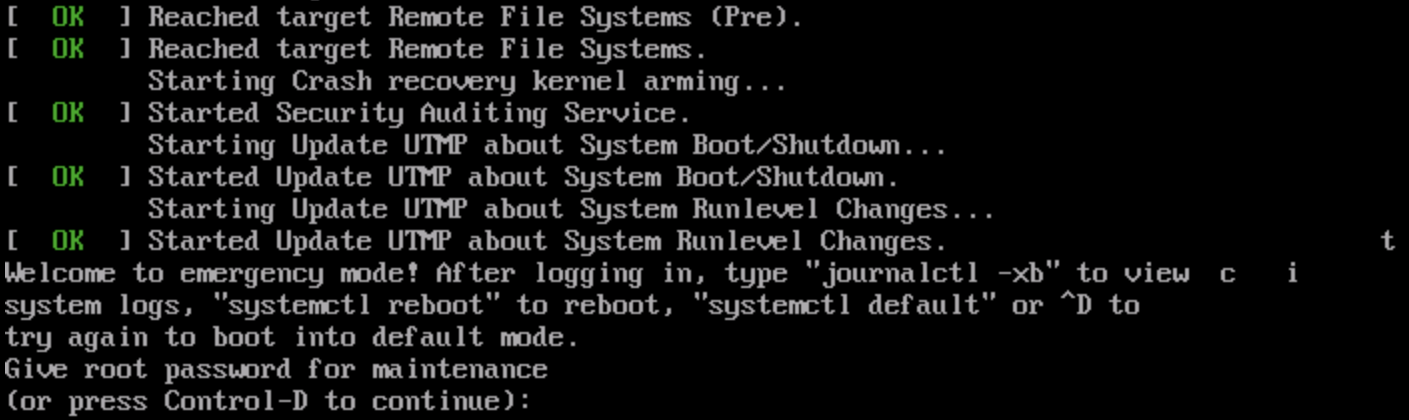
Error: Unable to remotely log in to the Linux CVM via SSH. After logging in to the CVM via VNC, you can check the system start-up failure and view the prompt message "Welcome to emergency mode".


Possible Causes

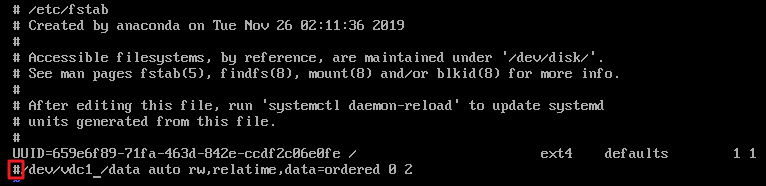
The /etc/fstab is not properly configured. For example, you've configured the auto-attaching of disk based on device name in the /etc/fstab file. If the device name is changed when the CVM restarts, this configuration will cause the system to fail to start up normally.

Solutions

See Steps to repair the /etc/fstab configuration file. Then, restart the CVM to verify the repaired file.

Steps

You can access the instance in the following 2 methods for troubleshooting:
Method 1: Login via VNC (recommended)
Method 2: Use rescue mode
2. After entering the VNC interface, you see the interface shown in Error Description. Enter the root account password and press Enter to log in to the server.
The entered password is not displayed by default.
If you do not have or forgot the root account password, see Method 2 for troubleshooting.
3. 
Run the following command to back up the /etc/fstab file to the /home directory, for example:

cp /etc/fstab /home
4. Run the following command to use VI editor to open the /etc/fstab file.
vi /etc/fstab
5. Press i to enter the edit mode. Move the cursor to the beginning of the error line and enter # to comment out this configuration.
Note:
If you cannot determine the error, it is recommended that you comment out the configurations of all attached disks except the system disks, and then configure the file as instructed in Step 8 after the server recovers.


6. 
Press Esc, enter :wq, and press Enter to save the configuration and exit the editor.

7. Restart the instance in the CVM console to see if it can be started and logged in properly.
Note:
Restart the instance through the console. For more information, see Restarting Instances.
8. 
After successful login
, if you need to configure the auto-attaching of the disk, see Cloud Disk Automount Failed upon Linux CVM Restart.
1. Enter the instance rescue mode, see Using Rescue Mode.
Note:
Run the mount and chroot commands as instructed in Using rescue mode to repair system, and make sure that you have entered the target system.
2. Follow Step 3 - Step 6 in Method 1 to repair the /etc/fstab file.
3. Exit the rescue mode as instructed in Exiting rescue mode.
4. After the instance exits the rescue mode, it is still shut down. Start it up as instructed in Starting Up Instances. Then, verify whether the system can be started up and logged in normally.
5. After successful login, if you need to configure the auto-attaching of the disk, see Cloud Disk Auto-mount Failed upon Linux CVM Restart.


Help and Support

Was this page helpful?

Help us improve! Rate your documentation experience in 5 mins.

Feedback